
As national governments in North America and Europe push right, their major cities are veering left.
Luca Rampersad | Originally Published: 1 November 2026
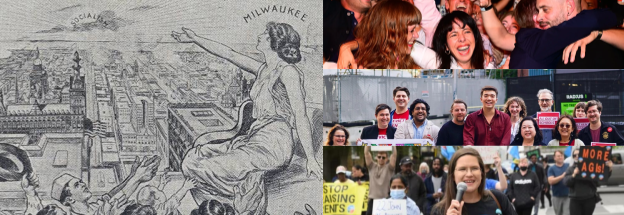
Photo credits (left to right, top to bottom): Dissent Magazine, MROnline, Jacobin, CBC News
In April of 1910, Milwaukee shocked the world. Eight years before the Russian Revolution, voters elected socialist Emil Seidel as their mayor, buoyed by a sweeping majority of allies in the city council. Contending that his Democratic predecessor had betrayed Milwaukee’s working-class in the interest of party politics and deference to the billionaire class, Seidel promised to instead actualize the desires of the people.
While their political project was, in some respects, doctrinaire — it involved standing up multiple new publicly-owned utilities — the socialists also took great pains to enact unglamorous yet observable quality-of-life improvements for residents. Alongside a free school textbook program, Seidel created a new municipal garbage disposal centre. While bringing streetcars into public ownership, he also created a state-of-the-art plumbing and sewage system. Critics, poking fun at Seidel’s focus on perfecting the unexciting, drab undergirding of Milwaukee’s urban society, coined a new pejorative: the Milwaukee council were declared “sewer socialists.” It is a term they would wear as a badge of honour over a political dynasty stretching 50 years.
A century and change later, the rise of right-populism and its implications for the global order is, not without good reason, the dominant political-analytical object of our age. From Marine Le Pen to the AfD in Europe, from Javier Milei to Keiko Fujimori to José Antonio Kast in South America, and from Donald Trump to Pierre Poilievre here in North America, the right has found a working-class in justified anger towards neoliberalism’s abject failure to deliver upon its promises of meritocratic competition, shared prosperity and access to a comfortable standard of living. They have turned the masses’ irate glares away from the capitalist world order and (much to the delight of that very order) towards migrants, queer people, and the most marginalized in society. It is both a trend of deep importance in a fractured global system and a moral outrage that denies anyone of conscience the privilege of observational detachment.
At the national level, left-populists like Jean-Luc Mélenchon, Zack Polanski, and Avi Lewis have not yet experienced the same type of breakthrough. However, as countries and provinces move right, their cities have become sites of resistance. Recently, Berlin, Vancouver, and Toronto have joined New York City’s Zohran Mamdani in heralding a resurgent left-populism: one that is uniting voters around rebuilding the basic institutions left to rot under neoliberal ideologues, and providing a direct antithesis to the success of national and provincial conservative political movements.
Berlin Pulls Left
The two German state elections of September 20th, 2026 represent a perfect microcosm of diverging populist fervours. In the state of Mecklenburg-Vorpommern, the ultra-nationalist far-right Alternative für Deutschland (AfD) party dumped the centre-right Christian Democratic Union (CDU) out of the Landtag and displaced the state’s ruling Social Democrats (SPD) to win the most seats and the highest vote share of any party. This victory for the AfD was its second in two weeks, with the party also having won the most seats in Saxony-Anhalt at the expense of the CDU. Chancellor Friedrich Merz, who comes from the CDU’s right flank, had to clarify that he would not be resigning in the midst of the “disastrous” electoral result in Mecklenburg-Verpommen.
On the very same night, Die Linke — Germany’s major party of the socialist left — won the most seats in Berlin’s House of Representatives. The Left, led by Elif Eralp, increased the party’s vote share from 12.2 per cent in 2023 to 25.7 per cent, leaving the CDU and SPD with nine and six-percentage-point drops, respectively. Die Linke also staved off an AfD challenge, with the ultra-nationalists climbing from 9.1 to 16.3 per cent. Eralp’s headline promise was to make good on a passed 2021 referendum to nationalize part of Berlin’s housing stock, which aims to take up to 260,000 units off the private market and lower costs for renters. While this pledge took up much of the political oxygen in the race, Die Linke also campaigned on fixing Berlin’s teacher shortage and improving funding for the arts and culture sector – decidedly more mundane issues that, having nonetheless been neglected under neoliberal governance, factor heavily in the sewer socialist political project.
In Vancouver, A Comeback for COPE
A month later, on October 17th, voters in Vancouver, British Columbia ushered in a leftward shift at their City Hall. Ken Sim, Vancouver’s former mayor and standard-bearer of the ABC Vancouver party, fought the election on the back of a 2025 budget that perfectly captured the trend of neoliberal institutional neglect. In what was ultimately his last budget, Sim, who initially campaigned on a centrist line that included both hiring more police and more nurses and mental health support staff, unveiled a property tax freeze and massive police budget increases furnished by deep cuts to urban planning, arts, and city staff. As ABC doubled down on this centre-right political line, a group of centre-left to left-wing parties consolidated around the Green Party’s Pete Fry as their candidate for mayor. Ultimately, Fry’s coalition won the day, crushing Sim’s ABC by a tally of 47 per cent to 32 per cent.
Just as notable as Fry’s election is the political comeback of one of those left-wing parties: the Coalition of Progressive Electors (COPE), which elected all its nominated candidates to the Vancouver City Council, School Board, and Park Board. An avowedly democratic socialist party, COPE briefly held the mayoralty and council majority from 2002 to 2005, before being condemned to the political wilderness for around two decades. COPE burst back onto Vancouver’s political scene during a 2025 by-election for two vacant council seats, with former dishwasher and punk rocker Sean Orr winning alongside OneCity’s Lucy Maloney. Having regained relevance in electoral politics, COPE ran twelve candidates on classic sewer socialist policies: a municipal housing fund, a public grocery pilot, and reversing Sim’s cuts (and, indeed, expanding arts funding) being among them.
While COPE regrouped and developed an election message, Orr became City Council’s most effective legislator. He used his perch as a city councillor to propose even smaller-scale, yet significant, changes: banning high-beam lights, supporting vertical farming, promoting air conditioning access for tenants, and restoring the False Creek tidal inlet after decades of industrial pollution. He ended up taking the most votes of any Councillor candidate. COPE’s Solomon Yi-Kieran, a student organizer and the youngest person ever elected to the City Council, mixes an overtly socialist political consciousness — their campaign slogan was, “We didn’t start this class war, but we’re going to win it” — with Seidel-esque dedication to improving the rudimentary elements of working-class life. On top of their dedication to COPE’s affordability message, Yi-Kieran will prioritize universal covered benches at bus stops and more priority bus lanes. Orr and Yi-Kieran, alongside the entire COPE slate, have mixed populist socialism with a laser-focus on improving everyday essential services, anchoring Vancouver to the left just a week before the entire province voted in a Conservative majority government.
In Toronto, Signs of a Working-Class Surge
While the October 26th electoral results in Toronto did not present a sweeping left victory in the aegis of Vancouver — many reliably centre-right councillors, such as Vincent Crisanti and Stephen Holyday, won their races — there were some signs of a left-wing resurgence in Canada’s largest city.
Incumbent Mayor Olivia Chow, a former NDP Member of Parliament, resoundingly won a second term on a message of cheaper transit, universal school food, building out public housing stocks, and expanding remedial measures targeting neglectful landlords. Her major challenger, former City Councillor Brad Bradford, ran on a Sim-esque centre-right message, promising a property tax freeze and hiring 1,000 more police officers. Bradford pledged to pay for it with a “line-by-line review” of the city budget to identify “wasteful” spending — a move that, when pursued by former mayor Rob Ford in partnership with consulting firm KPMG, infamously involved proposals to cut childcare spots, close libraries, and sell off the Toronto Zoo and other sentimentalized public assets.
As with Sim, Bradford experienced a devastating loss; Chow outperformed the polls and won the most votes for a mayoral candidate in Toronto’s history. She will return to City Hall with more progressive allies on Council to support her agenda. Vacant seats in University-Rosedale, Toronto-Danforth and Parkdale-High Park elected Chow’s stepson and former longtime City Councillor Mike Layton, former trustee Sara Ehrhardt and frontline care worker Diana Chan-McNally, while Nate Erskine-Smith, a progressive former Liberal MP, won Bradford’s old ward of Beaches-East York. Curran Stikuts, a community activist, knocked off incumbent Chris Moise — a figure that, while initially embraced by progressives, lost favour with them during his term on Council. The biggest political earthquake of the night was Frances Nunziata, a pre-amalgamation mayor, former Speaker of the City Council, and an institution of Toronto’s centre-right, losing to tenant activist Chiara Padovani in York South-Weston. Padovani, a leading figure in Toronto’s burgeoning, militant left-wing tenant organizing scene, helped to create the York South-Weston Tenants’ Union, which recently combined with Climate Justice TO to form the Toronto Tenants’ Union.
Getting the Basics Right
Alongside their promise to nationalize community housing associations, Eralp’s Die Linke ran to restore funding for Berlin’s arts scene. While fighting for a public grocer, Orr, Yi-Kieran, and COPE are also championing universal covered benches at bus stops. During her first term, Chow’s work on big-picture items like new transit ways and universal school food was buoyed by remarkable improvements in service efficiency; 911 wait times shot down by almost 70 per cent over her three years in office, and pothole repairs climbed from 178,837 in 2022, the year before she became mayor, to over 257,000 in 2025. Padovani, meanwhile — who represents a particularly flood-prone district — ran on both her credentials as a tenant advocate, and on a pledge to clean up the Black Creek Canal… and improve Toronto’s sewage system.
The sewer socialist model — one that, like right-populism, recognizes the problem of late-stage capitalist decay, but prescribes a completely different vision where the rudiments of everyday life are a collective right and responsibility, rather than a privilege afforded to an exalted few — is beginning to resonate in global cities whose higher levels are proving more and more prone to the right. More evidence may be necessary to establish whether we are living in a “global sewer socialist moment.” All the same, it is at least time to situate cities as international actors that, more and more, are confronting the dismaying current of right-populism with what Zohran Mamdani famously described as the “warmth of collectivism.” The resurgence of sewer socialism is an unmissable tide, rocking the foundations of international politics. But any sewer socialist would tell you that, on the path to building a socialist future, their first priority is fixing the pipes, building the benches, and filling the potholes neoliberal mayors and councils have left in their wake.
Luca Rampersad is a fifth-year Political Science and International Relations student at the University of Toronto, and Editor-in-Chief of The Attaché since November 2024. He self-identifies as a democratic socialist and co-chairs Canada’s Young New Democrats’ International Committee. He lives in Markham, Ontario.
References
1. Adair, James. “Vancouver’s socialist party was written off. Now they’re shaping the city’s politics.” The Breach, October 14, 2026. https://breachmedia.ca/vancouvers-socialist-party-rebuild/
2. Chiara Padovani for York South-Weston City Councillor. “Platform.” chiarapadovani.ca, accessed October 29, 2026. https://www.chiarapadovani.ca/platform
3. City of Toronto. “Potholes.” toronto.ca, accessed October 29, 2026, https://www.toronto.ca/services-payments/streets-parking-transportation/road-maintenance/potholes/
4. CivicInfoBC. “Vancouver (City).” localelections.ca, accessed October 29, 2026. https://localelections.ca/election_results/139_2026_results.html
5. Colaço, Inês. “2026 Berlin election explainer.” The Left Berlin, September 17, 2026. https://theleftberlin.com/2026-berlin-election-explainer/
6. Hett, Hanna. “Vancouver’s youngest-ever city councillor has specific public transit projects in mind.” DH Urbanized, October 28, 2026. https://dailyhive.com/vancouver/vancouver-solomon-yi-kieran-city-councillor-transit#google_vignette
7. Mackenzie, James. “Far-left party wins Berlin election, pledging to nationalise housing.” Reuters, September 20, 2026. https://www.reuters.com/world/far-left-party-wins-berlin-election-pledging-nationalise-housing-2026-09-20/
8. Marsi, Federica. “Germany’s AfD wins in key state: Is far-right on cusp of national rule?” Al-Jazeera, September 7, 2026. https://www.aljazeera.com/news/2026/9/7/germanys-afd-wins-in-key-state-is-far-right-on-cusp-of-national-rule
9. McElroy, Justin. “’I’m proud of this one’: Vancouver mayor talks budget with $50 million more for police, property tax freeze.” CBC News, November 6, 2025. https://www.cbc.ca/news/canada/british-columbia/ken-sim-interview-2026-budget-9.6968795
10. McElroy, Justin. “4 reasons why Pete Fry is the new mayor of Vancouver — and 1 reason Ken Sim lost.” CBC News, October 18, 2026. https://www.cbc.ca/news/canada/british-columbia/pete-fry-ken-sim-vancouver-mayoral-election-analysis-9.7385707
11. Nash, Peggy. “The municipal left wins in Toronto: What’s next?” Canadian Centre for Policy Alternatives, October 27, 2026. https://www.policyalternatives.ca/news-research/the-municipal-left-wins-in-toronto-whats-next/
12. Observing The City. “2026 Toronto Mayor Election Results.” observingthecity.ca, accessed October 29, 2026. https://www.observingthecity.ca/elections?race=mayor-2026
13. Perks, Gord, Janet Davis and Joe Mihevc. “Shuttering libraries. Selling the Zoo. Here’s what Brad Bradford’s Core Services Review really means.” Toronto Star, October 1, 2026. https://www.thestar.com/opinion/contributors/shuttering-libraries-selling-the-zoo-here-s-what-brad-bradford-s-core-services-review-really-means/article_3f1c8110-7127-47ef-803d-89d93c7ec9b6.html
14. Stromquist, Shelton. “Milwaukee Socialists’ Triumph and Global Impact.” publicbooks.org, April 5, 2023. Excerpt from Sheldon Stromquist, Claiming the City: A Global History of Workers’ Fight for Municipal Socialism,” Verso Books, 2023. https://www.publicbooks.org/milwaukee-socialists-triumph-global-impact/
15. Vote4Tomorrow. “Sean Orr.” votefortomorrow.ca, accessed October 29, 2026. https://vote4tomorrow.ca/election-2026/vancouver/sean-orr/
16. “Who is Friedrich Merz? Meet the man set to be Germany’s next chancellor.” France 24, February 23, 2025. https://www.france24.com/en/europe/20250223-who-is-friedrich-merz-meet-the-man-set-to-be-germany-s-next-chancellor

