
Travelling through Time: Pearsonian Internationalism & Carney’s Foreign Policy
Siya Duggal | Originally Published: 10 November 2025
On October 19, 2025, the National Post published an article titled, “‘Peacemaker’ Carney needs to attend to Canada.” This isn’t the first time a Canadian leader received the title of peacemaker on the world stage, but now the title is being used as criticism, not a compliment. The headline critiques Prime Minister Mark Carney’s policy, suggesting that he should focus his attention on Canadians rather than abroad. Carney’s alleged peacemaker policy is similar to the policy of one of his predecessors, Lester B. Pearson, who was Prime Minister of Canada from 1963 to 1968. These parallels prompt one to wonder whether the Carney administration is seeking inspiration from Pearson’s policy of national unity and international peacemaking.
Like Carney, Pearson led a minority Liberal government, yet his administration balanced concerns on the homefront and foreign policy, as it produced the defining Maple Leaf flag, supported official bilingualism, and also positioned Canada as an international humanitarian peacemaker. Pearson used official nationalism as a tool to unify the home front, while also strengthening Canada’s international image. Official nationalism is a tool that arose to protect imperial dynasties by strengthening national identity and unity, often through a single official language. However, states like Canada, under Lester B. Pearson in the 1960s, demonstrated that it could be used as a tool by any nation-state, as nations were imagined without linguistic communality. This article will examine key Pearsonian policies to determine whether Carney’s ‘peacemaker’ foreign policy truly mirrors the policies of his predecessor.
Pearson’s Adoption of the Maple Leaf Flag in 1965
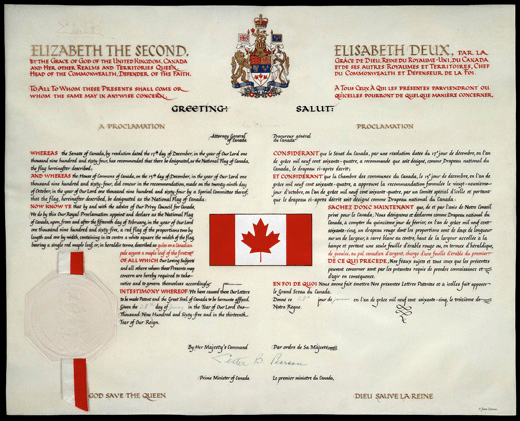
The Proclamation of the Canadian Flag, 1965. © Library and Archives Canada, Acc. No. 1989-253-1
In the 1960s, a great challenge facing the Pearson government was the need to produce a national identity that reflected Canada’s distance from the British monarchy, while balancing opposing Franco-Catholic and Anglo-American cultures because most of Canada’s citizens were of English and French descent. Pearson’s government overcame this challenge and united the homefront through a new national flag that presented Canada as an independent nation-state rather than a British Dominion. When proposing the flag in 1965, Pearson argued that the maple leaf is a deeply embedded national symbol that featured throughout Canadian history. Whether it truly was a national symbol was questioned since maple trees didn’t grow in Western Canada; nonetheless, the Maple Leaf was a neutral symbol that both the English and French resonated with, and the trees’ location was the least of Pearson’s concerns. Instead, he was tasked with appeasing both Anglo-Canadians, who wanted the flag to include the Union Jack, and French-Separatists who strongly opposed the inclusion of Anglo-Saxon elements. To address these seemingly irreconcilable views, Pearson declared that the Union Jack and Red Ensign can be flown separately alongside the Canadian flag. His efforts proved successful as over 60% of Canadians and a majority of parliament supported the flag. By successfully adopting the Maple Leaf flag, Pearson projected Canada as an independent nation on the world stage.
Officiating Bilingualism: The Royal Commission on Bilingualism and Biculturalism
Pearson complemented his Maple Leaf flag with support for making Canada officially bilingual, which further united French and English Canadians under one national identity. He founded the Royal Commission on Bilingualism and Biculturalism in 1963 to address rising French separatism during a 1960s reform movement known as the Quiet Revolution. French separatists challenged the inequality between the French and English languages in government institutions. The Bi and Bi Commission addressed their concern through its analysis of the role of English, French, and other cultures. The Commission supported the establishment of a bilingual official identity rooted in the fact that “Canada recognizes two official languages” and has two preeminent cultures, Francophone and Anglophone. Accordingly, the Commission was vital to the passage of the 1969 Official Languages Act, which cemented Canada’s bilingual identity by declaring French and English as Canada’s official languages.
By asserting that being home to multiple languages is an asset for Canada, the Commission demonstrated that states in the 20th century no longer needed to rely on a singular language to promote national unity; instead, they could use multilingualism to their advantage. Further, recognizing that Canada is a country of heavy immigration, the Bi and Bi Commission labelled Canada “an officially bilingual but fundamentally multicultural” country. Thereby, it set the stage for the succeeding government of Pierre Elliot Trudeau to characterize Canada’s official identity as multicultural, which remains Canada’s identity to this day.
1956: Canada as a Peacemaker in the Suez Crisis
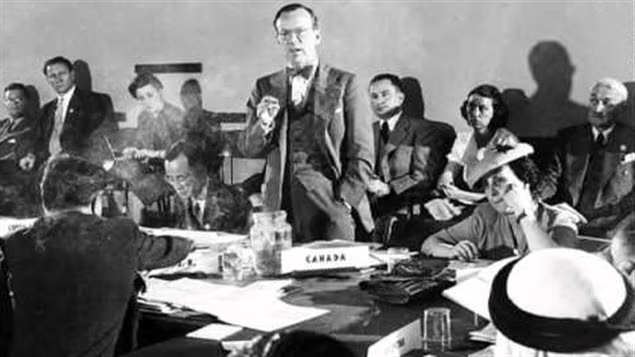
In addition to unifying Canadians under a concrete national identity, Pearson spearheaded a foreign policy that became known as Pearsonian Internationalism. His policy was characterized by peacekeeping and multilateralism. His actions during the Suez Crisis are a solid exhibition of Pearsonian Internationalism. Pearson publicly stated it was bewildering when Britain’s Prime Minister contacted him for support in the Anglo-French efforts to retake the nationalized Suez Canal. In doing so, he distanced Canada from Anglo-French militarism. Later, at the United Nations, Pearson proposed a plan which resolved the conflict and won the 1957 Nobel Peace Prize for his efforts. Pearson’s dedication to ensuring Canada was viewed as a neutral peacemaker came to the forefront when Egypt’s leader, Gamal Abdel Nasser, was wary of Canadian soldiers due to the similarities between Canadian and British uniforms. Pearson implemented a last-minute solution of Canada providing funds instead of military support. Media coverage at the UN emphasized Canada’s unprecedented level of responsibility, stating “Canada is almost a magic word here.” Turning back to domestic politics, Pearson successfully resisted opposition in the House of Commons, stating that he had not directly critiqued British foreign policy, despite disliking that the UK had not consulted Canada and other allies before using force.
1950s: Pearson’s Divergence from US Policy in the Vietnam War
In the Vietnam War, Pearson continued to characterize Canada as a peaceable middle power. In an era of growing American influence, he worked to portray Canada as independent from the United States. Pearson first expressed his concerns surrounding US policy through quiet diplomacy. However, when America continued bombing Vietnam, Pearson separated Canada from American foreign policy through a 1956 speech at Philadelphia’s Temple University. Excerpts from his address reveal that to maintain the Canada-US alliance, Pearson acknowledged America’s “honourable motives” in fighting communism, yet he furthered Canada’s identity as a peacemaker by openly opposing bombing. While Pearson’s lack of unconditional support caused a decline in US-Canada relations, it also established Canada’s autonomous position as a neutral mediator.
1964-1967: Aiding the Developing World
Alongside assisting in resolving conflicts, Pearson prioritized international assistance because he considered it vital to creating Canada’s international image. His travels through India, Pakistan, Burma, Singapore, and Japan acquainted him with poverty in the developing world. Pearson’s desire to assist developing countries yielded Canadian foreign aid rising by 280% between 1964 and 1967. He believed the world was increasingly “becoming…divided into rich and poor, developed and underdeveloped,” and that Canada could generate global peace by bridging these divides. Pearson also used foreign aid to further Canada’s national interests because international development would promote domestic security through public goods like public health and environmental protection. Through this aid policy, Pearson established Canada’s international identity as a “Just Society.”
Are Prime Minister Mark Carney’s policies inspired by those of Lester B. Pearson?
In the words of Mark Twain, history doesn’t repeat itself, but it often rhymes. It’s unclear if the Carney government is intentionally mirroring Pearsonian Internationalism, but there are undoubtedly some similarities. For instance, similarly to Pearson, the Carney government has attained the title of peacemaker at the Gaza peace summit (albeit with a differing connotation), separation from US foreign policy (as manifested through talks with China as well as European security partnerships, courtesy of the US-Canada tariff war), and pledged humanitarian assistance in the UN General Assembly in September 2025.
However, perhaps one of the greatest divergences is what the National Post’s critique focused on. While Carney acts as a peacemaker abroad, he is not mirroring the domestic unification that complemented Pearson’s peacemaking. After examining the success of Pearsonian Internationalism, it is evident that to have a resonating policy, Mark Carney’s government needs to forge an independent path that balances support abroad and on the homefront. Carney’s government recently tabled its first budget, which will underpin its policy going forward. So, the eyes are on Parliament to see whether the Carney administration, like that of Pearson, turns the title of ‘peacemaker’ into a compliment, or whether being critiqued by the National Post becomes the least of the minority government’s concerns …
Siya Duggal is a fourth-year student at the University of Toronto, double-majoring in International Relations and History. She has completed the Law & History and Human Rights & International Law Focus Streams. Siya was an Editor for Vol. XXIV of the Attaché Journal of International Affairs (2024-25), and currently serves alongside Matt Pindera as Co-Head of Commentary for the 2025-26 year.
References
1. Cabrera, Holly. “Carney Says Diversifying Trade Relationships with Europe, Asia among Key Fall Objectives.” CBC, September 10, 2025. https://www.cbc.ca/news/politics/carney-caucus-address-fall-priorities-1.7630250.
2. “Canada and the Vietnam War.” Radio Broadcast. CBC. CBC, 2010. https://www.cbc.ca/player/play/1882765832.
3. Government of Canada. “History of the National Flag of Canada – Canada.ca.” Canada.ca. Government of Canada, March 1, 2023. https://www.canada.ca/en/canadian-heritage/services/flag-canada-history.html.
4. Greenhill, Robert, and Marina Sharpe. “Lester B Pearson’s Road to Development.” Canadian Foreign Policy Journal 25, no. 1 (January 2, 2019): 19–38. https://doi.org/10.1080/11926422.2018.1522262.
5. Holloway, Steven Kendall. Canadian Foreign Policy: Defining the National Interest. Peterborough, Ont: Broadview Press, 2006.
6. Letters. “Letters: ‘Peacemaker’ Carney Needs to Attend to Canada.” National Post, October 19, 2025. https://nationalpost.com/opinion/letters/letters-peacemaker-carney-needs-to-attend-to-canada.
7. Morton, W.L. The Canadian Identity. Second Edition. 1961. Reprint, Toronto: University of Toronto Press, 1973.
8. Neville, William. “Canadian Adoption of Maple Leaf Flag Seen: However, Long Delay Is Expected because of Emotional Differences on New Design.” Los Angeles Times (1923-1995), 1964. ProQuest Historical Newspapers: Los Angeles Times. http://partneraccess.oclc.org/wcpa/servlet/Search?wcapi=1&wcpartner=proquesta&wcautho=100167144&wcissn=04583035&wcdoctype=ser.
9. Pearson, Geoffrey. Seize the Day: Lester B. Pearson and Crisis Diplomacy. Ottawa: Carleton University Press, 1993.
10. Perras, Galen Roger, and Asa McKercher. Mike’s World: Lester B. Pearson and Canadian External Affairs. Lester B. Pearson and Canadian External Affairs. Vancouver: UBC Press, 2017.
11. Yousif, Nadine. “Canada Prime Minister Carney to Visit Xi Jinping in China, Marking ‘Turning Point.’” BBC, October 31, 2025. https://www.bbc.com/news/articles/cx27pe8ekpdo.
 The Attaché