
Canada’s Refusal to Join the 2003 American Invasion of Iraq, Opposition to the 2026 US-Iran War, and Pursuit of an Independent Foreign Policy
Siya Duggal | Originally Published: 1 November 2026
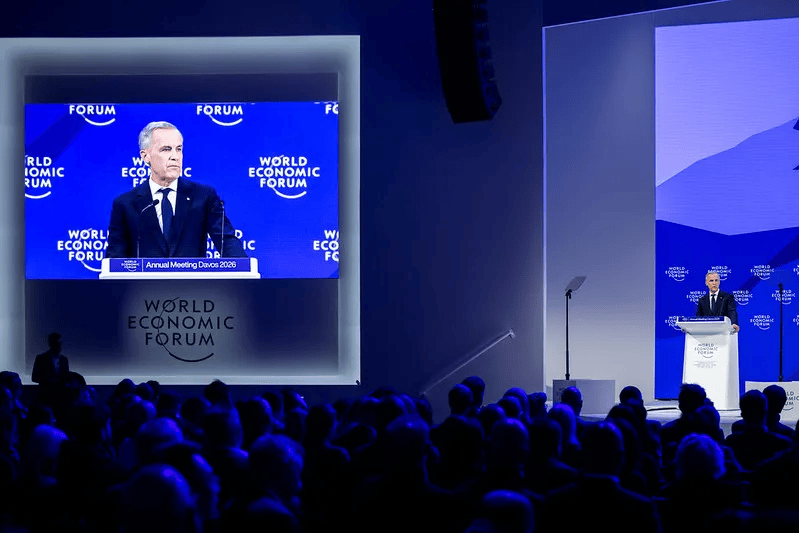
Special Address by Mark Carney, Prime Minister of Canada at the World Economic Forum Annual Meeting 2026 in Davos-Klosters, Switzerland, on 20 January. ©2026 World Economic Forum / Ciaran McCrickard
When the United States launched a military offensive against Iran earlier this year and invaded Iraq in 2003, Canada refused to join the conflicts. However, Canada supported broader American aims such as the War on Terror and preventing Iran from building a nuclear weapon. In doing so, Canada distanced itself from what has come to be seen as America’s new imperialism, and instead positioned itself as a proponent of the international rules-based order and the peace and security it was built to guarantee. Through this article, I aspire to present the similarities between Canada’s 2003 and 2026 responses in the Middle East, and in doing so, shine a light on Canada’s underlying effort to pursue a foreign policy independent of the world’s declining hegemon, despite being its neighbour. In January, at the World Economic Forum, Canadian Prime Minister Mark Carney stated, “Middle powers must act together because if you are not at the table, you are on the menu.” Over the past several decades, Canadian foreign policy has been geared toward ensuring the nation is at the table. As Canada faces threats of annexation and a trade war with its largest trading partner, maintaining a seat at the table is now more important than ever. Accordingly, Canada’s security hinges on its ability to successfully pursue an independent foreign policy.
Rewind to 2003: Canada’s Refusal to Join the Invasion of Iraq
In 1990, Canada condemned Iraq’s invasion of Kuwait and supported the American-led multinational coalition, which relied on the UN’s approval of the use of force to free Kuwait. As published by Veterans Affairs Canada, Canada sent over 4,000 military personnel, three warships, warplanes, and staff to support the coalition. In its coverage of the Iraq War, The Independent reported that while Kuwait was ultimately liberated and Iraqi forces defeated, Iraq’s dictatorial leader, Saddam Hussein, remained in power for 12 years, with the United States (US) viewing him as an especially urgent threat during the War on Terror that began after 9/11. In 2002, the US announced that Iraq had weapons of mass destruction and began calling for action to be taken against Baghdad (The Independent 2023).
While Canada supported the First Gulf War in 1990, it did not support the Second Gulf War in 2003, despite being America’s neighbour and ally. When the Canadian Defense Minister Bill Graham met with the US Secretary of State, leading up to the US invasion of Iraq, he was presented with a “PowerPoint slideshow” on why Canada should contribute militarily (Lennox 2009, 99-100). Graham was not convinced by the American presentation, nor was the Prime Minister. While Canada publicly avoided stating this belief, Prime Minister Jean Chrétien believed the American “case for war was built on a faulty premise” (Sayle 2010, 1). Moreover, by this time, Canadian public opinion on the broader War on Terror had shifted due to Canadian soldiers being killed by American friendly fire in Afghanistan (Lennox 2009, 98). Thereby, keeping its policy consistent with public opinion while refraining from publicly declaring the US premise for war as flawed, Canada conditioned its approval on international support, i.e. explicit United Nations Security Council approval, and Prime Minister Jean Chrétien opposed forced “regime change in Iraq” (Sayle 2010, 5-6). Canada also relied on domestic politics to support its position, particularly that “the ‘key’ to the Iraq decision ‘was Quebec’s vehement anti-war opinion’” (10). When the United Nations Security Council refused to formally support the use of force against Iraq, and 83% of Canadians opposed joining a war without United Nations authorization, Canada abstained from joining the invasion of Iraq (Lennox 2009, 100-101). That said, Canada continued to support other efforts in the War on Terror (101-106).
Fast Forward to Present Day: Canada’s Refusal to Join the US-Iran War
On February 28, 2026, the US and Israel launched a joint military offensive, known in the US as Operation Epic Fury, against Iran (Blanchard et al. 2026). The stated goal of the operation was to “eliminate imminent threats from the Iranian regime” via the destruction of its nuclear program (Blanchard et al. 2026). As published by CBC, when delivering remarks on March 4, 2026, Prime Minister Mark Carney reaffirmed Canada’s support for efforts to prevent Iran from obtaining a nuclear weapon, given Canada’s view that Iran becoming a nuclear power would threaten international peace and security. However, Carney also stated that Canada takes this position “with regret because the current conflict is another example of the failure of the international order.”
A week later, on March 9, 2026, Canadian Defence Minister David McGuinty clarified that Canada would not be joining the US-Israel-Iran conflict (Boyton 2026). McGuinty asserted Canada had not been consulted prior to the strikes on Iran, had not participated in the offensive, and refused to join the war (Boyton 2026). Echoing the policy of its fellow NATO members, Canada instead offered assistance to Middle Eastern countries who had faced attacks from Iran as a result of the conflict (Boyton 2026). On March 10, 2026, Carney echoed the sentiment in the Canadian House of Commons, stating Canada will never join the US-Iran War (The Canadian Press 2026). He highlighted that while Canada’s stance is that it “supports the necessity to prevent Iran’s nuclear program and the export of terrorism,” but Canada “is not participating in the United States and Israeli offensive and will never participate in it” (The Canadian Press 2026). As stated by Foreign Minister Anita Anand, Canada’s “foreign policy is focused on de-escalation and the protection of civilians and humanitarianism generally” (Fraser 2026).
The Undercurrent: A Uniquely Forged Sovereign Canadian Foreign Policy
There are many parallels between Canada’s position on Iran in 2026 and its position in 2003. In both cases, Canada refused to join an American military intervention in the Middle East, citing its adherence to international law and attempting to cooperate with allies to de-escalate the conflict. Canada voiced support for the broader American aims in both conflicts, whether it be the War on Terror or opposing Iran’s development of a nuclear weapon, yet did not send its own troops. That said, Canada has been more vocal in its opposition to America’s deviation from the international rules-based order in the 2026 US-Iran conflict, whereas it attempted to keep its disdain for the US intervention in Iraq under wraps in 2003. This is perhaps reflective of Canada’s broader shift on the world stage to pursuing a policy that benefits Canadian interests, rather than appeasing the United States, particularly as US President Donald Trump threatens to annex Canada and transform it into America’s 51st state.
Parallels can also be drawn between Canada’s 21st-century policy and the country’s foreign policies during the Cold War. As George Melynk asserted in Canada and the New American Empire: War and Anti-War, the fear of Islam and positioning of Arabs as ‘terrorists’ is the 21st-century equivalent of the American fear of communism during the Cold War (4). During the Cold War, Canada positioned itself in the capitalist camp and echoed American paranoia about communism, yet also opposed American bombing campaigns against civilians during the Vietnam War. In the 21st century, Canada supported the American War on Terror, sent troops to Afghanistan pursuant to the right to collective self-defence, and voiced its support for the American aim to counter terrorism in the Middle East. However, similarly to its opposition in Vietnam, Canada opposed interventions in Iraq and Iran that could not be justified under the UN Charter. In doing so, Canada has pursued a foreign policy that allows it to balance its alliance with its neighbour, maintaining the largest undefended border on the planet, while also positioning itself as a country that abides by international law and has sovereign policies that do not entirely align with America’s new imperialism.
Pursuing a sovereign policy is greatly beneficial to Canadian interests, as a dependency on the United States is unstable, particularly as it causes Canada to be greatly impacted by American political transitions (Juneau 2024, 2). Canada supports the values of the US-led Liberal International Order, particularly its roots in the rule of law, but US President Trump’s “America First” strategy is instead isolationist and rooted in power, making it contrary to Canada’s interests (Layne 2018, 89). During the “unipolar moment,” allying with the US was the pragmatic choice for middle powers like Canada (Belo 2022, 278). However, in the current multipolar world, a focus on appeasing the US would instead lead to Canada missing opportunities to collaborate with emerging powers in areas that are vital to Canadian interests. As Layne (2018) stated, “for the next several decades…it will be neither China’s world nor America’s: international leadership will be contested” (108). Thereby, Canada’s best interest lies in implementing a uniquely independent foreign policy that maximizes benefits for Canada, rather than picking a particular Great Power to support. The advantages of such a pursuit have been demonstrated as Canada avoids entanglement in American imperialist interventions, and they were also evidenced when Canadian businesses profited due to Canada’s decision to export wheat to China in 1961 during the Great Chinese Famine, despite the US embargo on China (Belo 2022, 287).
Moreover, Canada’s commitment to pursuing a sovereign foreign policy was recently broadcasted by Prime Minister Mark Carney in his speech at the World Economic Forum on January 20, 2026, published on the Prime Minister of Canada website, wherein he stated:
Middle powers must act together because if you are not at the table, you are on the menu.
But I would also say that Great powers can afford to go it alone. They have the market size, the military capacity, and the leverage to dictate terms. Middle powers do not. But when we only negotiate bilaterally with a hegemon, we negotiate from weakness. We accept what is offered. We compete with each other to be the most accommodating.
This is not sovereignty. It is the performance of sovereignty while accepting subordination.
In a world of great power rivalry, the countries in between have a choice: to compete with each other for favour or to combine to create a third path with impact.
Carney’s speech reflects Canada’s efforts to forge an independent foreign policy, efforts that began with the Lester B. Pearson Administration in the 1950s when Canada began diverging from British and American foreign policy to create a unique identity as “The Maple Leaf Humanitarian Peacemaker.” 7 decades later, Canada continues to pursue foreign relations that solidify its independence on the world stage while living next to the globe’s declining hegemon. While Canada in the 1950s and 1960s attempted to serve as a peacemaker that assisted decolonizing nations, it is now positioning itself as a beacon for middle powers to produce a new international order that benefits them. Only time will tell how successful these efforts are, though receiving an invitation to be the European Union’s first associate member is a promising start …
Siya Duggal is a student at the University of Toronto, studying International Relations, History, and Political Science. She has completed the legal history, human rights, and international law focus streams. Her primary research interests are: Canadian foreign relations, South Asian history, the Modern Middle East, international law, and the efficacy of international organizations. Siya was an Editor for Vol. XXIV of the Attaché Journal of International Affairs (2024-25) and Co-Head of Commentary (2025-2026). Under her leadership, the 2025-2026 Commentary Division published 50 articles, and Siya looks forward to continuing this success as Head of the 2026-2027 Commentary Division. In her free time, Siya enjoys visiting cafés around campus, with Goldstruck and Coco Espresso Bar being her favourites.
References
1. Belo, Dani. 2022. “Middle Power Foreign Policy in an Era of Gray Zone Conflict: Addressing the Challenges for Canada.” In Canada and Great Power Competition. https://doi.org/10.1007/978-3-031-04368-0_13.
2. Blanchard, Christopher M., Jeremy M. Sharp, Clayton Thomas, and Jim Zanotti. 2026. “U.S. Conflict With Iran.” In Congress.Gov. https://www.congress.gov/crs-product/R48887.
3. Boynton, Sean. 2026. “Canada ‘Will Not Be Participating’ in Iran War, Defence Minister Says.” Global News, March 9. https://globalnews.ca/news/11722309/canada-iran-military-participation-mcguinty/.
4. Carney, Mark. 2026. “‘Principled and Pragmatic: Canada’s Path’ Prime Minister Carney Addresses the World Economic Forum Annual Meeting.” Prime Minister of Canada, Government of Canada, January 20. https://www.pm.gc.ca/en/news/speeches/2026/01/20/principled-and-pragmatic-canadas-path-prime-minister-carney-addresses.
5. CBC News. 2026. “Carney Supports Iran War with ‘Regret’ – Transcript.” CBC, March 4. https://www.cbc.ca/radio/frontburner/carney-supports-iran-war-with-regret-transcript-9.7114237.
6. Fraser, Suzan. 2026. “Canada Was Not Consulted on Iran War and Won’t Join Offensive Action, Minister Says.” AP News, March 17. https://apnews.com/article/canada-foreign-minister-iran-offensive-b2fd01da9d620e7c86e6b7846970ae01.
7. Juneau, Thomas. 2024. “Canada’s Instruments of National Power Suffer from Crippling Human Resources Vulnerabilities.” International Journal , 1–4. https://doi.org/10.1177/00207020241276096.
8. Layne, Christopher. 2018. “The US–Chinese Power Shift and the End of the Pax Americana.” International Affairs 94 (1): 89–111. Oxford University Press. https://doi.org/10.1093/ia/iix249.
9. Melnyk, George. 2004. Canada and the New American Empire: War and Anti-War. University of Calgary Press.
10. Rawnsley, Jessica. 2026. “Canada Welcomes EU Proposal to Become ‘Associate Member.’” BBC, September 17. https://www.bbc.com/news/articles/cwly7vkke4jxo.
11. The Canadian Press. 2026. “Canada Will ‘Never Participate’ in Iran Offensive, Carney Says.” CTVNews, March 11. https://www.ctvnews.ca/politics/article/canada-will-never-participate-in-iran-offensive-carney-says/.

