
How Parisian Covered Passages Precursed the American Mall
Jackson Leung | Originally Published: 24 January 2026
Un soir en juin de 1781, une incendie ravage l’Opéra sur le lotissement du Palais-Royal…
i. The Palais-Royal and the Galerie de Bois
In 1632, Cardinal Richelieu acquired the property across from the Louvre, the Palais-Royal, a rectangular plot of land with a central garden. The Palais-Royal was later bequeathed to the House of Orléans, junior branch of the Royal House of France, in 1692, when Louis XIV offered the property to his brother, Philippe de France. After a fire destroyed much of the property, including the eminent opera house, his son, Philippe d’Orléans the Regent, sought to revitalize the site with new commercial activity, commissioning extensive renovations. Phillipe hired architect Victor Louis to direct the property’s redesign. Pursuant to his vision, the Palais-Royal’s perimeter was allocated to be subdivided and commercialized into smaller parcels to build housing, boutiques, theatres, and cafés distributed across three wings.
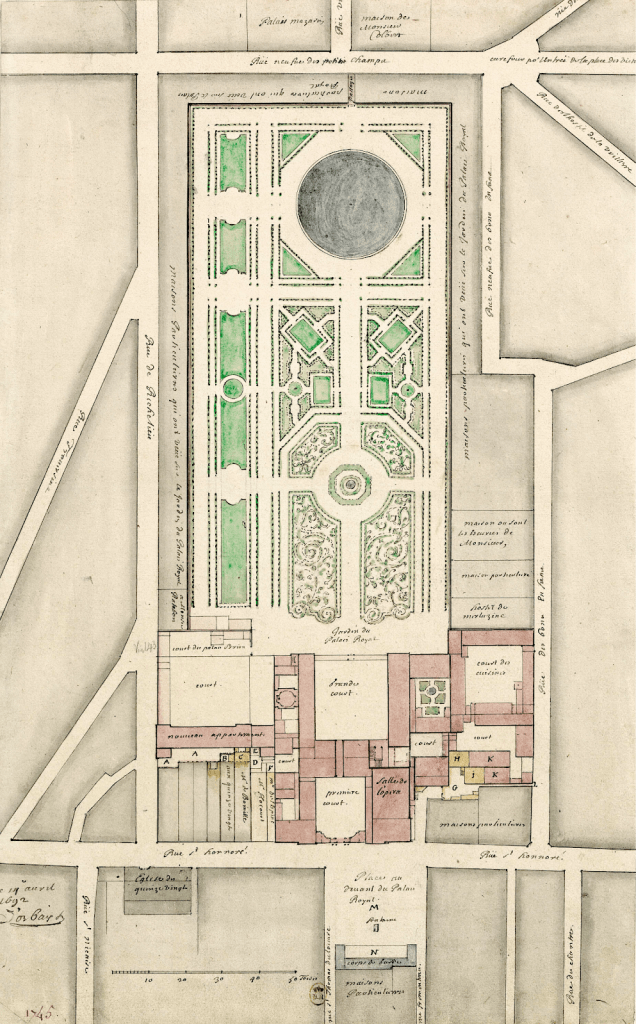
D’Orbay, François. Plan général du Palais-Royal et de ses environs en 1692. Pen and ink, Chinese ink wash, and red ink wash. Bnf, Paris.
The proposed design for the redevelopment of the Palais-Royal was to draw inspiration from the colonnade of Place Saint-Pierre in Rome—the façades would consist of large pilasters and composite capitals atop a railing. A series of quincunx Tuscan columns would support flat vaults, creating a connection between the garden and the three enveloping streets. The Palais-Royal would later become a microcosm of an idealized post-revolutionary Paris, where various merchants, artists, bookshops, and cafés would cohabitate in the eighty-eight boutique shops, whilst the arcades were frequented by prostitutes and casual meanderers.
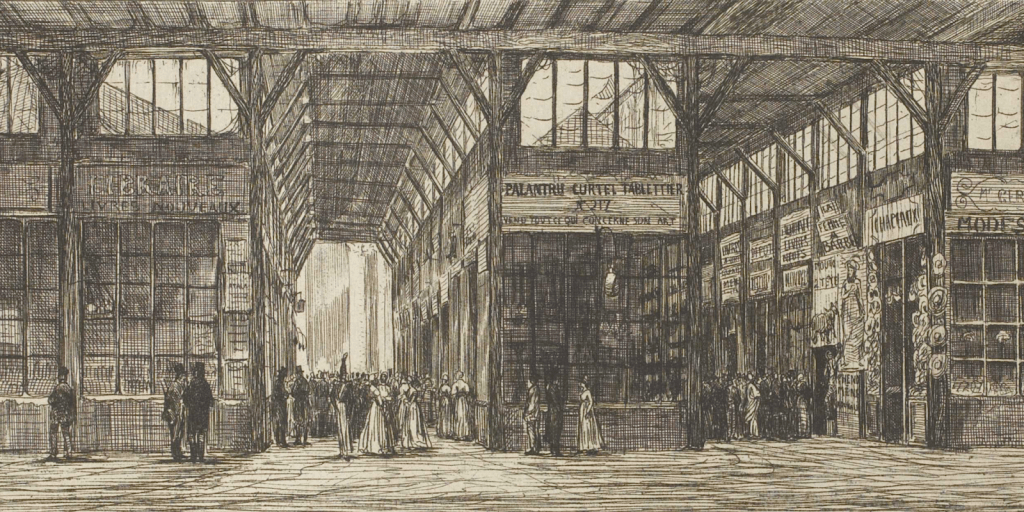
Martial, A.-P. Palais-Royal : Galerie de bois. Print. BnF, Paris.
In 1786, the Galerie de Bois was constructed to distinguish the Palais-Royal’s courtyard from the garden, and formed the fourth edge of the quadrangular parcel. Two galleries were each lined with four rows of shops, and were notably illuminated by open windows under the roof’s overhang, enabling semi-zenithal lighting. However, the gallery was held in negative esteem; it was notoriously known by its sordid reputation as a place of prostitution.
ii. The Novel Prestige of the Covered Passage
To escape the insalubrity of the 19th-century streets, a new commercial typology was born in Paris: the covered passageways. Influenced by the Galerie de Bois and the shopping arcades of the Palais-Royal, as well as Florentine open loggias, these ‘arcades’ functioned as covered pedestrian roads, forming a system of perpendicular pathways that cut through city blocks and connected boulevards to one another. These passages typically were topped by a glass roof, allowing natural light to permeate into the space, and were intended for the genteel middle classes. Their climatized nature enclosed and protected patrons from city sullage and inclement weather, allowing people to socialize and leisurely spend their time strolling.
Shopping arcades grew in popularity, both in France and internationally, expanding to evolve into increasingly complex and elaborate forms, as in the Cleveland Arcade (1890) and the Passage Pommeraye in Nantes (1843). In Paris, covered passages were influenced by societal trends and were sometimes themed: the Passage du Caire was ornamented with Orientalist friezes and sculpted forms, whilst the Passage des Panoramas boasted a panoramic painting salon, and the idea of galleries also later further grew into the idea of promenades.
iii. The Decline of the Shopping Arcade and Rise of the Shopping Mall
With the rapid urban redevelopment under Haussmann in the second half of the 19th century during the Second Empire, the covered passages were supplanted by the newer, more modern ‘grand magasins haussmanniens,’ or department stores. Many arcades fell into disuse and subsequent disrepair, prompting their closure and fall into ruins as they quickly became relics of a bygone era. Today, only twenty-two covered passages still exist in Paris.
Nevertheless, the typology was given another chance of renewal—through the American mall. Design elements and principles were recycled and reconfigured to fit the economic and social needs of the burgeoning middle class in America; with the rise of suburbs and autocentric design in the United States, a new shopping centre style was required. Most importantly, indoor climatization radicalized the shopping experience and was central to the design, and indoor retail complexes mimicked their precursors in form and function, with their glass roofs and verticality (think of the Eaton Centre!), overtaking the department store as the newest retail standard. Thus, a new typology sprouted from the remains of the arcade: the enclosed shopping centre, more commonly known as the shopping mall.
Jackson Leung is a third-year Architectural Studies student at the University of Toronto. He is the current Head of Design for the Attaché Journal of International Affairs (2024–2026). Jackson is currently based in Paris, participating in an academic exchange at École Nationale Supérieure d’Architecture de Paris-Belleville.
References
1. Françoise Fromonot. “Paris des pouvoirs, Paris des passages.” Paris, de la tête aux pieds (class lecture at École Nationale Supérieure d’Architecture de Paris Belleville, Paris, France, 29 September 2025).
 The Attaché