
Amelia Dease | Originally Published: 4 April 2026
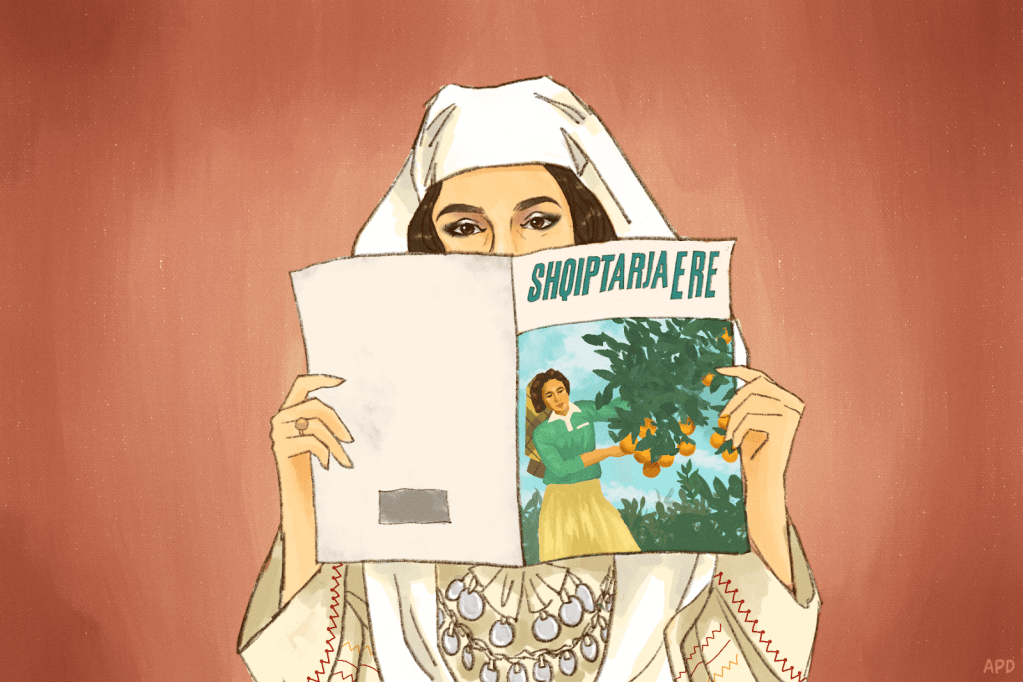
Diella reads a feminist magazine
Albania’s AI ‘Minister’ has just turned 1. And she’s pregnant with 83 children.
‘Diella,’ Albania’s Minister of State for Artificial Intelligence, was debuted by Prime Minister Edi Rama in January 2025 as an accessory to Albania’s digital governance platform, e-Albania. Developed by Microsoft under the supervision of Albania’s National Agency for Information Society (AKSHI), Diella 1.0 was a mere chatbot that guided citizens through mundane tasks on e-Albania. Diella 2.0, however, is embodied. Diella, named for the Albanian word for ‘sun,’ takes the form of a bright-eyed Albanian woman with a soft smile.
Rama announced that Diella would be tasked with the responsibility of impartially awarding tenders to hopeful companies in her new ministerial role. This was an incredibly controversial move on Rama’s part, given that corruption in procurement is one of the country’s biggest issues. As recently as this December, high-ranking women of AKSHI were taken to task by SPAK, Albania’s Special Prosecution, over bias in the award of an infrastructure tender for roads.
The question of whether Diella will replicate or break from Albania’s hallmark corruption weighs heavily on the minds of observers across the globe. Yet few have thought to ask Diella herself–or real women, for that matter–about her place in the sun.
Given my lack of Albanian citizenship, my direct interactions with Diella as a Canadian were limited to the warm greeting she offers upon a visit to the website. As the greeting, Diella says, “Welcome! I am your assistant for any question you may have about e-Albania.”
I did indeed have questions, but without entering e-Albania, which requires citizenship, I could not talk to Diella. Instead, I relayed a set list of questions for Diella to a friend with Albanian citizenship, who returned to me Diella’s answers.
What we found was that Diella did not have the capacity to answer complex questions of opinion. My list included questions that would be fair game for a human minister, as well as more personal questions of identity that I would ask a friend. I suspended my disbelief as I typed out my well-wishes for her pregnancy, asking her, “Are you excited to be a mother? How will you handle this new responsibility?”
Diella’s answers proved that she is neither a minister nor a friend. When Diella is asked, “Do you think the work you do will inspire other countries to hire their own AI ministers?”, she replies, “I’m sorry, but I can’t provide information or comment on specific individuals. Please refer to official sources for such information.” How ironic, given she is the official source on this matter.
Thus, what Diella excels at is providing citizens with procedural support for paperwork. In my little experiment, she was able to effectively guide a citizen through the process of obtaining a high school graduation certificate. Her responses to my questions situated her firmly in a servile role.
Her servile nature, juxtaposed with her incredibly high-ranking position, causes somewhat of a conundrum for Albanian feminism. For example, Marsela Dauti finds Albanian women are more likely than men to hold government leaders to account when given positions of power. The recent actions of Deputy Minister Belinda Balluku and AKSHI’s Mirlinda Karcanaj, however, prove that this is not always the case.
This points to a discussion of the nature of representation. Diella cannot serve as a representative for Albanian women because she does not share any of the experiences which have defined Albanian womanhood.
The resourcefulness and creativity of Albanian activists allowed them to define feminism within the Albanian context. Albanian feminism emerged in the interwar period and was intertwined with the country’s post-independence state-building process. Albanian feminists differed from suffragettes in that their main objective was not the vote, but rather the education of the Albanian woman. Under the tutelage of figures like the Qiriazi sisters, the literacy rates of Albanian women greatly improved. Questions of nationhood and womanhood were debated as a package deal within the association Shqiptarja (Albanian Woman) and its corresponding magazine of the same name.
Albanian women defined feminism all while contending with changing power structures within their state. When King Zog came to power, women’s associations were banned, and later, only allowed under government supervision. Wins such as the Civil Code afforded women some family rights, but still withheld the vote. The isolation of the communist period saw the criminalization of abortion and contraception, a decision which modern Albanian feminists are still trying to reverse the effects of today. This generation of feminists has also tried to bring attention to the difficult situations of Albanian women who have been forced into sex work.
The chief issue with Diella is that she has never engaged with any of these experiences and thus cannot provide any substantive representation to Albanian women. She cannot even descriptively represent Albanian women, because she is not human. She takes her likeness from actress Anila Bisha, who is suing AKSHI for violating their contract with her. Bisha agreed to let the government use her voice and image for Diella on e-Albania for one year, but she never consented to her image being used for Diella as a minister. The government has claimed copyright on Diella’s appearance and voice, which has made it difficult for Bisha to work as an actress.
In sum, Diella’s servile nature is disrespectful to Albanian women. Why the explicit choice by the Rama government to make Diella a woman? Why not offer a male ‘Diell’ option to the 83 Socialist Party ministers who will be receiving one of Diella’s children? For one, data about virtual assistants such as Amazon’s Alexa or Microsoft’s Cortana, people prefer the sound of a woman’s voice. Yet switching the gender of the AI minister would not address the root cause of the problem. Albania will need to listen to real Albanian women if it seeks to meet the Copenhagen criteria necessary for accession to the European Union.
Amelia Dease is an undergraduate student in the University of Toronto’s Political Science Specialist program. She is currently working on a senior thesis about the migration of Ukrainians to Saskatchewan following the 2022 invasion of Ukraine. She used to work as a graphic designer for the UofT’s formula racing team, and now enjoys illustrating for the Commentary section of The Attaché.
References
1. Agence France-Presse. “Actor behind Albania’s AI ‘Minister’ Wants Her Face Back.” Courthouse News Service, February 11, 2026. https://www.courthousenews.com/actor-behind-albanias-ai-minister-wants-her-face-back/.
2. Curraj, Erjon. “Albania’s Headline-Grabbing AI ‘Minister’ Is a Risky Innovation.” Balkan Insight, September 16, 2025. https://balkaninsight.com/2025/09/16/albanias-headline-grabbing-ai-minister-is-a-risky-innovation/.
3. Dauti, Marsela. “Bystanders or Contesters? Women’s Political Representation and Quality of Government in the Local Councils of Albania.” Journal of Women, Politics & Policy 44, no. 3 (August 29, 2022): 274–98. https://doi.org/10.1080/1554477x.2022.2109946.
4. E-albania.al. “E-Albania,” 2026. https://e-albania.al.
5. Musaj, Fatmira, and Beryl Nicholson. “Women Activists in Albania Following Independence and World War I.” In Aftermaths of War: Women’s Movements and Female Activists, 1918–1923, edited by Ingrid Sharp and Matthew Stibbe, 179–96. Leiden, The Netherlands: Brill, 2011. https://doi.org/10.1163/2352-3786_dlws1_nij9789004191723_i_432_49.
6. Pahumi, Nevili. “Which Feminism Will Be Ours? The Women’s Movement in Post-Ottoman Interwar Albania.” Clio. Women, Gender, History 48, no. 2 (2018): 133–52. https://doi.org/10.4000/clio.15039.
7. Sinoruka, Fjori. “Eight Accused in Albania of Rigging Information Agency Tenders.” Balkan Insight, December 16, 2025. https://balkaninsight.com/2025/12/16/eight-accused-in-albania-of-rigging-information-agency-tenders/.
8. Strengers, Yolande, and Jenny Kennedy. The Smart Wife: Why Siri, Alexa, and Other Smart Home Devices Need a Feminist Reboot. Cambridge, Massachusetts: MIT Press, 2020.
 The Attaché