
Adrianna Loria | Originally Published: 11 April 2026
January 2026
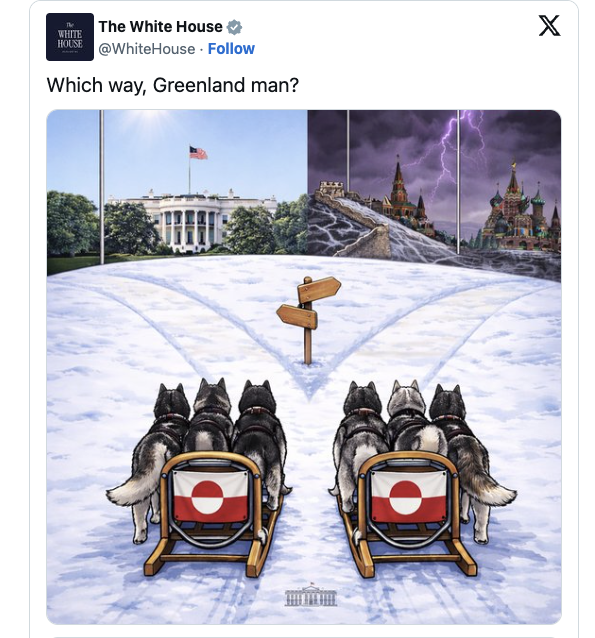
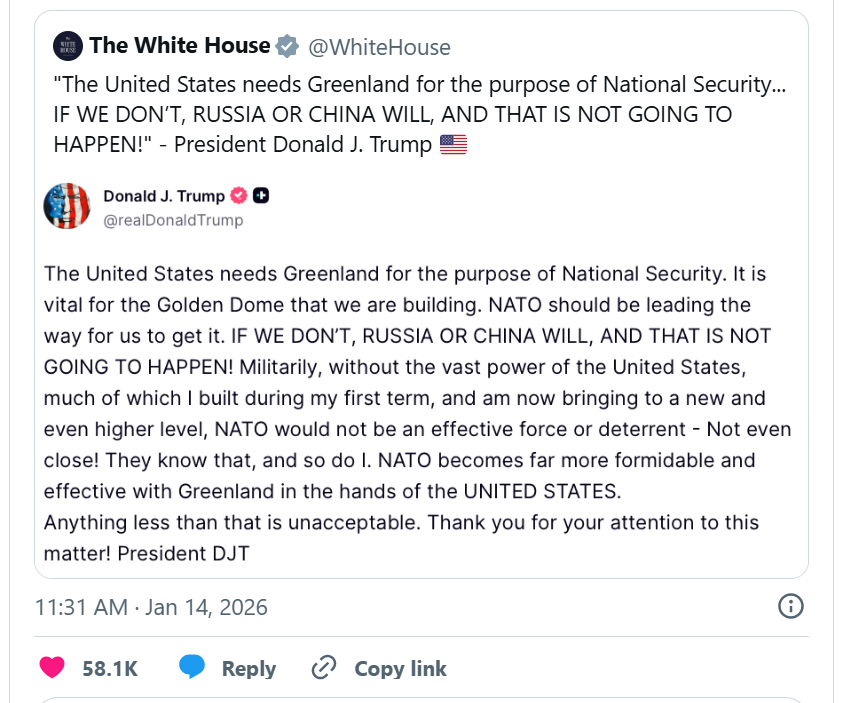
On January 14, 2026, as U.S. Vice President J.D. Vance and Secretary of State Marco Rubio met with the foreign ministers of Denmark and Greenland, the White House shared an image on X captioned “Which way, Greenland man?” This image showed Greenland at a crossroads between “the sunny U.S.” and “the doom of Russia and China.” Alongside it was the statement: “The United States needs Greenland for the purpose of National Security…IF WE DON’T, RUSSIA OR CHINA WILL, AND THAT IS NOT GOING TO HAPPEN!”
And just 3 days later, President Donald Trump escalated tensions by announcing an additional 10% tariff on Denmark, the United Kingdom, and 6 other European nations. He stated this tariff will remain in effect “until such time as a deal is reached for the complete and total purchase of Greenland.”
If great powers can simply purchase or coerce their way into gaining territory, what does that say about the resurgence of great power politics and the weakening of the rules-based global order? And, most importantly, what does it mean for Indigenous rights in Greenland?
Why Greenland Matters to Washington
The U.S. has an interest in Greenland, partially influenced by its 2025 National Security Strategy, which lists China’s expanding influence in the West as a growing concern.
With an estimated 60% share of global mining and roughly 90% of refining capacity, China has significant leverage over the supply chain for these critical minerals. This control leaves the U.S. and other nations vulnerable to supply disruption and price manipulation, creating a dangerous dependency for nations that rely on these elements to support economic growth.
China has advanced its Polar Silk Road initiative, seeking to maintain its dominance as a provider of rare earth elements by establishing mining interests in Greenland and collaborating with Australian companies to secure further opportunities. Greenland is rich in mineral resources, ranking eighth in the world, with an estimated 36.2 million tonnes. Two of its largest deposits, Tanbreez and Kvanefjeld, have reserves of uranium and neodymium, which are crucial for technologies like high-power magnets and aircraft manufacturing, including the production of F-35 fighter jets. Accordingly, Trump has framed control over these resources as a national security concern, seeking to limit China’s access to them.
President Trump’s goal appears to go beyond just acquiring Greenland, with his remarks and threats pointing to a strategic effort to push China out of the competition for rare earth elements while advancing U.S. economic interests.
However, treating Greenland primarily as a national security concern dismisses the rights of its predominantly Indigenous population. President Trump’s use of coercive tactics, including threats of military force and economic tariffs, raises serious concerns about respect for Indigenous rights. Together, the Kalaallit, Tunumiit, and Inughuit peoples make up nearly 90% of Greenland’s population and hold the right to self-determination under the 2009 Self-Government Act and the United Nations Declaration on the Rights of Indigenous Peoples (UNDRIP). UN experts say prioritizing U.S. interests over the rights of Greenlanders risks “normalizing lawlessness” and dismantling the global order.
Greenland Can’t Be Bought or Taken
While Greenland is an essential part of Denmark, the 2009 Self-Government Act explicitly recognizes the people of Greenland as a people under international law with the right to self-determination. Under the Act, any decision on Greenland’s independence must be made by the people of Greenland themselves, not the Danish government.
This creates a real dilemma for the U.S., as Denmark cannot just “sell” Greenland because it lacks the authority to transfer the territory without the consent of its people. Put simply, Denmark can’t sell what isn’t theirs to give.
On top of that, any attempt to “buy” or take over Greenland would also violate the principles of UNDRIP.
UNDRIP Article 3 grants Indigenous peoples the right to self-determination, meaning only they can decide their political status and shape their economic, social, and cultural development. In the context of Greenland, this supports the fact that Denmark can’t legally hand over Greenland to the U.S., since a government isn’t allowed to transfer rights that actually belong to Indigenous peoples. Furthermore, Article 19 requires that states consult and cooperate to obtain the “free, prior, and informed consent” (FPIC) of Indigenous peoples before adopting measures that affect them, including any change in territorial status. Recent polling shows that while 80% of Greenlanders favour independence from Denmark, 85% oppose joining the U.S., indicating that U.S. control over the territory would likely not have the consent of most Greenlanders.
Moreover, Trump’s threats of military force conflict with Article 30, which states that military activities cannot take place on Indigenous lands without either a legitimate public interest or the consent of the Indigenous peoples concerned. And in this context, neither exception applies. UN experts explain that any expansion of the U.S. military presence under the 1951 Defense Agreement without Greenland’s full agreement would therefore be a violation.
When Geopolitics Threatens Indigenous Rights
Greenland’s 2026 crisis reflects a shifting global order, marked by a revival of major power competition and a gradual weakening of the post-WWII rules-based system. We’re at a turning point where powerful states, specifically the U.S., are showing a greater willingness to depart from international norms to stay ahead of rivals like China and Russia.
This renewed rivalry puts Indigenous rights at risk, as the self-determination recognized under the 2009 Self-Government Act and affirmed by UNDRIP could take a back seat to the interests of major powers. As the crisis unfolds, we’re left asking: will Indigenous rights be upheld, or will they be overshadowed by U.S. ambitions?
References
1. Denmark. Act on Greenland Self-Government. Act No. 473. June 12, 2009. https://english.stm.dk/media/4vgewyoh/gl-selvstyrelov-uk.pdf.
2. Cordall, Simon Speakman. “‘The End of the World as We Know It’: Is the Rules-Based Order Finished?” Al Jazeera, January 21, 2026. https://www.aljazeera.com/news/2026/1/21/the-end-of-the-world-as-we-know-it-is-the-rules-based-order-finished.
3. Curtis, John, and Stefano Fella. “President Trump and Greenland: Frequently Asked Questions – House of Commons Library.” House of Commons Library, January 23, 2026. https://commonslibrary.parliament.uk/research-briefings/cbp-10472/.
4. Dodds, Klaus, and Mark Nuttall. The scramble for the Poles: The geopolitics of the Arctic and Antarctic. Cambridge, UK: Polity Press, 2016.
5. Froman, Michael. “On the Ground in Greenland: Arctic Security and Great Power Competition.” Council on Foreign Relations, August 8, 2025. https://www.cfr.org/articles/ground-greenland-arctic-security-and-great-power-competition.
6. Goddard, Stacie E. “The Rise and Fall of Great-Power Competition.” Foreign Affairs, April 22, 2025. https://www.foreignaffairs.com/united-states/trump-rise-and-fall-great-power-competition.
7. Golden, J., Janire Pascual-Gonzalez and Michael J. Williams. 2026 “Worth Its Weight in Lithium? The Dynamics of Sustainability, Rare Earth Minerals and NATO” Preprints. https://doi.org/10.20944/preprints202601.1523.v1.
8. Johansson, Peter. Handbook of indigenous peoples’ rights. 1st ed. London: Routledge, 2016.
9. Kaplan, Susan A., and Genevieve LeMoine. “Greenland’s Inuit Have Spent Decades Fighting for Self-Determination.” The Conversation, January 27, 2026. https://theconversation.com/greenlands-inuit-have-spent-decades-fighting-for-self-determination-274268.
10. Katila, Anna. “As Us and Denmark Fight, Greenland’s Voices Are Being Excluded Once Again.” The Conversation, January 15, 2026. https://theconversation.com/as-us-and-denmark-fight-greenlands-voices-are-being-excluded-once-again-273131.
11. Lamy, Steven. “Trump’s Stated Reasons for Taking Greenland Are Wrong – but the Tactics Fit with the Plan to Limit China’s Economic Interests.” The Conversation, January 20, 2026. https://theconversation.com/trumps-stated-reasons-for-taking-greenland-are-wrong-but-the-tactics-fit-with-the-plan-to-limit-chinas-economic-interests-273548.
12. Nyberget, Jørgen. “Indigenous Self‑determination and Greenland.” Verfassungsblog, January 22, 2026. https://verfassungsblog.de/inuit-greenland/.
13. Østhagen, Andreas. “Trump & Greenland: Is There Logic in the Chaos?” The Arctic Institute – Center for Circumpolar Security Studies, January 8, 2026. https://www.thearcticinstitute.org/trump-greenland-logic-chaos/.
14. “Greenland: UN Experts Urge United States to Respect International Law and Rights.” OHCHR. United Nations, January 14, 2026. United Nations. https://www.ohchr.org/en/press-releases/2026/01/greenland-un-experts-urge-united-states-respect-international-law-and-right.
15. United Nations. Office of the High Commissioner for Human Rights and United Nations General Assembly. 2008. United Nations Declaration on the Rights of Indigenous Peoples: Adopted by the General Assembly on 13 September 2007. Pocket-sized format. United Nations, Office of the High Commissioner for Human Rights. https://www.un.org/development/desa/indigenouspeoples/wp-content/uploads/sites/19/2018/11/UNDRIP_E_web.pdf.
16. United Nations, Office of the High Commissioner for Human Rights (OHCHR). “Greenland: UN Experts Urge United States to Respect International Law and Rights.” Press release, January 14, 2026. https://www.ohchr.org/en/press-releases/2026/01/greenland-un-experts-urge-united-states-respect-international-law-and-right.
17. United States, National Security Strategy of the United States of America (Washington, DC: The White House, 2025), https://www.whitehouse.gov/wp-content/uploads/2025/12/2025-National-Security-Strategy.pdf.Wearden, Graeme. “World Is Entering Time of ‘Great Power Politics’, Warns German Chancellor.” The Guardian, January 22, 2026. https://www.theguardian.com/business/2026/jan/22/friedrich-merz-german-chancellor-speech-davos-world-economic-forum.
 The Attaché