
An opinion piece
Layan Alothaimeen | Originally Published: 4 April 2026
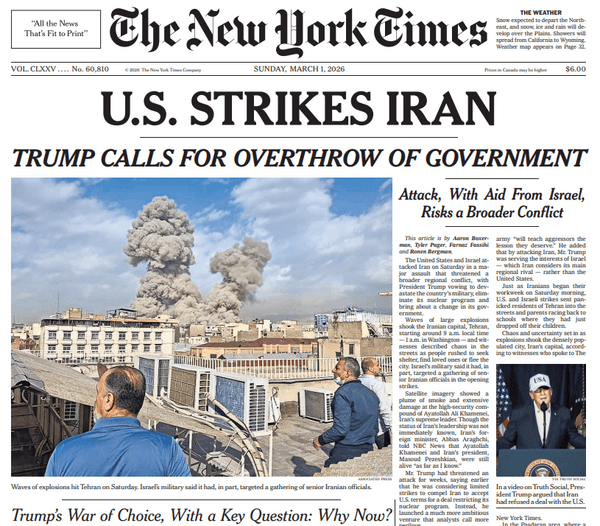
The front page of The New York Times on Sunday, March 1, covers the US war against Iran
The decline of diplomacy has caused our world to enter a global arena where no norms are present. Breaking this down, this article defines diplomacy or global diplomacy as the ability for states to engage in talks in order to reach an agreement on an issue or conflict. Global norms are tied to international law, and countries uphold these norms in order to uphold their image, but this is not the case anymore.
The decline of global diplomacy can be attributed to a couple of events. First, US President Donald Trump has always wanted to delegitimize global diplomacy institutions and does not see the importance of them as the world continues to face transnational challenges. In 2016, one of Trump’s campaign promises was that he would pull out of the Paris Climate Accord. During his 2024 presidency, he took this to another level by threatening to pull out of the North Atlantic Treaty Organization (NATO) and the United Nations (UN). These institutions are only as powerful as states make them, so it threatens international institutions’ efficacy when the world’s largest superpower attempts to delegitimize them. These institutions are responsible for upholding norms, so when these institutions are not given legitimate platforms, the norms also leave with them. The power held by the US in the efficacy of international institutions like the UN is perhaps best exhibited by UN Security Council (UNSC) resolutions that have failed to pass due to the US vetoing them, despite all other UNSC members being in favour of adoption. For instance, in June 2025, the US vetoed a UNSC Resolution calling for a permanent ceasefire in Gaza; 14 UNSC members voted in favour, while the US was the sole vote against the Resolution.
Other conflicts after this can also be connected to the lack of diplomacy. Russian President Vladimir Putin’s war on Ukraine can be connected to a fear and a desire to push back against NATO. The notion against NATO is also an attack on global diplomacy and global security. Russia did not want to see a large former Soviet state fall to Western diplomacy. Putin’s policy shows that many older leaders still see the world in terms of influence and conquest, rather than in terms of globalization and shared issues to tackle.
The biggest event that contributed to the death of diplomacy was Israel’s war in Gaza. In this war, the world has seen the destruction of Gaza and the killing of at least 75,000 Palestinians between October 7, 2023 and January 5, 2025. Israeli Prime Minister Benjamin Netanyahu was convicted as a war criminal by the International Criminal Court. Due to the ICC’s limited jurisdiction, it relies on states to voluntarily adhere to international law. If the warrants are not upheld by states, the ICC’s influence will be reduced significantly. Given that the US has not signed on to the Rome Statute (the ICC’s founding document) and thereby has not accepted ICC jurisdiction, it has not enforced the ICC warrant. Netanyahu was welcomed with applause by the US Congress. While certain states have respected the warrants and stated they would arrest Netanyahu if he visits their country, other states, like the US and Argentina, have opposed the ICC warrant, showing a lack of adherence to international legal norms. In addition to not adhering to the ICC warrant, the US has sanctioned an ICC judge for issuing the warrant. This goes to show the US’s lack of adherence to international law, and also highlights Trump’s consideration of international institutions as unimportant.
Moving on to current affairs, the 12-day Israel-Iran war in June 2025 was just a teaser to the current war. This war ended in a ceasefire, which is only the first step to peacebuilding. But again, the lack of global diplomacy has fostered an environment where leaders do not tend to engage in talks if it demands compromise. Israel has long avoided engaging in peace talks, going back to even the 1993 Oslo Accords. Despite Israel being the main signatory to the Oslo Accords the method of the negotiations were on Israeli terms as the accords deliberately postponed addressing core Palestinian issues and its terms remained ambiguous and could be interpreted differently by each side. This accord is being highlighted as it was the first agreement between Israel and Palestinian representatives and its failures display Israel negotiations don’t have room for compromise and this holds true with Israel Iran relations and the current global environment has fostered this more.
The period from June to now was a buildup period to the current war. If peace stops at a ceasefire, then it is only a matter of time before the war continues because this is a temporary stop. It is evident that during this time, Netanyahu aimed to convince Trump to join the war against Iran and drew inspiration from Venezuela as Trump draws parallels with his success in Venezuela and aims to emulate that in Iran. The US removed the Venezuelan leader by arresting him, and it appears that similar logic was then applied to Iran. However, the aftermath in both cases varies, demonstrating the lack of coordination and planning in this conflict.
Overall, due to the decline of global diplomacy, Israel and the United States, particularly President Trump, attacked as a bilateral team; they did not consult the US Congress, other states, allies or the UNSC. This is not the first time the US has gone to war in the Middle East. However, wars before Trump often involved consultations with allies and/or the UN Security Council. For instance, President Bush consulted the UNSC before proceeding with the War on Terror. Even if his justifications for the war were faulty, by consulting the council, President Bush legitimized the UNSC as an institution. The current war did not follow the same process, which is part of Trump’s larger plan to dismantle and delegitimize global diplomacy along with other leaders. Without the UN as a legitimate player, there is no institution upholding norms, giving states the ability to do anything they please.
References
1. Al Jazeera Staff. “What Are the ICC Countries Where Netanyahu and Gallant May Face Arrest?” Al Jazeera, November 21, 2024. https://www.aljazeera.com/news/2024/11/21/what-are-the-icc-countries-where-netanyahu-and-gallant-may-face-arrest.
2. Gungor, Yasin. “ICC Judge Sanctioned by US for Warrant against Netanyahu Says He Can No Longer Use Credit Cards, Order Things Online.” Anadolu Ajansı, 2026. https://www.aa.com.tr/en/world/icc-judge-sanctioned-by-us-for-warrant-against-netanyahu-says-he-can-no-longer-use-credit-cards-order-things-online/3875305.
3. Ingber, Rebecca. “Mapping State Reactions to the ICC Arrest Warrants for Netanyahu and Gallant.” Just Security, March 6, 2025. https://www.justsecurity.org/105064/arrest-warrants-state-reactions-icc/.
4. Kent, Lauren. “Analysis: Trump Has Drawn Parallels between Iran and Venezuela. but There’s No Delcy Rodríguez in Tehran.” CNN, March 3, 2026. https://www.cnn.com/2026/03/03/middleeast/iran-venezuela-trump-regime-change-parallels-intl.
5. Mishra, Vibhu. “US Vetoes Security Council Resolution Demanding Permanent Ceasefire in Gaza.” UN News, June 4, 2025. https://news.un.org/en/story/2025/06/1164056.
6. Mansour, Mohammad. “Gaza Death Toll Exceeds 75,000 as Independent Data Verify Loss.” Al Jazeera, February 19, 2026. https://www.aljazeera.com/features/2026/2/18/gaza-death-toll-exceeds-75000-as-independent-data-verify-loss.
7. Olmsted, Edith. “‘let’s Just Do It’: How Netanyahu Convinced Trump to Bomb Iran.” The New Republic, March 2, 2026. https://newrepublic.com/post/207228/donald-trump-benjamin-netanyahu-iran.
8. Schulten, Katherine. “The War in Iran: A Place for Student Questions and Reactions.” The New York Times, March 2, 2026. https://www.nytimes.com/2026/03/02/learning/the-war-in-iran-a-place-for-student-questions-and-reactions.html.
9. Shlaim, Avi. “The Oslo Accord.” Journal of Palestine Studies 23, no. 3 (1994): 24–40. https://doi.org/10.2307/2537958.
 The Attaché