
Diego Moura Panario | Originally Published: 30 March 2026
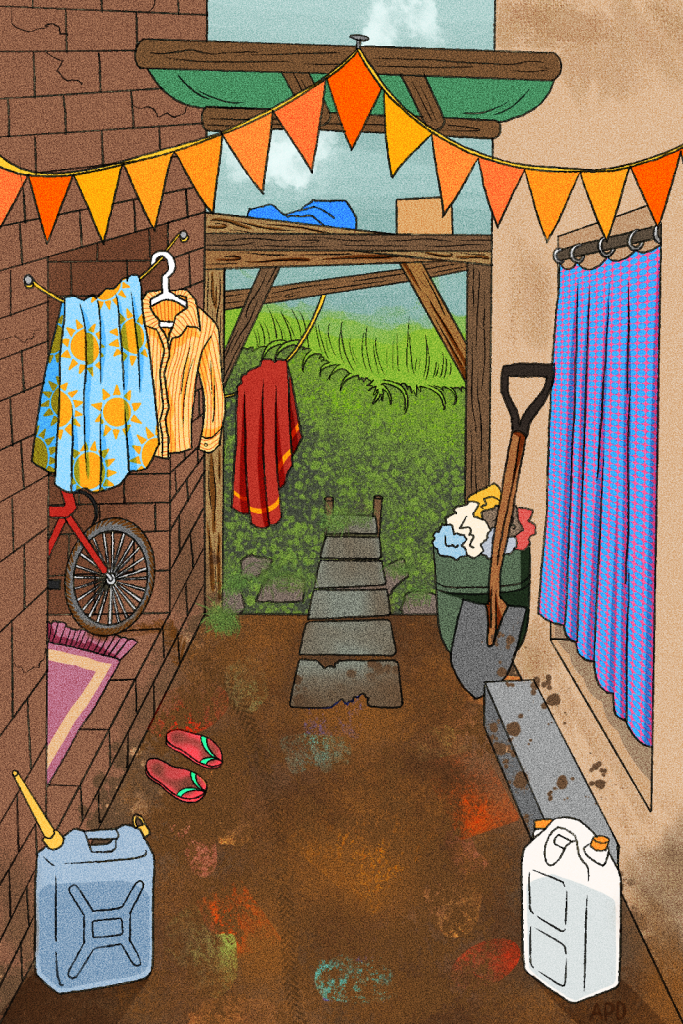
Artwork by Attaché Commentary’s Political Cartoonist, Amelia Dease
Most political analysis focuses on national and regional levels of governance, with little attention given to cities. As the world’s urban population is 58% and growing, per the UN Department of Economic and Social Affairs, city governance must become a larger area of focus. When one considers that the majority of the world’s future population growth will occur in cities, it becomes an extremely important area to study. Because of the dense nature of cities, even small improvements can positively impact millions of people. According to UN Habitat, of the 4.78 billion urbanized people, 25% live and 58% work in informal conditions. The majority of future population growth is expected to occur in the Global South, specifically in Africa and South & Southeast Asia, regions with above-average urbanization rates. UN Habitat also reported that Sub-Saharan Africa’s current urban population lives 54% and works 88% informally, and in South Asia it is 43% and 84% respectively. In short, the planet is only becoming more urbanized, and in the most informal locations. Shelter is one of the most basic human needs, and one’s living conditions directly affect all other aspects of their life. The improvement and formalization of informal communities can directly improve the living conditions of millions of people worldwide. And the lack of movement on formalizing housing conditions now condemns future generations to a growing informality problem.
In the United Nations Sustainable Development Goals (SDGs), informality is only directly talked about twice: in Indicator 8.3.1: to decrease informal employment by sector and sex, and Indicator 11.1.1: to decrease the urban population living in slums or informal settlements. The SDG Indicators give reporting standards to measure improvements over time. Goal 8.3.1 uses an ILO employment statistic standard to make countries comparable, while for 11.1.1 there are more specific definitions for slums and informal settlements. Slums are classified as missing one or more of the following criteria: access to water, sanitation, sufficient living area/overcrowding, habitable location, and quality of housing structures. Informal housing will have similar issues, but the definition is more focused on the legal right to the land and protection from forced evictions.
Informal work has many negative effects, stemming from the lack of legal protections, be it work safety, unemployment insurance, social security, or fixed work schedules. These factors all add to the precarity of informal work. Slums/informal housing, by definition, are missing some of the most basic human needs. The lack of these basic necessities creates further issues related to health, climate, and entrenched inequality in cities. The lack of access to clean water is a crucial issue in informal housing. The burden of collecting clean water often falls on children, who must drop out of school to fetch water for their families. Similarly, many kids have to work informally to bring in some extra income for the family. These basic needs are prioritized over other opportunities, which could lead to longer-term improvement to one’s economic standing (such as education), leading to cycles of informality.
Informal housing does not appear out of nowhere; it occurs due to governments’ choices or inability to provide sufficient housing for the rapidly growing city. Baumgart and Kreibich describe that informality occurs from mass migration from the rural to the urban. Migration occurs for many reasons. Push factors of migration are factors which push people to leave their homes, such as war, famine, bad harvests, or natural disasters. Pull factors are the reasons why people choose to move to improve their lives, such as employment, education, or better living standards. Informality can be broken into a few different forms: deregulation, exclusion, and fragility. Informality by deregulation is defined as a strong state purposefully applying laws and regulations unequally to create informality to meet certain political or economic objectives. An example of informality by deregulation would be how China chooses to tie social services to one’s home province, limiting migrant workers’ access to housing and other social services. Informality by exclusion, in contrast, is when a weak state chooses not to formalize informality and continues to plan as if the informal sector did not exist. This can be done to gain the benefits of that community’s labour without the need to provide basic services. The increased tax base from property taxes would be less than the cost to provide municipal services. Examples of this form of informality can be found in Latin American countries. The last form of informality is by fragility. Unlike the previous two forms, where the state is choosing to create or keep informality for its own gain, this type of informality is created by state failure. These are weak states that lack the institutional capacity to plan for or integrate the growth in urban populations. This form of informality is most commonly seen in Sub-Saharan African states. While the manner in which informality is created in each form is different, they all still condemn informal communities to worse living standards than the formalized community.
Informality by fragility is the most severe due to the fact that states lack the capacity to actually implement the changes if they wished to. In comparison, the former two forms of informality are more detrimental, as they result from the state’s decision to create or maintain those conditions. Informal settlements house the most marginalized communities in society and produce worse outcomes than formalized housing structures. Informal communities will have increased health risks due to the lack of clean water, sanitation, overcrowding, or living in a temporary structure. While living in a non-habitable location could mean worse health because you live near a manufacturing site, or being more prone to climate disasters like flooding. These are the direct impacts of informal settlements, which directly affect six SDG Goals. While other goals, such as 4: Quality Education or 5: Gender Equality, are worsened as by-products of informality, since the burden of water collection falls predominantly on women and girls, worsening gender inequality and the gender gap in school time.
The United Nations SDGs have failed to mobilize member states to tackle informality. Since its ratification in 2015, there has been little progress on reducing the percentage of people living in slums. UN data on indicator 11.1.1 shows a minuscule improvement in slum population from 2015 to 2022:
| Country | 2015 | 2022 | Change |
| Globally | 24.9% | 24.7% | 0.2% |
| Latin America & Caribbean | 17.4% | 16.9% | 0.5% |
| Central & Southern Asia | 49.6% | 42.8% | 6.8% |
| East & Southeast Asia | 24.4% | 24.7% | -0.3% |
| Sub-Saharan Africa | 53.4% | 53.5% | -0.1% |
While globally there was barely any change, Central & Southern Asia saw the largest improvement by 6.8%. While East & Southeast Asia and Sub-Saharan Africa both had a larger slum population now than when the SDGs were first implemented in 2015. Meaning there has been a complete failure in improving informality in these regions.
For indicator 8.3.1 on informal work, the picture is only slightly better, from the ratification in 2015 to 2024:
| Country | 2015 | 2024 | Change |
| Globally | 59.6% | 57.8% | 1.8% |
| Latin America & Caribbean | 55% | 51.3% | 3.7% |
| Central & Southern Asia | 85.5% | 83.8% | 1.7% |
| East & Southeast Asia | 61.7% | 54% | 7.7% |
| Sub-Saharan Africa | 92% | 88.5% | 3.5% |
While most regions see a much larger decrease in informal work than in housing, globally, there has barely been a change in global informal work. 2% over almost a decade is a barely noticeable difference when close to 60% of the world works in informal conditions.
These numbers indisputably demonstrate that the United Nations SDGs have been an utter failure in encouraging countries to deal with informality. They call to decrease informality, which is necessary, but without more concrete steps, they leave implementation up to member states and their subnational governments, who either lack the capacity to address informality or benefit from maintaining it. Consequently, there has been very little movement on dealing with informality. Informality, and especially housing informality, worsens most human-focused SDGs. The process of formalizing housing has knock-on effects in health, education, sanitation, clean water access, gender equity, and water access, and more. Integration of informal communities into cities, and providing basic municipal services of clean water, sanitation, electricity, and garbage collection, is one policy change which could dramatically improve multiple SDG metrics. Just basic municipal services would vastly improve health, educational, and gender divide outcomes. Most other social SDGs are byproducts of informality, and so dealing with informality will improve all these SDGs. This is why dealing with informality must be a priority. Since most of the world’s future population growth will be in cities in Asia and Sub-Saharan Africa, the lack of progress on informality over the past decade in these regions is extremely frightening. By sheer demographics, the world’s informal population is going to only increase. While the SDGs were set up with good intentions, they fail to grasp the incentives cities have to keep informality and so stay a lofty goal without dealing with the reality on the ground. The failure of the SDGs to push states, municipalities, NGOs, and IGOs to reduce the global informal population will subject future generations of the most marginalized people to live in conditions that the global community agreed a decade ago needed improvement.
References
1. “World Urbanization Prospects 2025 Summary of Results.” n.d. https://www.un.org/development/desa/pd/sites/www.un.org.development.desa.pd/files/undesa_pd_2025_wup2025_summary_of_results.pdf.
2. “Urban Population and Demographic Trends.” n.d. Data.unhabitat.org. https://data.unhabitat.org/pages/urban-population-and-demographic-trends.
3. “Housing, Slums and Informal Settlements.” n.d. Data.unhabitat.org. https://data.unhabitat.org/pages/housing-slums-and-informal-settlements.
4. “The Gendered Burden of Water Collection in Sub-Saharan Africa.” 2024. World Bank. March 13, 2024. https://www.worldbank.org/en/data/interactive/2024/03/13/gendered-burden-of-water-collection-in-afe-afw-sub-saharan-africa.
5. Kreibich, Volker. 2016. “The Mode of Informal Urbanisation: Reconciling Social and Statutory Regulation in Urban Land Management,” February, 163–84. https://doi.org/10.4324/9781315548814-13.
6. Baumgart, Sabine, and Volker Kreibich. 2011. “Informal Urbanization—Historical and Geographical Perspectives.” disP – The Planning Review 47 (187): 12–23. doi:10.1080/02513625.2011.10654015.
7. “SDG Indicator Metadata (Harmonized Metadata Template -Format Version 1.1).” n.d. https://unstats.un.org/sdgs/metadata/files/Metadata-08-03-01.pdf.
8. “SDG Indicator Metadata (Harmonized Metadata Template -Format Version 1.0).” 2021. https://unstats.un.org/sdgs/metadata/files/Metadata-11-01-01.pdf.
 The Attaché