
Luke Allsup | Originally Published: 27 September 2026
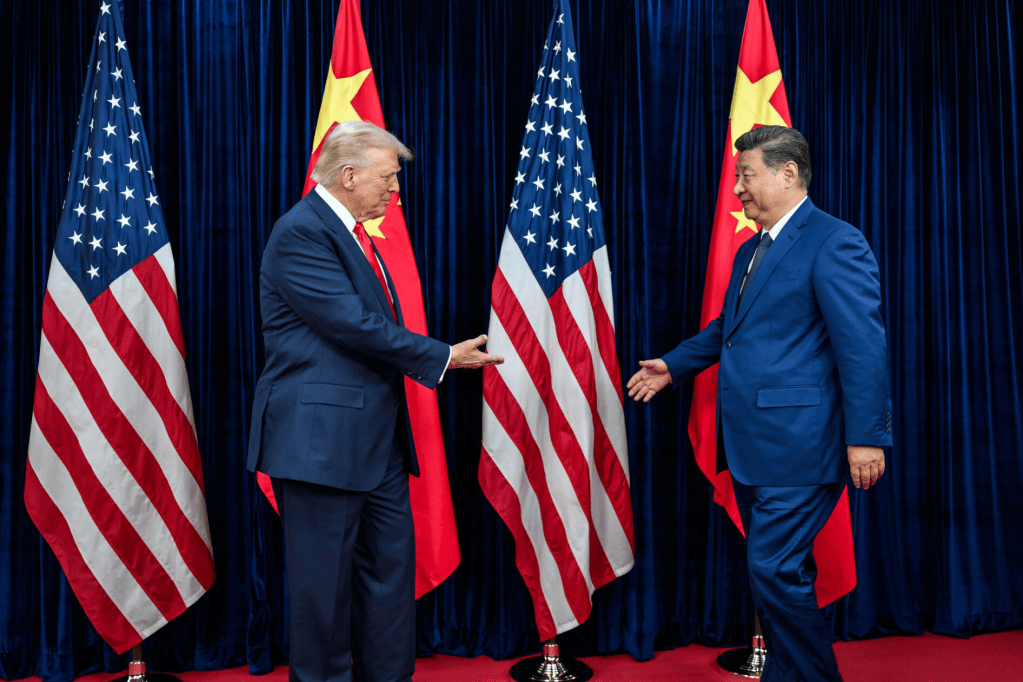
American President Donald Trump greets Chinese President Xi Jinping before a bilateral meeting at the Gimhae International Airport terminal, Thursday, October 30, 2025, in Busan, South Korea. (Source: Official White House Photo by Daniel Torok via The Diplomat)
Is a conflict between the United States (US) and China inevitable? John Mearsheimer asserts that it is, grounding his reasoning in realist assumptions about hegemonic powers. Fareed Zakaria, on the other hand, argues against this claim on the grounds of mutually beneficial trade and China’s integration into the liberal order. Of the two perspectives, Zakaria’s proposition regarding US-China relations is more grounded. Should China be left unprovoked, it will not take a militarily or economically aggressive stance toward the United States. China does not indicate unprovoked aggression for three reasons: economic interdependency that benefits both parties, a non-offensive military posture, and non-restrictive trade policy. Critics may point to the militarization of the South China Sea and the Taiwan issue, but these problems indicate regional ambitions and little towards broader global aspirations.
In stating, “China is acting according to this same realist logic, in effect imitating the United States. It wants to be the most powerful state in its backyard and, eventually, in the world,” Mearsheimer argues that great powers are doomed to compete because there is no higher authority capable of reconciling disputes between them (Mearsheimer, 2021: 50-51). Zakaria contrasts this realist viewpoint with a more liberal interpretation of peace, akin to Michael Doyle, in which markets benefit states through trade and therefore create incentives against violent conflict. Such disputes interrupt trade and hinder both parties (Doyle, 1986: 1161). Applied to China-US relations, it is not in China’s interest to start a conflict, as “Beijing’s elites know that their country has prospered in a stable, open world. They do not want to destroy that world” (Zakaria, 2020: 68). Washington likewise sought to intertwine the two economies so that China would become more dependent on the US economy, meaning that conflict is not ideal for either side (Zakaria, 2020: 66). From a liberal perspective, there are therefore incentives to maintain peace despite realist assumptions about inevitable competition.
The shortfalls of Mearsheimer’s argument become clearer when examining actual foreign policy. He accuses China of “pursuing an increasingly aggressive foreign policy” and argues that it is not a responsible global actor (Mearsheimer, 2021: 53-55). However, he provides little evidence beyond China’s claims concerning Taiwan and territorial disputes over the Japanese Diaoyu Islands. Zakaria instead provides evidence against China being an expansionist aggressor: “Beijing is now the second-largest funder of the United Nations and the UN peacekeeping program. It has deployed 2,500 peacekeepers, more than all the permanent members of the Security Council combined” (Zakaria, 2020: 56-57). China also accounted for 18.69% of UN peacekeeping contributions in 2024-25, second only to the United States at 26.95% (United Nations, n.d.). These contributions support Zakaria’s argument that China has been shifting away from aggression rather than toward it.
China’s military record also contrasts with that of the United States. China has not participated in a formal war since 1979, whereas the United States has engaged in numerous military conflicts since World War II (Zakaria, 2020: 56; U.S. Government Publishing Office, n.d.). The countries also differ sharply in their overseas military presence. As of 2020, the US controls 750 military bases outside its 50 states (Vine, 2023). Meanwhile, China has one confirmed overseas base in Djibouti (Glaser and Gunness, 2023). Although China’s military presence is expanding, this disparity challenges the characterization of China as an increasingly aggressive global power.
Critics may point to the militarization of the South China Sea, as well as the Taiwan issue, to assert China is pursuing an aggressive foreign policy. These issues, however, are primarily regional and do not necessarily demonstrate broader global military ambitions. In 2025, a Chinese vessel attempted to ram Filipino vessels in the region close to the Philippines (Ng, 2025), an incident critics considered evidence of China’s refusal to adhere to international law (Siade-Cox, 2025). Yet, two conclusions follow from a comparative perspective. First, this policy is primarily regional rather than global, limiting its relevance to Mearsheimer’s claim about inevitable great-power competition. Second, China’s actions are not clearly more aggressive than recent US foreign policy. In the same year, the United States carried out airstrikes on at least six Venezuelan boats under the pretext that they were carrying drugs, resulting in 27 fatalities (Ocando Alex, 2025). Although China’s actions in the South China Sea may indicate aggression, they have not produced fatalities on the same scale. As such, while regional power competition could potentially escalate, current evidence does not establish broader global ambitions. The Taiwan issue similarly concerns China’s regional objectives rather than necessarily demonstrating an intention to dominate globally.
China’s trade and internal policies provide further evidence against an aggressive interpretation. Zakaria maintains that China is not a “mortal danger” to the liberal international order (Zakaria, 2020: 63). Among the BRICS countries, “China is consistently ranked as the most open and competitive economy” (Zakaria, 2020: 57). During the period examined by Zakaria, China had one-third as many non-tariff barriers as the United States (Zakaria, 2020: 58). Its treatment of foreign firms also provides evidence of economic openness: in 2015, foreign plaintiffs brought 63 intellectual-property cases in Beijing, with foreign firms receiving favorable rulings in every case (Zakaria, 2020: 59). Aside from all this, China has also pursued strict anti-corruption policies since Xi Jinping’s election. These efforts have reduced bureaucratic corruption, improved resource allocation, and produced positive effects in financial markets (Fang, 2023). Thus, China’s trade and internal policies prove that an aggressive trade stance is unlikely should they remain unprovoked.
The main difference between Zakaria’s and Mearsheimer’s articles is that Mearsheimer takes a more alarmist approach towards China, while Zakaria provides a more realistically optimistic view grounded in trade incentives and policy indicators. Conflict with the United States is not in China’s interest, as it will disrupt mutually beneficial trade processes. If we are to examine actual policies as indicators of aggression, China passes in this regard too. Due to its lack of military interventions and minimal number of foreign military bases, China is unlikely to be an immediate threat. In fact, it has instead indicated itself to be a responsible global power through its contributions to the UN peacekeeping program. Concerning trade, hostility should not be expected from China. The global superpower has one of the most competitive economies, which thrives on fair property courts and government anti-corruption campaigns.
With all the aforementioned points taken into account, China should not be viewed as a certain aggressor. Consequently, the United States should not take a directly hostile stance towards China, as China does not pose an existential threat if left unprovoked. This means avoiding militarization on the part of the US in East Asia, maintaining communication, and refraining from restrictive trade policies such as tariffs. Instead, the US should maintain open trade and peaceful relations. At the same time, the United States should not be dependent on these relations, only making use of this trade for improved quality of life. Given this fact, it would be best for the US to begin bringing back domestic industries so as to not be so dependent on China for its productive capacity. While Trump has promoted policies to do so, as assessed in a recent Politico article, a meaningful improvement in US manufacturing has yet to be seen.
References
1. Chen, Dingfing, and & Yingfan Chen (2025, December). What will 2026 bring for China-US relations? The Diplomat. https://thediplomat.com/2025/12/what-will-2026-bring-for-china-us-relations/
2. Desrochers, Daniel, and Sam Sutton. (2026, April) “A Year Later, Here’s Where Things Stand on Trump’s Manufacturing Revival.” Politico. https://www.politico.com/news/2026/04/02/manufacturers-still-waiting-trump-tariff-promises-00854987.
3. Doyle, Michael. (1986). “Liberalism and World Politics.” American Political Science Review 80 (December): 1151-1169.
4. Fang, Hanming. (2023, May). Lessons from China’s anti-corruption campaign (NBER Working Paper No. 31276). National Bureau of Economic Research. https://www.nber.org/system/files/working_papers/w31276/w31276.pdf
5. Glaser S. Bonnie, and Kristen Gunness. (2023, October 25). China’s military diplomacy and its quest for bases abroad. The German Marshall Fund of the United States. https://www.gmfus.org/news/chinas-military-diplomacy-and-its-quest-bases-abroad
6. Mearsheimer, John J. (2021). “The Inevitable Rivalry: America, China, and the Tragedy of Great Power Politics.” Foreign Affairs 100 (November/December): 48-59.
7. Ng, Kelly. (2025, August 11) “China rams own warship while chasing Philippine vessel.” BBC News. https://www.bbc.com/news/articles/cev22n0lm1xo
8. Ocando Alex, Gustavo. (2025, October). “Venezuelan fishermen in fear after US strike on boats in the Caribbean”. BBC. https://www.bbc.com/news/articles/c77z48lg2l5o
9. Siade-Cox, Celia. (2025, April 25). “China continues to militarize the South China Sea – here’s what should be done.” George W. Bush Presidential Center. https://www.bushcenter.org/publications/china-continues-to-militarize-the-south-china-sea-heres-what-should-be-done
10. United Nations. (n.d.). How we are funded. United Nations peacekeeping. https://peacekeeping.un.org/en/how-we-are-funded
11. U.S. Government Publishing Office. (n.d.). Military history: American conflicts and wars. FDLP Resource Guides. https://libguides.fdlp.gov/military-history-american-conflicts-and-wars
12. Vine, David. (2023). Lists of U.S. military bases abroad, 1776–2020 [Data set]. American University Research Commons. https://aura.american.edu/articles/online_resource/Lists_of_U_S_Military_Bases_Abroad_1776-2020/23856486
13. Zakaria, Fareed. (2020). “The New China Scare: Why America Shouldn’t Panic about Its Latest Challenger.” Foreign Affairs 99 (January/February): 52-69.

