
Louise Rhodes | Originally Published: 30 November 2025
Distraught by yet another episode of political chaos in Paris, Corsicans are, once again, watching the promise of their autonomy dissolve into thin air. On July 30th, 2025, a project of constitutional law for Corsican autonomy was at last submitted to the French Senate, a long-awaited milestone in a 50-year-old struggle. But, as French ministers have repeatedly been swept off the board over the past month, Corsicans doubt that the question of their autonomy remains at the top of the political agenda.
“Nothing would be worse for the State than going back on its word,” declared Prime Minister Lecornu on the Corsican situation in a speech given on October 14th, 2025. Still, for many, the promise rings hollow, as the Senate’s review of the constitutional law project slipped off the calendar with no new date announced.
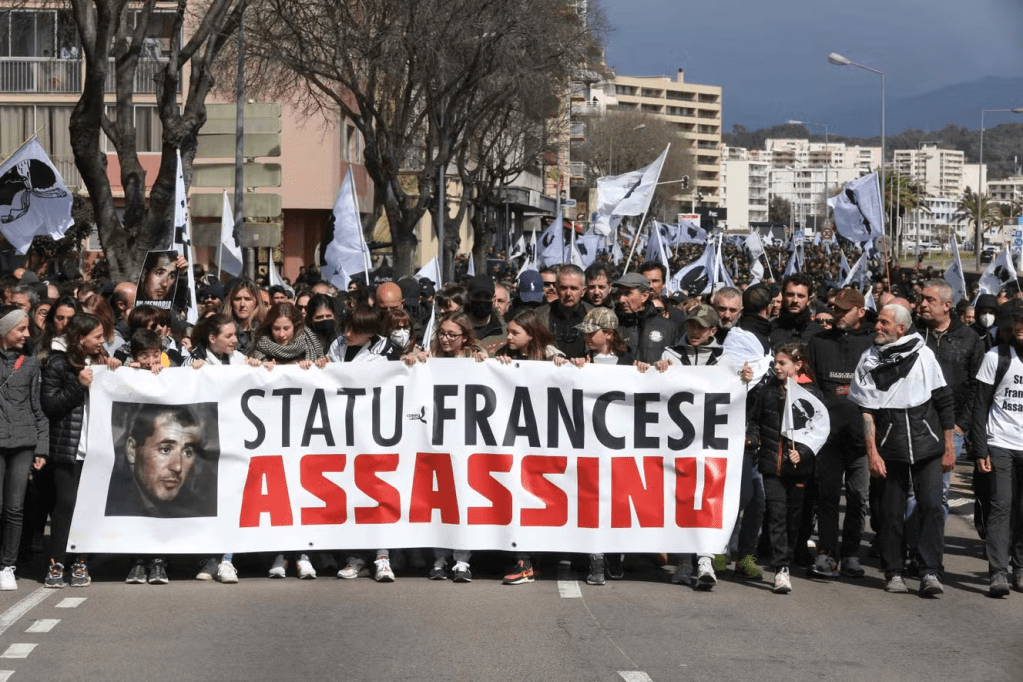
Yet, it was not that long ago that France was reminded of Corsica’s tenacious fight for autonomy. Following the death of Corsican nationalist Yvan Colonna in 2022 after his attack in prison, violent riots on the island sparked a revival of grievances and a resurgence of Corsican terrorism, and pressured the Republic to respond to the island’s demands.
(Pascal Pochard-Casabianca / AFP)
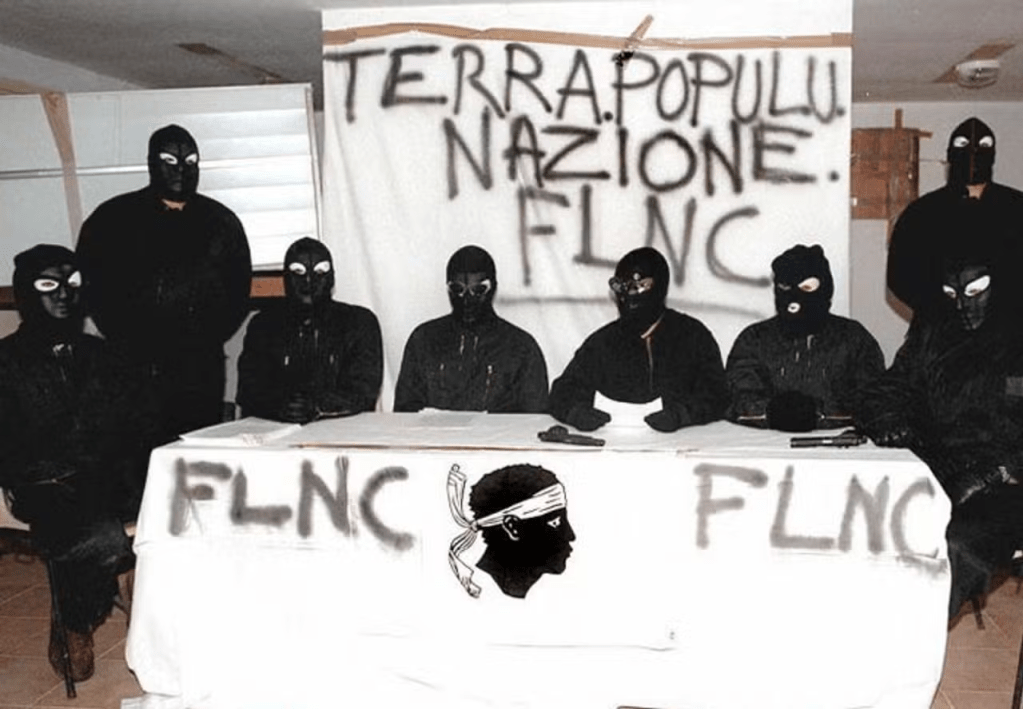
Tried and condemned for the assassination of Corsica’s prefect Claude Erignac in 1998, Colonna had become a symbol of Corsican nationalism. Many still considered him innocent, as he never admitted to the crime, and the trials found minimal incriminating evidence. Accordingly, the State Council’s constant refusals to allow Colonna’s transfer to Corsica reignited strong resentment towards authorities. Ultimately, France’s failure to protect Colonna from the attack provoked the eruption of riots across the island, with slogans such as “The French State is an Assassin” galvanising protests. More concerningly for the French government, the Front de Libération Nationale de la Corse (FLNC), known for its nationalist terrorism between the 1970s and 2014, suggested it would resume operations if France were to keep denying demands for autonomy.
The memory of Corsican separatist terrorism is still fresh for French authorities. ‘Blue night’ operations carried out at night, explosions, and targeting of official buildings have characterised the mafia-style modus operandi of Corsican separatism, with over 10,000 attacks perpetrated over 40 years. Despite the relentlessness of separatist groups and the violence of terrorist attacks, little advancement for autonomy was achieved, with the granting of a ‘special statute’ in the 1980s as the sole notable outcome. However, the threat of a potential reignition of terrorism a few weeks before the 2022 presidential elections prompted President Macron to reopen the dialogue with Corsican representatives.
(Le FLNX/AFP)
The quest for autonomy remains significantly contentious. Corsicans still maintain a patriotic connection to the French Republic in the legacy of a rich history, including the national integration of the island under Napoleon I, as well as its strong role in the Second World War Liberation.
Nevertheless, Corsicans have felt deprived, exploited and colonised for decades. The first branches of nationalist movements rose with economic grievances, given the challenging landscape of the island, and were met with economic and agricultural reforms which re-established a hostile ‘colonial domination’ sentiment, with overtourism from the continent spiking up real estate speculation. In addition, as noticed in recent election outcomes, continental emigration to the island has jeopardised regional political action and distorted Corsica’s position: the Rassemblement National (RN) scored over 40% in the last elections, which local representatives attribute to French voters. The Corsican Assembly remains majoritarily autonomist, but Corsicans, fearful of a colonial dissolution of their political agency, are advocating for a resident status as a guarantee of their regional sovereignty.
The infringement of other minority rights has also been at the core of the autonomist struggle. Whereas cultural rights are widely protected, and even valorised within the framework of tourism, language rights have systematically been rejected. Not only did France never ratify the European Charter for Regional or Minority Languages, arguing for an incompatibility with Article 2 of its Constitution, courts also banned the use of Corsican in the Regional Assembly. Legislative autonomy has also been demanded, with representatives arguing that the centralisation of legislation in Paris generates disconnection from on-the-ground issues, and overlooks the island’s interests.
In this context, the project of Constitutional Law for an Autonomous Corsica within the Republic seems theoretically appealing. In practice, not so much. Constitutional provisions, including French as the official language (art. 2), or the Republic being ‘undividable’ (art. 1), block the institutionalisation of demands such as the recognition of Corsican as an official language, or the existence of a Corsican ‘people’. The resident status requested by locals was deemed inconsistent with the constitutional principle of equality. Geographical positioning also adds complexity to self-governance demands, implying compliance with European law and legislation that other French territories are exempt from. Moreover, the project is entrapped by parliamentary shuttling, and the recent rescheduling of the Senate’s review further postpones its institutionalisation.
This case highlights a cynical irony. Over the decades, Corsicans have been denied their minority rights, pressured into assimilation, exploited by their so-called “brothers”. The situation falls far short of the Liberty, Equality, and Fraternity values that the Republic prides itself on. Even more so when France has demonstrated willingness in granting extensive autonomy and territorial sovereignty in New Caledonia, but showed reluctance in recognising the Corsican identity and its right to self-governance.
What happens next remains unclear. Until a new date for the Senate’s review is announced, the project is paralysed. The intention of the State to grant Corsica some autonomy is an encouraging step, but relies heavily on the longevity of the government in place, which is more than compromised at present. The proposal for autonomy could appease regional claims for more sovereignty, and provide a landing point to years of tensions. Yet, even if the project were to come into force, several grievances would remain unanswered, and Corsica is not sheltered from the possibility of a revival of separatist identity amidst the chaos of the French political chessboard.
References
1. Duerr, G. (2019). Secessionism and Terrorism: Bombs, Blood and Independence in Europe and Eurasia. Routledge.
2. “Les indépendantistes de Nazione demandent une refonte du corps électoral en Corse.” Le Monde, August 5th, 2024. https://www.lemonde.fr/societe/article/2024/08/05/les-independantistes-de-nazione-demandent-une-refonte-du-corps-electoral-en-corse_6267724_3224.html
3. “Mort d’Yvan Colonna : la manifestation pour le militant indépendantiste à Ajaccio dégénère.” Le Monde, April 3rd, 2022. https://www.lemonde.fr/societe/article/2022/04/03/corse-des-affrontements-eclatent-a-ajaccio-en-marge-de-la-manifestation-de-soutien-a-yvan-colonna_6120391_3224.html
4. “Macron calls for calm after death of jailed Corsican nationalist”. The Guardian, March 22nd, 2022.https://www.theguardian.com/world/2022/mar/22/france-calls-calm-corsica-nationalist-dies-prison-yvan-colonna
5. Texte n° 869 (2024-2025) de M. François REBSAMEN, ministre de l’aménagement du territoire et de la décentralisation, déposé au Sénat le 30 juillet 2025. https://www.senat.fr/leg/pjl24-869.html
6. “Corse: nouvelle manifestation pour Yvan Colonna, nouvelles violences.” Le Point, April 3rd, 2022. https://www.lepoint.fr/politique/yvan-colonna-nouvelle-manifestation-a-haut-risque-politique-03-04-2022-2470735_20.php?utm_source=chatgpt.com
7. Avis sur un projet de loi constitutionnelle pour une Corse autonome au sein de la République. Conseil d’État. https://conseil-etat.fr/avis-consultatifs/derniers-avis-rendus/au-gouvernement/avis-relatif-au-projet-de-loi-constitutionnelle-pour-une-corse-autonome-au-sein-de-la-republique
8. “Quelle suite pour le processus d;autonomie de la Corse avec le nouveau gouvernement Lecornu? ” France 3, région Corse ViaStella October 10th, 2025. https://france3-regions.franceinfo.fr/corse/avec-le-nouveau-gouvernement-lecornu-quelle-suite-pour-le-processus-d-autonomie-de-la-corse-3233630.html
9. Code du patrimoine: Partie législative (Articles L1 à L770-4). France. https://www.legifrance.gouv.fr/codes/id/LEGIARTI000043530076/2021-05-24
 The Attaché