
A Comparative Film Review of The Zone of Interest and Son of Saul
Ngila Stone | Originally Published: 21 March 2026
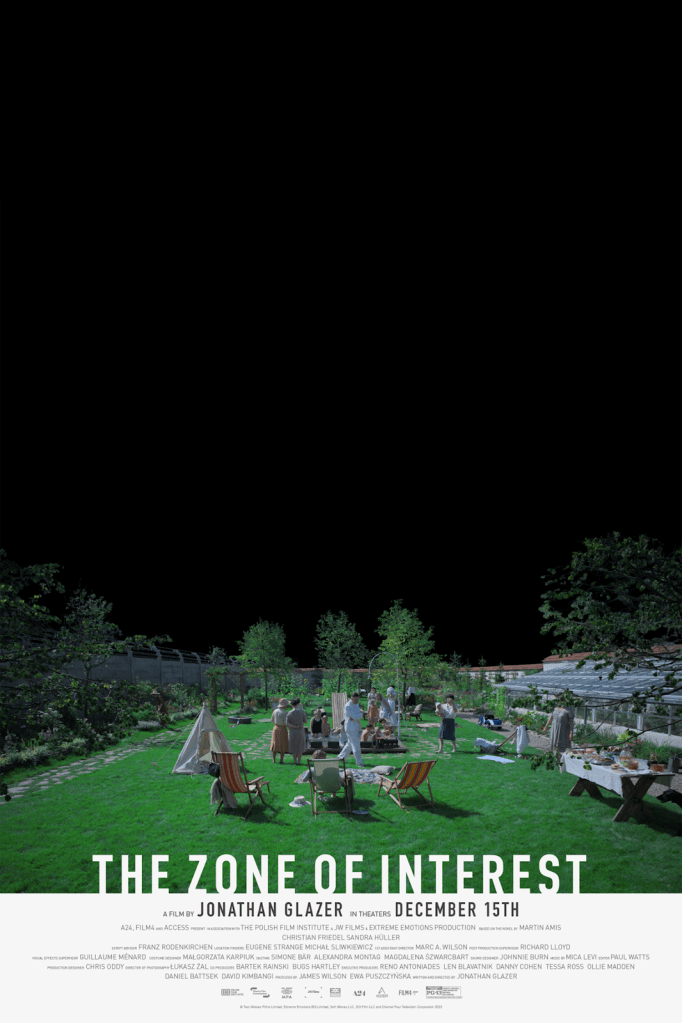
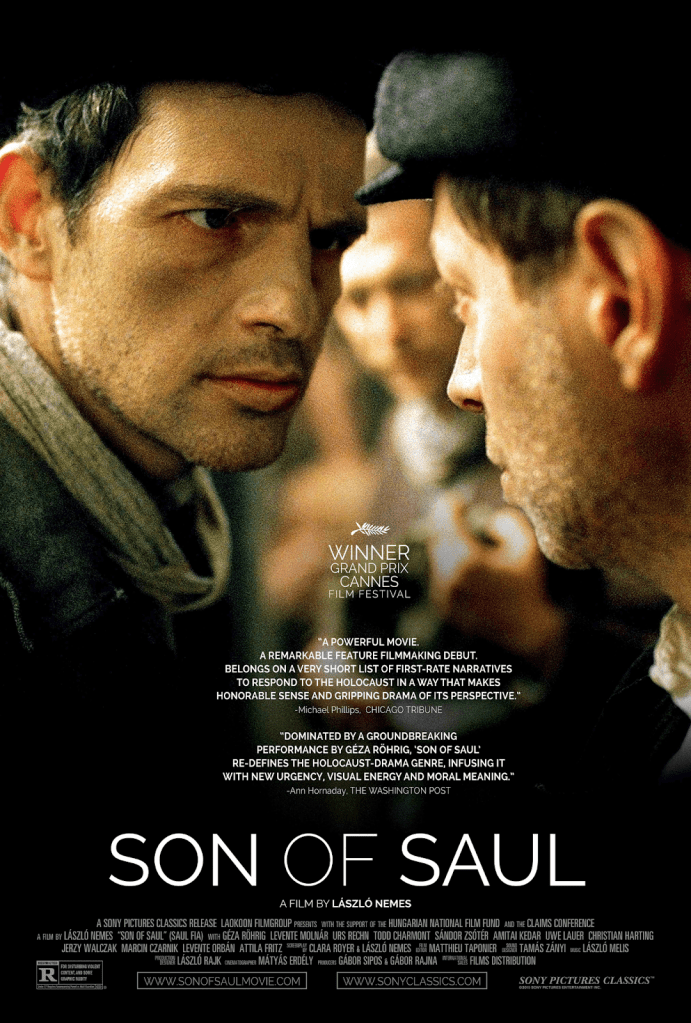
It is not a stretch to say that The Zone of Interest and Son of Saul are two halves of one story. Both films are set at the Auschwitz-Birkenau concentration camp, yet they take on duelling points of view. This, in and of itself, seems reason enough to put them next to each other, but it is a simplification of what draws the films together. Looking at the films technically, and only then at their content, it is possible to draw a deeper connection between the two, beyond the facts of setting and period.
Before delving further, it is important to give a summary of each film. The Zone of Interest follows the daily routines of the Hoss family as they try to build their dream life in their house and garden right next to the Auschwitz-Birkenau concentration camp. Son of Saul follows Auslander or Saul, a prisoner and sonderkommando within Auschwitz. As a sonderkommando, Saul has been forcibly recruited to help the camp guards carry out the most gruesome of their tasks, mostly “processing” the incoming prisoners through the gas chambers. While carrying out these tasks, Saul comes to a young boy who seems to have survived the gassing but is quickly killed by a camp doctor. Saul claims the boy is his son, and the film follows Saul’s quest to get the boy a proper Jewish burial.
The Zone of Interest, directed by Jonathan Glazer, utilizes a detached and distant film style. The audience feels less like they are with the characters and more like they are observing them as they move through their daily routines. The film’s pacing is slow and lends to the mundane nature of household chores and long days at the office. Often, the camera hangs in one location for an extended sequence as the characters move; an example being a shot of the house exterior as the audience watches Rudoulph Hoss walk through each room and turn off the lights.
Glazer opts to add wide-angle shots, such as a sequence wherein Glazer holds on the back steps of the house as Roudolph returns home with his underlings, and simultaneously, a camp worker polishes his boots around the side of the house while a servant girl brings out a glass with which Hoss can toast to his birthday. This fluid overlap of actions and interactions grounds the film and removes any sense of drama or even emotion.
Son of Saul, directed by László Nemes, is perhaps as stylistically different as it could be from Glazer’s paired-back vision. Nemes’ film utilizes an almost exclusive close-up camera shot and creates the illusion that it is being filmed by a single camera by rarely changing angles. This means that the audience often cannot see characters or locations in their entirety and has to wait until Saul moves to get a better look. The visual information of the settings and supporting cast of characters is severely limited, causing a general blurring effect where very few faces and places stand out to be recognized. The audience is meant to go on a journey with Saul, and that is precisely what the tight camera work accomplishes, as it gives the audience as narrow a perspective as the determined Saul.
Another method that Nemes uses to build on this goal is freely using a shaky camera, which implies that the cameraman is running to keep up with Saul as he bolts across the camp yard to the fence or ducks to the ground to avoid flying bullets. As a technique that’s very common in documentary films, the shaky camera is often utilized to imply a level of reality and make the audience feel as though they are in the middle of the action. Most feature films use exclusively steady camera work, where even if there is panning, it is along a track, creating a seamless movement. This is what is used in The Zone of Interest, for example. Nemes alternates between using a steady and shaky camera to highlight moments of action and raise the tension for the audience as they accompany Saul.
These two directorial styles accomplish very different tones for their respective films. Where The Zone of Interest is almost empty in its space, Son of Saul feels at times claustrophobic. While the two directors did not consult each other or make their films as complements to each other, this difference creates an interesting parallel between the two. This comes based on one of Frau Hoss’ lines midway through The Zone of Interest. Rudolph Hoss has received a promotion that requires him to leave Auschwitz. He shares this with his wife, and the two instantly start fighting as Frau Hoss argues that their family cannot leave. Trying to find the words, Frau Hoss lands on this argument: “This is our lebensraum.”
Lebensraum is a German term that directly translates to “living space.” It was a centrepiece of Nazi rhetoric and propaganda as Hitler argued for the racial Germans or volksgemeinschaft’s right to a prosperous and rich “living space” that could only be achieved through an expanding imperial Reich. This Lebensraum could only be achieved at the expense of other racial or ethnic groups that included the Slavs, Romani, and Jewish people. The line’s implications are clear as Frau Hoss stands meters away from Auschwitz, as the home she is defending has smoke stacks rising above its garden walls. It is Lebensraum in the most literal sense, a quiet “paradise garden” that can only exist because of the horrors being carried out directly beside it. This is an idea that Glazer’s removed camera work seems to highlight. The Hoss family is able to live and move as they please, unconstrained. The camera can capture wide shots of gardens and paths, all as Frau Hoss walks confidently from one end to the other. They have all the space they could desire.
Saul, on the other hand, has none. With the camera a metre, sometimes centimetres, from his face, there is no freedom of movement. Saul spends much of the film attempting to manufacture ways to move around the camp to varying levels of success. The climax of which is when he is almost shot in a mass grave because he is trying to sneak a rabbi from an incoming group of prisoners. He is not left alone but constantly rubbing shoulders with other prisoners and sonderkommando he is grabbed by guards. It seems all of the “living space” Saul once had has been stripped from him for the sake of his new neighbours.
As a Hungarian Jew, Saul had experienced one of the most rapid implementations of Nazi racial policy of the Holocaust. Starting in April 1944, Hungarian Jews had been stripped of legal rights, subjected to Nazi registration and then forced into Ghettos especially in urban centers such as Budapest. By this stage of the war, the Nazi machine had all but perfected the process by which they could carry out the final solution, and Adolf Eichmann himself had been sent to Hungary to implement it.
The Hungarian government and military have attempted to avoid accountability by pointing to the German occupation, when in reality the Germans would have been unable to work as quickly as they did without support from the Hungarians on a national, but also local level. As Jews were rounded up, neighbours began collecting their land and possessions and benefited from the arrests. While Saul is not a real historical character, in extrapolating on his backstory, it is easy to understand his level of desperation; he has been stripped of his home and identity. He has lost his family and likely does not feel he has a home to return to, even if he survives.
But why then is Frau Hoss a woman who has everything she wanted, so desperate as well? Frau Hoss uses the words from Nazi propaganda in discussing her life and situation. Her commitment to what they’ve built is shown throughout the film to be strong enough to ignore the death beside her. One sequence shows Frau Hoss receiving a fur coat taken from one of the murdered prisoners. She closes the door to her room and tries it on, even taking lipstick out of the pocket and testing it. While the fact that she does this privately implies a level of knowledge or guilt that is undercut in the next scene when she roughly hands the coat to one of their servants and tells her it needs to be cleaned.
The Nazi propaganda ministry had ensured that the messaging of the war was that of an existential struggle of the German aryan volk against their enemies, mainly the Jews. Propaganda from the eastern front in Poland, where Frau Hoss now resides, had invented stories of women and children being attacked and shot. Initially, these had been a motivation for the German regular army, the Wehrmacht, but they had largely societal implications as well. This constructed narrative convinced people like Frau Hoss that it was either ‘us or them’ and that there was no true security until the ‘them’ had been purged. So, even though Frau Hoss seems so well off, she has been told over and over again that she is not truly secure and that her dream is something that requires continued work and sacrifice. When she says, “This is our Lebensraum,” she is making all of those implications.
So both characters are in an existential struggle, one very real and one very carefully constructed. Their reactions, however, are entirely different, with Saul prepared to risk his own life over and over to get a burial for the boy and Frau Hoss unwilling to risk moving her family to another city even if she would have had a privileged life there as well. Other prisoners comment on Saul’s behaviour, with one commenting that he is risking the “living for the dead.” Yet Saul is unwilling to end his quest as it becomes clear that the boy is a symbol of everything that has been lost. Saul wants to give at least one child a proper burial to reclaim a small portion of his history and humanity. In a reversal, Frau Hoss is paying for the living with the dead, purposefully giving up her humanity for the sake of an idyllic vision infused with propaganda.
To return to the camera work of both films, the contrast between them gains even more meaning. The fact that The Zone of Interest is distant and observational underlines the fact that the threats to Hoss’ dream life, to them, are also coming from the outside. The sense of removal and emotionless tone demonstrates how desensitized they are to the violence around them. Son of Saul, on the other hand, is so close and personal that the audience cannot escape. The threats are all immediate, and many of the risks are coming from Saul himself as he is willing to take on higher and higher amounts of danger for the body of the boy. The contrast in “living space” between the films aligns itself with the historical narratives of their characters.
While in the end, both films seek to accomplish very different visual and narrative goals, the parallels between the two films create a deeper understanding of both. The fight for “living space” so human and existential is a question both films grapple with, and in seeking to answer it, the directors carefully utilize camera spacing and angles to achieve contrasting tone and style. Rather than focusing on the actual violence of Auschwitz, both films keep it just out of frame and, in doing so, force the audience to regard their central characters. In The Zone of Interest, this observation is from a careful distance and in Son of Saul, it is from as close as possible.
 The Attaché