
Analyzing Manchester Guardian’s 1956 Coverage of the Suez Canal’s Nationalisation
Siya Duggal | Originally Published: 6 December 2025
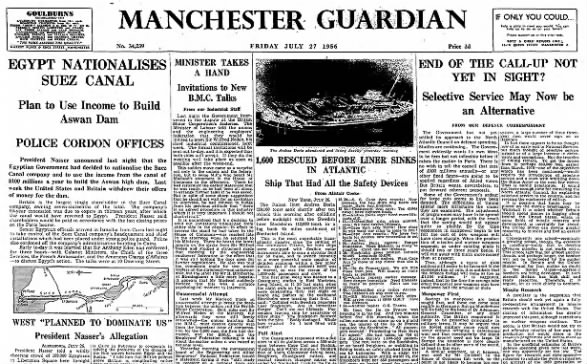
Front Page of Manchester Guardian – July 27, 1956
The Suez Canal is often described as a technological marvel, which is vital to global trade because it functions as the fastest sea shipping route between Asia and Europe. However, this image obscures the technology’s roots in exploitative European practices. On July 26, 1956, Egyptian President Gamal Abdel Nasser nationalised the Suez Canal. Nasser did not alter the physical function of the canal. Instead, he transformed it into a symbol that furthered Egyptian nationalism. The speech and law through which Nasser nationalised the canal was covered by the Manchester Guardian – a British newspaper now named The Guardian – in their front-page article titled, “West ‘Planned to Dominate Us’: President Nasser’s Allegation” on July 27, 1956. This title and the article itself both demonstrate that the European understanding of Nasser’s nationalisation reflected strategic amnesia and reification.
The Manchester Guardian operated on Fleet Street in London, and its primary audience was individuals residing in the United Kingdom. Thus, the article reflects the British understanding of Nasser’s nationalisation. It describes claims made in Nasser’s speech nationalising the Suez Canal, presents a six-clause law passed through which he nationalised the Suez Canal Company “in the name of the nation,” and lastly details the influence of political factors such as a Russian arms deal and the United States’ refusal to fund the building of the Aswan High Dam.
Through the sections, “Russian Arms Deal” and “In Name of Nation,” the article guides readers to focus on how the nationalisation of the canal is influenced by political factors such as Nasser’s aspirations to boost Egyptian nationalism. It mentions Nasser’s statement that, “With the $500 millions revenue from the Suez Canal company in the next five years, we will not look to Britain and the United States for their $70 millions grant.” This statement embodies the argument advanced by Barkawi and Brighton (2011) – “strategy is not about war…but about how to use military and other instrumentalities to attain or secure interests” – as it depicts that Nasser effectively used nationalisation of the Suez Canal Company to finance the Aswan Dam.
However, in attempting to shift the focus to nationalism and political factors, the Manchester Guardian shifts focus away from the fact that Nasser’s nationalisation of the Suez Canal was also part of his policy to restore Egyptian dignity. Historian Lucia Carmianiti (2024) reveals that forced labour was used to build the Suez Canal. This historical context is important as it informed the views of Egyptian workers in 1956, as they had long been overlooked while the Suez Canal’s technical wonders were marvelled at. The support of these workers was key to Nasser’s successful nationalization, and it was reflected in the crowd of 100,000 Egyptians cheering during Nasser’s speech. While the article describes that Nasser asserted Egyptians will build “the high dam on the skulls of the 120,000 Egyptian workmen” who died building the Suez Canal, it does not commentate on the quote and presents it as Egyptian opinion, not fact. Further, through its title, the article presents Nasser’s statements as mere allegations rather than the truth.
By minimizing the history of Egyptian workers’ exploitation, the news coverage exhibits and furthers the strategic amnesia surrounding the Suez Canal’s construction. Kate Crawford (2021) defines strategic amnesia as deliberately forgotten history, while explaining that the history of mining often overlooks the exploitation of workers and the displacement of Indigenous peoples. The Manchester Guardian perpetrates strategic amnesia as it states “the Suez Canal company…is an Egyptian registered company but with a majority of foreign shareholders…The concession was due to expire in thirteen years after which under the terms of the original 99-year concession, the canal would revert to Egypt.” Through such claims, the article critiques Nasser for violating international agreements while omitting discussion of the reasons he did so, including the fact that the Suez Canal was being used as a British base despite being owned by an Egyptian company. Thereby, despite including Egypt’s perspective through Nasser’s statements, the article privileges the Western European perspective.
The Manchester Guardian’s narrative also reflects the process of reification, as described by George Lukacs (1971) and Leo Marx (1997), in which individuals characterize technology as an autonomous agent, which leads to a technology’s fundamental nature as a relation between people being obscured; rather, this relation “takes on the character of a thing.” In presenting the Suez Canal Company as a singular object that Nasser nationalised, the article obscures that the company consisted of European executives who exploited Egyptian workers and that Nasser’s nationalisation was underpinned by the aim of resisting foreign control and protecting Egyptian national security.
Turning to present-day, the Manchester Guardian’s article is interesting for readers in 2025 because the strategic amnesia surrounding the Suez Canal persists today. While Nasser highlighted European exploitation of Egypt in 1956, the role of workers in operating the Suez Canal continues to be overlooked. When the canal was blocked in 2021, news coverage on the blockage detailed that the operation of supply chains depends largely on technologies like the Suez Canal, yet it furthered the strategic amnesia and reification surrounding the canal by omitting discussion of the human workforce operating it. This coverage also exhibited techno-somnambulism, which Langdon Winner (2014) describes as society’s “capacity and willingness to reflect” on technology’s significance, is far less than our ability to curate technologies. Despite many entities constantly relying on the Suez Canal for trade, the high level of dependence was only consciously understood when the canal ceased to function.The concepts of strategic amnesia, reification, and techno-sombulism are not limited to historical technologies like the Suez Canal. They are also visible through current technologies like fulfillment centres. In a society where reliance on online shopping is growing, many individuals order packages and view it as a single company shipping them products. However, there are many more elements in the supply chain which are often overlooked, such as the workers in fulfillment centres who package goods, their working conditions, delivery companies, and the software developers who operate Amazon’s website. On balance, the phenomena surrounding online shopping reflect that concepts found when studying the history of technology remain present in societies across the globe today.
References
1. Barkawi, Tarak, and Shane Brighton. “Powers of War: Fighting, Knowledge, and Critique.” Int Polit Sociol 5, no. 2 (June 1, 2011): 126–43. https://doi.org/10.1111/j.17495687.2011.00125.x
2. Carminati, Lucia. “Of Machines and Men: Mechanization and Migrant Labor on the Suez Canal, 1859–64.” In The Oxford Handbook of Modern Egyptian History, edited by Beth Baron, 0. Oxford University Press, 2024. https://doi.org/10.1093/oxfordhb/9780190072742.013.3
3. Crawford, Kate. Atlas of AI: Power, Politics, and the Planetary Costs of Artificial Intelligence. New Haven: Yale University Press, 2021.
4. “Egypt Nationalises Suez Canal.” Manchester Guardian, July 27, 1956. https://www.theguardian.com/world/2021/jul/27/egypt-nationalises-suez-canal-nasser-1956
5. Guardian Staff. “History of the Guardian.” The Guardian, December 11, 2017. https://www.theguardian.com/gnm-archive/2002/jun/06/1
6. Helwa, Racha, and Perrihan Al-Riffai. “A Lifeline under Threat: Why the Suez Canal’s Security Matters for the World.” Atlantic Council, March 20, 2025. https://www.atlanticcouncil.org/in-depth-research-reports/issue-brief/a-lifeline-under-threat-why-the-suez-canals-security-matters-for-the-world/
7. Louis, WM. Roger, and Roger Owen, eds. Suez 1956: The Crisis and Its Consequences. Oxford University Press, 1991. https://doi.org/10.1093/acprof:oso/9780198202417.001.0001
8. Marx, Leo. “‘Technology’: The Emergence of a Hazardous Concept.” Social Research 64, no. 3 (1997): 982. http://www.jstor.org.myaccess.library.utoronto.ca/stable/40971194
9. Reuter, British United Press, and Associated Press. “West ‘Planned to Dominate Us’: President Nasser’s Allegation.” Manchester Guardian, July 27, 1956. https://www.theguardian.com/world/2021/jul/27/egypt-nationalises-suez-canal-nasser-1956
10. Segal, Edward. “Blocked Suez Canal Is Latest Reminder Why Companies Need Crisis Plans.” Forbes, March 28, 2021. https://www.forbes.com/sites/edwardsegal/2021/03/27/blocked-suez-canal-is-latest-reminder-why-companies-need-crisis-plans/
11. Winner, Langdon. “Technologies as Forms of Life.” In Ethics and Emerging Technologies, edited by R.L. Sandler, 48. Palgrave Macmillan, 2014.
12. Zakar, Adrien. “Week 10: Labour.” HPS202H1: Technology in the Modern World. Class lecture at University of Toronto, Toronto, ON, November 10,
 The Attaché