
Aryan Rajagopal | Originally Published: 4 April 2026
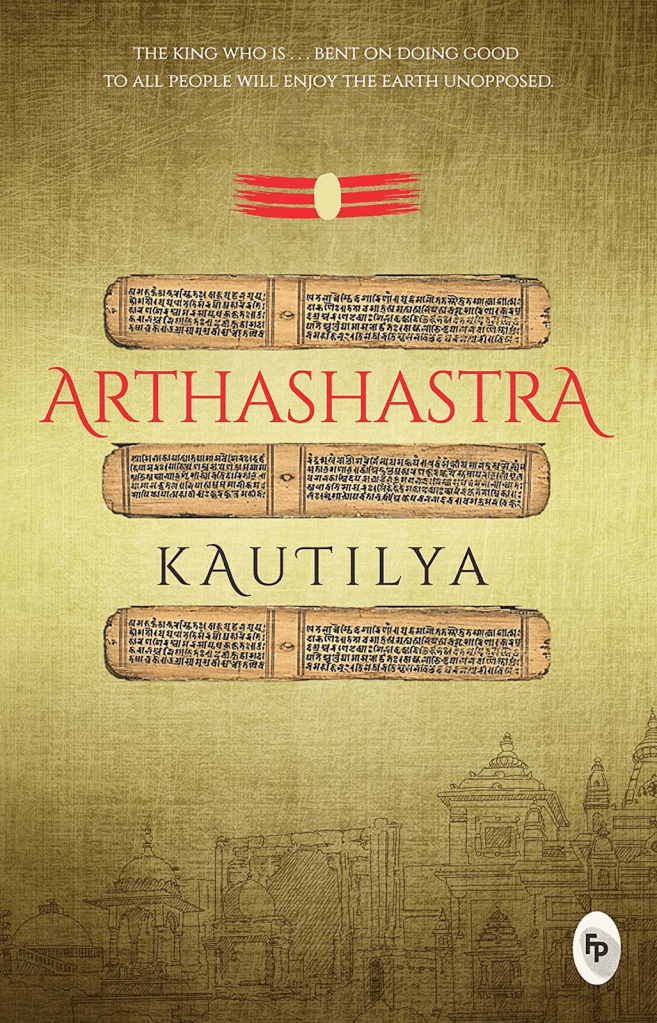
Kauṭalya‘s Arthashastra
Throughout history, philosophers and leaders have rendered competing interpretations of “virtuous rule” and debated the means of achieving it. One such man was Kautilya, a political thinker from the Maurya Empire, who provided a unique perspective on virtue linked to the individual excellence of rulers. He authored the Arthashastra, which describes a political framework centred on distinct regulations and treatment for social classes, referred to as rule by dhamma, determined by spiritual purity, i.e. varna. The Arthashastra is a political treatise aimed at the betterment of societies, making it a document that highlights ideal societal values even today. Kautilya contends that the ability of rulers depends on their display of moral acts and the strict enforcement of the Hindu caste system, with different interpretations of “the Law” for each to ensure order. In this essay, I argue that Kautilya approaches virtuous rule as extending outwards from a ruler’s personal discipline, supported by the maintenance of social hierarchies with differing interpretations of individual morality, establishing a political mandate through the pursuit of dhamma.
To engage with the Arthashastra from this standpoint requires a deeper understanding of Kautilya’s commentary on individual morality, particularly its connection to and embodiment by political rulers. Throughout the treatise, he notes specific customs that an ideal leader ought to display as a model for society, a majority of which originate from a belief in a spiritual lifestyle through dhamma, interpreting virtuous rule as beneficial for rulers as individuals and as members of a wider society. Commenting on the traits held by this ideal leader, Kautilya defined “non-injury, truthfulness, purification, lack of malice, compassion, and forbearance” as “common to all” and thus relevant to virtuous rule (Arthashastra, 1.3.13). He not only promotes the adoption of moral customs by political rulers, but goes further to appoint them as “model citizens” for the remainder of society to follow. This viewpoint aligns with Kautilya’s general standpoint on the role of political leaders, who he sees as moral guides with a duty to uphold on behalf of their subjects. His commitment to righteous rule is founded in a strict respect for principles outlined through dhamma, utilizing individual and state power to ensure popular adherence, as he encourages political leaders to “promote [preexisting and new] righteous customs,” and “put an end to [unrighteous customs] promoted by others” (13.5.240). This rigid commitment to righteous rule is a testament to Kautilya’s most significant element of political rule: securing order among citizens and society. Both through the encouragement of values and traditions deemed “virtuous” and the systematic elimination of those deemed “unrighteous,” Kautilya seeks to create a society where authority is unquestioned in its merits and refuses to stray from consistency. These sentiments define his pragmatic assessments of virtuous rule, promoting the identification and systematic elimination of acts deemed oppositional to virtue.
Centring on the strict moral discipline of rulers and obedience to righteous principles, Kautilya emphasizes the importance of respecting social hierarchies outlined through dhamma. The separation of social classes is not presented as a discriminatory measure; rather, Kautilya sees it as a necessary step for righteous leadership to which all rulers must adhere. Specifically, when engaging with individual conceptions of “the Law,” he stresses that “kings should not permit people to violate the Law specific to each of them,” as a violation would lead to the destruction of people through “intermixture” (1.3.14). When referencing the Law, Kautilya refers to the virtuous ways of life lived by the four social castes, defined as “Success,” experienced uniquely and without interruption. He specifies that political rulers must do everything within their power to prevent interference in these customs and promote the continuity of Success, noting that violations would risk their pursuit of a righteous life. Kautilya does not pose this differentiation for the sake of posing one social caste as superior and more deserving of virtuous treatment than another. Rather, Kautilya views an adherence to the ways of life specified through dhamma as spiritually grounding, something he believes is important for rulers to understand. Kautilya theorizes that, when rulers take excessive liberties and violate others’ virtuous ways of life, it will wrongfully empower others to do the same. He aims to avert this, largely by empowering rulers and the kingdom as a whole, to prevent “intermixture” and, as described, promote righteous customs broadly. This speaks to Kautilya’s attempt to have leaders represent the ideals of a kingdom and its people, demonstrated previously by requiring rulers to emulate virtuous practices. By granting each caste these freedoms and using the power of the state to support them, Kautilya aims to enable rulers to “enforce the Law specific to each by providing guidance on duties,” redefining political rulers as conduits for knowledge and virtue (1.7.1). He posits that leaders have a duty to receive education, or “training,” to deepen their personal knowledge, better support their subjects and confirm an ongoing commitment to “the Law.” Kautilya places great importance on the education of a king, defining it as essential to understanding and executing leadership through the Law. This training is key to the role of rulers and the responsibilities they carry to administer the Law correctly in accordance with dhamma, dictating the key relationship between a ruler’s own practices and those of their citizens.
Drawing on Kautilya’s descriptions of training for rulers, he further argues why their personal customs can impact the righteousness of a kingdom and, specifically, its people. When describing the benefits associated with “energetic” kings—that is, those who actively observe and promote virtuous practices to their subjects with intent—compared to those who are “lethargic,” he notes that the latter tend to have subjects who “consume his enterprises,” justifying the need for rulers to remain energetic (1.16.1). Using the term “energetic,” Kautilya describes the importance of a ruler’s public image and the customs they portray to a kingdom. Believing that people will naturally replicate deeds they observe from those in power, he reaffirms the need for rulers to remain virtuous in their actions to guarantee a society of similar merits. Connecting the “energy” of rulers to the promotion of morally correct beliefs and acts, he theorizes that rulers who fail to do so will lose the will of their people and fall to their enemies. Similarly, speaking on the education of rulers and the importance of training to advancing righteous rule, Kautilya stresses a “desire to learn” as crucial to the development of a mindset devoted to the principles of dhamma (1.5.2). Restating the role of rulers as conduits of knowledge, Kautilya adds that their ability to demonstrate and encourage righteous practices is of the utmost importance to achieve a properly functioning political society.Kautilya does not make his belief in a strong imitational dynamic between rulers and subjects in promoting virtuous governance obvious in this text. Conventional readings of his Arthashastra frame political rule as concerned with strict, social hierarchies, with little consideration for virtue besides justifying the caste system through dhamma. On the contrary, Kautilya presents a leadership style that goes beyond using dhamma as a justification; rather, he considers it a basis for virtuous rule. Framing leaders as responsible to their people in action and representation, he reminds future rulers of the important role they hold in creating and encouraging virtue among all members of a society. The universality of these considerations is paramount to Kautilya’s framework, balancing social order with righteous action to assist leaders to become the best possible educators in virtue for their subjects. The Arthashastra is not merely a treatise for political rulers; it is a moral realignment for the betterment of entire societies.
References
1. Kauṭalya. 2013. King, Governance, and Law in Ancient India: Kauṭilya’s Arthaśāstra: a New Annotated Translation. Translated by Patrick Olivelle. New York: Oxford University Press.
 The Attaché