
Siya Duggal | Originally Published: 5 March 2026
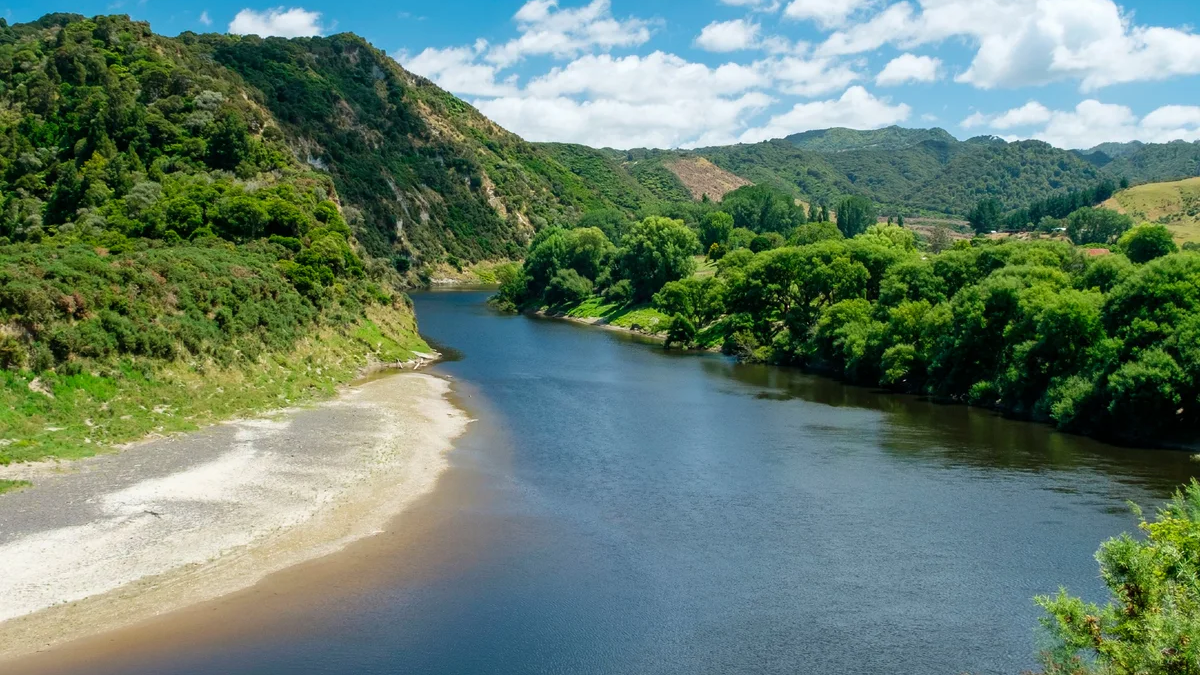
The Whanganui River in New Zealand, a legal person since 2017 (The Guardian).
In the past decade, we have witnessed a seemingly momentous shift in international law, as two rivers on opposite sides of the globe were granted legal personhood. Corporations and humans have been joined by two new legal persons: New Zealand’s Whanganui River and Québec, Canada’s Magpie River. The granting of legal personhood to these rivers is a significant win for Indigenous Peoples who were fighting for their protection. A question we must now ask is: what are the implications of these successes for global Indigenous rights?
After 160 years of the Ma’ori, an Indigenous Polynesian people, demanding legal protection for the Whanganui River, it was granted legal personhood in 2017. As a legal person, the river can now be an entity in court. If its waters are threatened through pollution or unauthorized activities, it can sue. It can also enter contracts, own property, and be sued. The Whanganui has one Ma’ori representative and a second representative from the New Zealand government. Similarly, since 2021, Canada’s Magpie River has nine rights, including, but not limited to, the rights to sue, flow, be free from pollution, and maintain biodiversity. Its representatives are appointed by the Minganie Regional County Municipality (Minganie RCM) and Innu Council of Ekuanitshit.
Legal Personhood as a Reflection of Indigenous Law
Rivers being deemed legal persons aligns with Indigenous legal views, which personify nature. Turning first to Indigenous legal views in Canada, in Delgamuujw v. Attorney General (British Columbia), Indigenous Elder Mary Johnson testified that when her ancestors played with their fish rather than only taking to eat, they disappeared and tracks were found leading to the nearby lake; the disappearances were considered to be the lake enacting revenge for the overharvested fish. Historian John Burrows describes that such experiences inform Indigenous views on the treatment of nature. Like the lake in Johnson’s testimony, as legal persons, the rivers can now take action when wronged and have rights that must be respected.
A similar personification of nature is found in Ma’ori legal views. The Ma’ori believe they are intertwined with the Whanganui, so harming the river is equivalent to harming the Ma’ori tribe. Accordingly, in deeming the Whanganui a legal person and thus granting it similar rights to humans, the New Zealand settler legal system now acknowledges Ma’ori legal perspectives.
Looking Through the Eyes of States
While it is clear that Indigenous groups advocate for the granting of legal personhood to protect their legal views, what remains perplexing is why states acquiesce to their requests. Scholars studying Indigenous opposition in Canada and New Zealand assert that a shift in how land is shared would inevitably involve challenging a state’s underlying constitutional order. Given this context and noting that states view legal pluralism, i.e. multiple legal systems, as a threat to their sovereignty, why would states extend the definition of personhood beyond what is traditional for their legal systems?
One incentive for the state is that granting legal personhood to rivers also benefits non-Indigenous actors. Some scholars argue that legal personification of rivers is part of a broader non-Indigenous movement to protect nature through legal recognition; they liken rivers’ personification to Ecuador’s affirmation of nature’s rights in its constitution, and Pennsylvania’s recognition of ecosystems’ inalienable right to exist. While environmental benefits associated with legal personification often lead to collaboration between Indigenous and non-Indigenous actors (for instance: the Magpie’s recognition involved joint efforts by the non-Indigenous Minagie RCM and the Indigenous Innu Council), Indigenous actors play a fundamental role in the granting of personhood.
This vital role is reflected in environmental organization Ecojustice’s failed case. Despite Québec’s Magpie being recognized as a legal person, in another Canadian province, Alberta, Ecojustice’s claim that the Athabasca River is a legal person was rejected, with the argument that personifying the Athabasca isn’t necessary to support environmental protection. Ecojustice’s failure suggests that environmental benefits may not be the sole reason states grant legal personhood to rivers. It is more likely that states’ obligations to uphold Indigenous rights, potentially coupled with climate promises, yield legal personhood grants.
Turning to states’ international Indigenous rights obligations, Indigenous scholar Sheryl Lightfoot describes Canada and New Zealand as “over-compliant” because they enact laws and policies that exceed their international obligation. Yet, despite this “over-compliance” implying strong support for Indigenous rights, Indigenous peoples in both states face many challenges. New Zealand provides rights but expects Indigenous peoples to eventually assimilate into the colonial order. Meanwhile, Canada provides strong protections for Indigenous language and cultural rights to maintain its image as a “harmonious multicultural society and good human rights steward,” but it opposes stronger—namely, territorial—rights. Canada and New Zealand’s acknowledgment of Indigenous law, through legal personification of rivers, somewhat fits this pattern. Since the rivers are represented jointly by Indigenous and non-Indigenous government representatives, Canada and New Zealand maintain state sovereignty over the rivers, while being seen as acknowledging Indigenous legal rights.
However, in acting as an acknowledgement of Indigenous legal rights, these legal personifications mark a departure from Canada and New Zealand’s conception of Indigenous rights, including only human and cultural rights. Moreover, Canada and New Zealand both argued that Indigenous self-determination is meant to be granted by states through the states’ legal systems and practices. In such environments, Indigenous Peoples succeeding in gaining state recognition of their legal views, even if not yet complete self-determination, marks a vital positive shift.
A Path Forward: The Future of Global Indigenous Legal Rights
What began with the Whanganui continues to produce ripple effects, as in November 2025, the Colorado River was decreed a legal person by Indigenous peoples in the United States. Since legal personification allows Indigenous peoples to file lawsuits on behalf of the river in the state legal system, rivers’ personification is a manifestation of Indigenous Peoples’ right under UNDRIP Article 5 to maintain their distinct legal institutions, while participating “in the political, economic, social and cultural life of the State.” Ultimately, the Whanganui, Magpie, and Colorado rivers becoming legal persons reflects a growth in Indigenous Law’s global influence. Legal personification has emerged as a new pathway for Indigenous peoples to assert sovereignty and protect their rights. Nonetheless, there remains more to be done, as Indigenous law is not yet considered equal to that of states.
Siya Duggal is a fourth-year student at the University of Toronto, pursuing a double-major in International Relations and History alongside a minor in Political Science. She has completed the legal history, human rights, and international law focus streams. Siya was an Editor for Vol. XXIV of the Attaché Journal of International Affairs (2024-25), and currently serves as Co-Head of the Commentary Division (2025-2026). In her free time, Siya enjoys trying new cafés and is on a quest to visit all the UofT Libraries before graduating.
References
1. Borrows, John. Canada’s Indigenous Constitution. University of Toronto Press, 2010.
2. Berge, Chloe. 2022. “This Canadian River Is Now Legally a Person. It’s Not the Only One.” National Geographic. April 15, 2022. https://www.nationalgeographic.com/travel/article/these-rivers-are-now-considered-people-what-does-that-mean-for-travelers.
3. Erueti, Andrew. 2022. “Introduction.” In The UN Declaration on the Rights of Indigenous Peoples: A New Interpretative Approach, 0. Oxford University Press. https://doi.org/10.1093/oso/9780190068301.003.0001.
4. Evans, Kate. 2020. “The New Zealand River That Became a Legal Person.” BBC. March 20, 2020. https://www.bbc.com/travel/article/20200319-the-new-zealand-river-that-became-a-legal-person.
5. Jang, Mallory. 2021. “Rights of Nature and Indigenous Peoples: Navigating a New Course.” Peter A. Allard School of Law. University of British Columbia. September 2, 2021. https://allard.ubc.ca/about-us/blog/2021/rights-nature-and-indigenous-peoples-navigating-new-course.
6. Kriwokon, Ben. 2025. “Is a River a Legal Person? The AER Rejects Personhood for the Athabasca River.” Dentons Canada Regulatory Review. November 13, 2025. https://www.canadaregulatoryreview.com/is-a-river-a-legal-person-origins-of-the-trend/.
7. Lightfoot, Sheryl R. 2010. “Emerging International Indigenous Rights Norms and ‘Over-Compliance’ in New Zealand and Canada.” Political Science 62 (1): 84–104. https://doi.org/10.1177/0032318710370584.
8. Lurgio, Jeremy. 2019. “Saving the Whanganui: Can Personhood Rescue a River?” The Guardian, November 29, sec. World news. https://www.theguardian.com/world/2019/nov/30/saving-the-whanganui-can-personhood-rescue-a-river.
9. Maaka, Roger, and Augie Fleras. 2005. The Politics of Indigeneity : Challenging the State in Canada and Aotearoa New Zealand. University of Otago Press.
10. United Nations. 2007. “United Nations Declaration on the Rights of Indigenous Peoples.” United Nations Declaration on the Rights of Indigenous Peoples, September. https://doi.org/10.1353/hrq.2011.0040
11. Xanthaki, Alexandra. 2017. “Collective Rights: The Case of Indigenous Peoples.” In Human Rights in Philosophy and Practice. Routledge.
 The Attaché