
Russia’s sabotage campaign reveals several critical flaws within Germany’s counterterrorism strategy. But what does it tell us about the future of terrorism?
Blair Shang | Originally Published: 31 January 2026
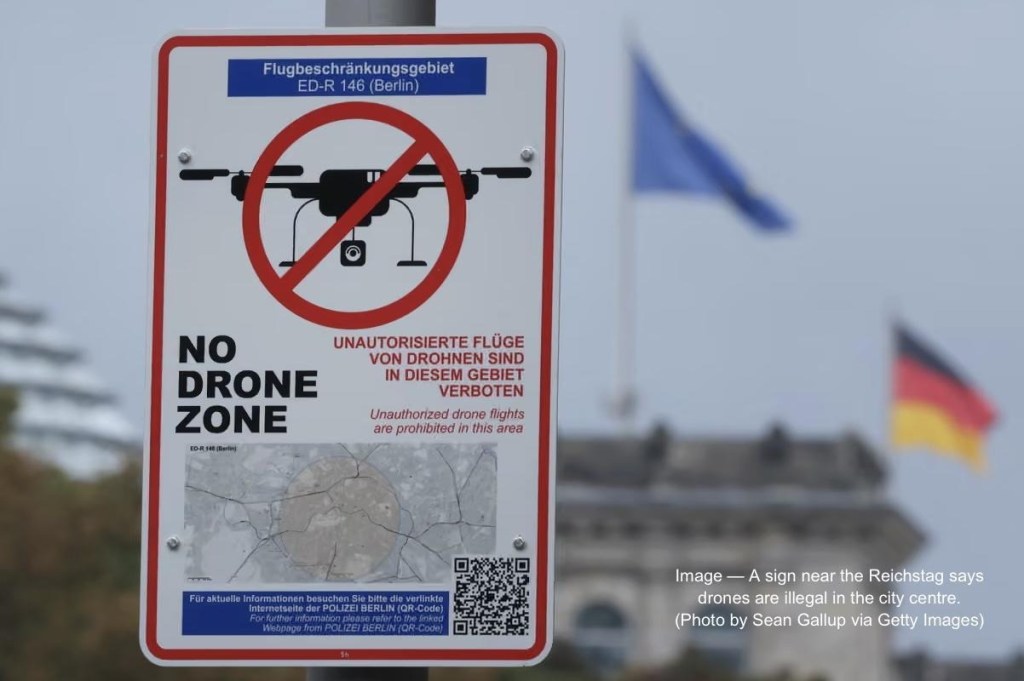
From September to October 2025, drones had caused significant disruptions across Europe, targeting the infrastructure (i.e. airports, refineries, shipyards) of several NATO states. The Federal Police Bundeskriminalamt (BKA) and the head of the German Foreign Intelligence Service (BND), Bruno Kahl, claim the actions are part of Russia’s wider grey zone warfare in Europe.
“To think Russia will remain content with diplomatic harassment and drone incursions would be a grave misconception of its capabilities and determination.”
The events formed the latest escalation in a series of confrontations between Russia and NATO since the Russian invasion of Ukraine in February 2022. But drones present an acute, yet unprecedented, problem for Germany, where constitutional guardrails prevent the effective protection of critical and strategic infrastructure within its own borders.
Germany’s Enforcement Problem
On 8 October 2025, the German parliament passed an amendment to the Federal Police Act authorising the shoot-down of drones over German airspace. The measure expanded the remit of the Federal Police (Bundespolizei) to protect critical infrastructure. But the German military (Bundeswehr)—which remains the best equipped to handle drone incursions—is, however, sidelined from internal security.
The German Republic’s effort to combat Kremlin operations within its borders is complicated by its Nazi legacy. The postwar constitution, or the Basic Law, established provisions in Article 87a and Article 35 to prevent the Bundeswehr from intervening in domestic affairs.
Although the German military is permitted to down drones within the perimeter of its own installations, it cannot extend operations to the whole territory. The law stipulates that the Bundeswehr can only be deployed in the event of an external attack. Drones, however, have not yet met the legal threshold.
Russia’s Unconventional War on Europe
Russia has shown neither signs of halting nor de-escalating its campaign, which is now no longer isolated to its immediate neighbours. The number of Russian sabotage attacks in Europe has quadrupled year-on-year between 2022 and 2023, and tripled again from 2023 to 2024. It has not only increased quantitatively, but also changed in form and intensity.
On 16 November 2025, two Ukrainian saboteurs working on behalf of the Russian secret service detonated a rail line in Poland connecting Warsaw and Ukraine. Polish Foreign Minister Radosław Sikorski has since called it “an act of state terror.” The events in Poland demonstrate a serious escalation from the previous, albeit relatively peaceful, status quo. It is also the normalisation of an increasingly belligerent Russia that is threatening the spillover of violence into greater Europe.
The actions demonstrate Russia’s willingness to target infrastructure in order to secure strategic advantages in its war against Ukraine. It forms part of its broader confrontation with the West, with the aim of deterring decisions against its interests. Germany has been a particular target of Russian attacks. Germany hosts the largest contingent of American military installations in Europe. In 2024, the Bundespolizei arrested two suspected Russian spies for planning attacks against US military facilities in Germany. The German energy infrastructure is particularly vulnerable to sabotage after decades of deferred maintenance and insufficient investment, and are of obvious interest for potential Russian attacks.
Germany’s inability to sufficiently escalate the issue to a military level creates a political-legal limbo—a problem too big for the Bundespolizei and too small for the Bundeswehr. Although in the mid 2010s, the German state faced a similar dilemma of action at the height of Jihadi-inspired attacks across Europe.
The Coming Hybrid Terrorism
It is difficult to define Russia’s covert campaign against NATO, although one suitable term comes to mind to describe it.
“Russia’s sabotage campaign fits the definition and characteristics of terrorism.”
Terrorism is defined as a politically charged act of violence, or the threat thereof, conducted with the intention to undermine state legitimacy or functions. The commonplace notion holds that terrorism could only be perpetrated by non-state or sub-state actors. But as previous examples have shown, the connection between state and non-state actors has become increasingly difficult to deny.
Russia’s military doctrine integrates Critical National Infrastructure (CNI) sabotage in the concept of gibridnaya voyna (hybrid warfare). The core tenet in hybrid warfare is the intentional blurring between wartime and peace, resembling less like warfare and more of a “hybrid terrorism.” It combines state and non-state elements in two ways: state-terror and state-sponsored terror.
Hybrid warfare marks a shift from conventional conflicts. Hostile states can employ irregular tactics without declaring war or sponsor non-state actors to achieve their aims by proxy. The battlefield will be defined by non-state actors using technology, such as drones, which challenge the legal, moral, and security dimensions of the state.
The term “hybrid terrorism” fits because its purpose is to influence the political process. Public opinion is fundamental, since physical attacks serve as tools for information warfare, galvanising public opinion and triggering a political reaction. Infrastructure attacks especially create fissures between state and society, and even NATO allies. It is unclear when faced with competing national priorities, how committed the West will be to deter Russia collectively while having to defend against unconventional war waged against itself.
If current trends in Europe foreshadow any trajectory, it is likely that future terrorism will become driven less by ideology or religion, and more by the dynamics of great-power competition between Russia and NATO. The Russian link to terrorism in the West will only intensify and grow with geopolitical tensions.
The Need for a German Response
Germany’s peace constitution prevents the formation of any effective security framework. But Germany must rethink its decentralised and uncoordinated counterterrorism strategy to prevent subversive attacks.
“When facing a carefully designed strategy that targets all aspects of society, a comprehensive counter-strategy is vital to national survival.”
Drones also create a novel problem. It offers greater anonymity than human proxies, requiring less planning and training, and is operated at minimal costs. Russia has so far maintained a policy of recruiting proxies for its sabotage campaigns. Drone incursions and infrastructure sabotage remain separate issues. But it is uncertain how long this policy divergence will last. Germany should be prepared for the eventuality of when drones will be applied for destructive purposes. This scenario is not entirely unrealistic given the present prevalence of combat drones in Ukraine.
Albeit, Russia is not the only threat. Non-state actors could similarly employ drones. The threat of the proliferation of battlefield weapons is high. An elaborate weapon smuggling network exists from Ukraine to Europe, which has been facilitated by the Schengen Zone that is similarly exploited by Russia’s intelligence services. Germany should reconsider its constitutional safeguards in light of the needs of the present Zeitenwende (change of times). As things stand, it is sacrificing national security for a legacy that no longer corresponds to reality.
References
1. Ali, Ahmed. “The Drone Advantage in Modern Warfare -.” Strategic vision institute, December 19, 2024. https://thesvi.org/the-drone-advantage-in-modern-warfare/.
2, The Associated Press. “Poland Set to Charge 2 Ukrainians with Sabotage of Terrorist Nature for Railway Explosion | CBC News.” CBCnews, November 19, 2025. https://www.cbc.ca/news/world/railway-blast-poland-ukraine-arrests-9.6984275.
3. Carlough, Molly, Benjamin Harris, and Abi McGowan. “Where Are U.S. Forces Deployed in Europe?” Council on Foreign Relations, February 27, 2025. https://www.cfr.org/articles/where-are-us-forces-deployed-europe.
4. Ciobanu, Claudia, and Emma Burrows. “Poland Says Railway Blast Was an ‘unprecedented Act of Sabotage’ .” Global News, November 17, 2025. https://globalnews.ca/news/11529889/poland-railway-blast-unprecedented-act-of-sabotage/.
5. Edwards, Charlie, and Nate Seidenstein. “The Scale of Russian Sabotage Operations Against Europe’s Critical Infrastructure.” IISS, August 19, 2025. https://www.iiss.org/research-paper/2025/08/the-scale-of-russian–sabotage-operations–against-europes-critical–infrastructure/.
6. Evans, Angelica, Frederick W. Kagan, Olivia Gibson, Jennie Olmsted, Justin Young, and Ian Matthews. “Russian Offensive Campaign Assessment October 31, 2025.” Institute for the Study of War, October 31, 2025. https://understandingwar.org/research/russia-ukraine/russian-offensive-campaign-assessment-october-31-2025/.
7. The Federal Government of Germany. “Basic Law for the Federal Republic of Germany.” Federal Ministry of Justice and Consumer Protection. Accessed January 26, 2026. https://www.gesetze-im-internet.de/englisch_gg/.
8. Federal Office for Information Security. “What Are Critical Infrastructures?” Federal Office for Information Security, August 15, 2022. https://www.bsi.bund.de/EN/Themen/Regulierte-Wirtschaft/Kritische-Infrastrukturen/Allgemeine-Infos-zu-KRITIS/allgemeine-infos-zu-kritis_node.html.
9. Fillingham, Zachary. “Russia’s Gray Zone Warfare Campaign in Europe.” Geopolitical Monitor, June 5, 2025. https://www.geopoliticalmonitor.com/russias-gray-zone-warfare-campaign-in-europe/.
10. Giles, Keir. “Russian Disruption in Europe Points to Patterns of Future Aggression.” Chatham House, May 1, 2024. https://www.chathamhouse.org/2024/05/russian-disruption-europe-points-patterns-future-aggression.
11. Jones, Seth G. “Russia’s Shadow War Against the West.” CSIS, March 18, 2025. https://www.csis.org/analysis/russias-shadow-war-against-west.
12. Khomenko, Ivan. “Poland and Romania Stop Covert Russian Operation to Move Explosives Into Ukraine.” UNITED24 Media, October 21, 2025. https://united24media.com/latest-news/poland-and-romania-stop-covert-russian-operation-to-move-explosives-into-ukraine-12680.
13. Khomenko, Vladyslav. “RPG-30 and Verba Manpads: Romanian and Moldovan Customs Officers Seize Arsenal of Russian Weapons.” Militarnyi, November 21, 2025. https://militarnyi.com/en/news/rpg-30-and-verba-manpads-romanian-and-moldovan-customs-officers-seize-arsenal-of-russian-weapons/.
14. Mattis, James N., and Frank Hoffman. “Future Warfare: The Rise of Hybrid Wars.” US Naval Institute, November 2005. https://www.usni.org/magazines/proceedings/2005/november/future-warfare-rise-hybrid-wars.
15. Melkozerova, Veronika. “Ukraine’s Kill Zone: How Drones Ended Trench Warfare.” POLITICO, November 18, 2025. https://www.politico.eu/article/surviving-the-killzone-how-drones-erased-frontline-and-changed-war-in-ukraine/.
16. Nöstlinger, Nette. “Nazi Legacy Complicates Germany’s Efforts to Fight Russian Drones.” POLITICO, October 10, 2025. https://www.politico.eu/article/germany-nazi-legacy-russian-drones/.
17. Press and Information Office of the Federal Government. “Modern Powers for the Federal Police.” The Federal Government of Germany, October 8, 2025. https://www.bundesregierung.de/breg-en/federal-government/cabinet-federal-police-act-2388640.
18. Rees, David A. “Weak but Good? German Counterterrorism Strategy Since 2015.” American Intelligence Journal 35, no. 2 (2018): 74–82. https://www.jstor.org/stable/26566568.
19. Richardson, Louise. What Terrorists Want: Understanding the Enemy, Containing the Threat. New York: Random House, 2013.
20. Siebold, Sabine, and Bernadette Baum. “German Police Investigate Suspected Russian Espionage at Military Bases.” Reuters, January 13, 2025. https://www.reuters.com/world/europe/german-police-investigate-suspected-russian-espionage-military-bases-2025-01-13/.
21. Stevenson, Chris. “Suspected Spies Arrested in Germany over Plot for Sabotage Attacks on Ukraine Aid.” The Independent, April 19, 2024. https://www.independent.co.uk/news/world/europe/russia-spy-ukraine-war-germany-b2530870.html.
22. United States House Committee on Armed Services. “A Cooperative Strategy For 21st Century Seapower.” Congress, December 13, 2007. https://www.congress.gov/110/chrg/CHRG-110hhrg44078/CHRG-110hhrg44078.pdf.
23. Urbancik, Johanna. “Russian Drones over Germany: Why the Bundeswehr Cannot Intervene.” Euronews, September 5, 2025. https://www.euronews.com/2025/09/05/russian-spy-drones-over-germany-why-bundeswehr-can-not-shoot-them-down.
24. Ålander, Minna. “Death by a Thousand Paper Cuts: Lessons from the Nordic-Baltic Region on Countering Russian Gray Zone Aggression.” Carnegie Endowment for International Peace, December 4, 2025. https://carnegieendowment.org/research/2024/11/russia-gray-zone-aggression-baltic-nordic?lang=en.
 The Attaché