
Abhinaya Gutta | Originally Published: 24 January 2026
Toronto’s Harbord Street is surrounded by parks, families, and daily movement. Yet, its spatial design limits the emergence of sidewalk life and everyday social interaction. Narrow pedestrian paths, fragmented park edges, and compartmentalized street functions prevent the street from becoming a truly lived public space. Despite its proximity to Bickford Park and Art Eggleton Park, the sidewalk remains thin and constrained, offering little room for pause, encounter, or informal gathering. The spatial organization prioritizes movement over occupation, resulting in a street that is primarily passed through rather than inhabited.
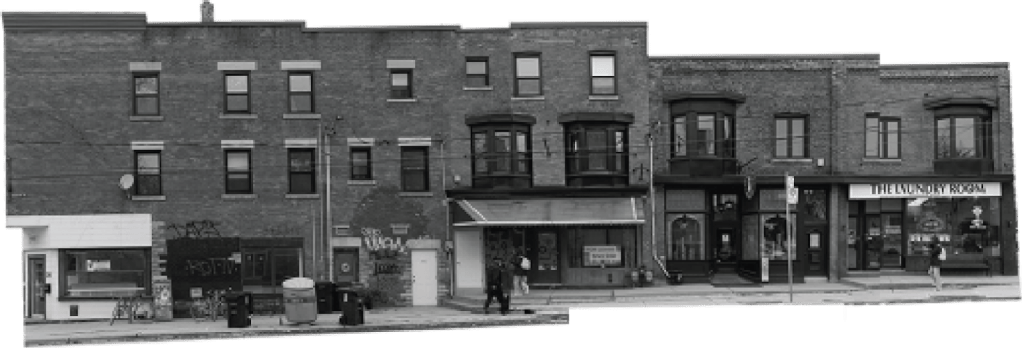
Toronto’s Harbord Street
In contrast, Barcelona’s La Rambla is structured around pedestrian presence and sustained public occupation. Organized as a wide and continuous promenade, the street allows walking, pausing, observing, and gathering to occur simultaneously within the same spatial field. Rather than separating movement from social life, La Rambla enables everyday circulation to support informal interaction through spatial generosity and overlapping functions. Social rhythms unfold along the length of the street rather than being contained within isolated pockets, allowing public life to remain embedded in everyday movement.
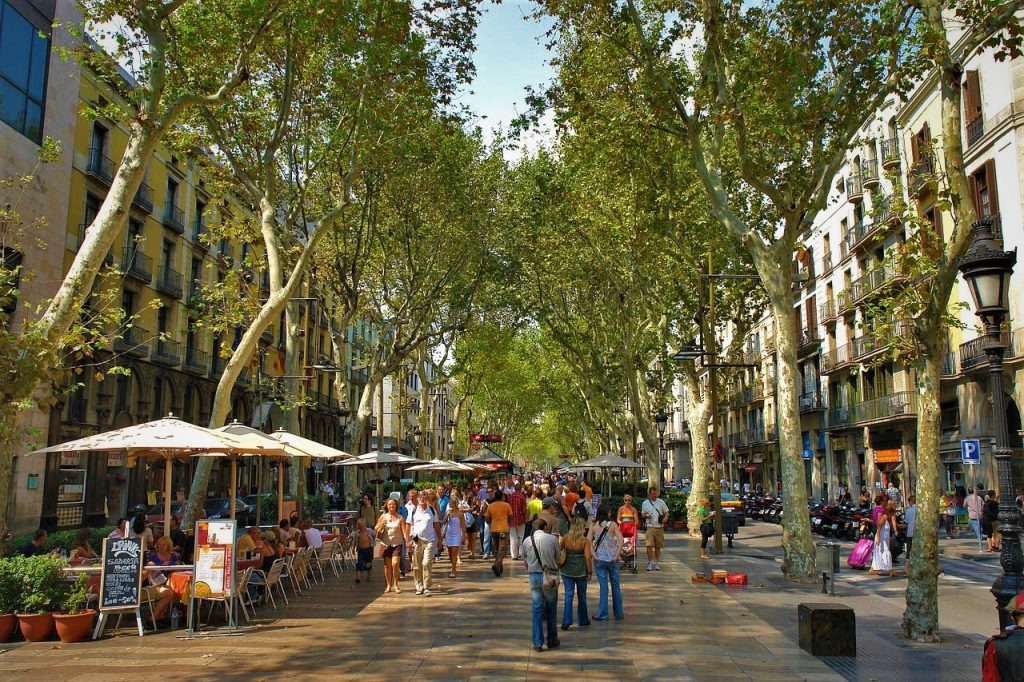
Barcelona’s La Rambla
Drawing on observations and theoretical frameworks from Jane Jacobs, Duygu Cihanger, and Christopher Alexander, this article examines how Harbord’s physical structure suppresses informal social rhythms and weakens the relationship between people and their built environment, whereas La Rambla illustrates how pedestrian priority and spatial overlap sustain public presence and social rhythm.
The sidewalk is a major part of public life, yet on Harbord Street, this foundation is thin and fractured. Narrow pedestrian paths are interrupted by trash bins and street furniture, allowing just enough space for a single person to pass through and suppressing the sidewalk’s potential as a social space. Cars are parked tightly against the curb, reinforcing isolation and preventing differing degrees of contact. These conditions leave little room for pause or interaction. Jane Jacobs’ idea of the self-appointed public character has not emerged in this community, largely due to the absence of tangible social infrastructure. While a neighbourhood’s strength is often found in its web of public respect and trust formed over time by sidewalk life, Harbord Street fails to support that life and, in doing so, hollows the street of its social structure.
On La Rambla, pedestrian space is organized as a central promenade flanked by narrower service lanes rather than as a sidewalk pressed against traffic. This sectional arrangement produces a hierarchy of movement, where faster pedestrian flows tend to occupy the central axis while slower movement and brief occupation occur closer to the edges. Rows of plane trees line the promenade, creating a shaded interior corridor that visually compresses the space and encourages reduced walking speeds. In segments such as the Rambla de Sant Josep, temporary market structures occupy the center of the promenade, forcing circulation to bend and fragment. These spatial interruptions generate moments of negotiation, where pedestrians slow, adjust their paths, and briefly share space, allowing informal encounters to emerge as part of movement itself rather than as a separate activity.
As discussed, the sidewalk on Harbord Street feels comparatively isolated even as moments of everyday life appear in motion. People walk their dogs, children pass by, and residents return home, yet the space does little to hold or support these interactions. In contrast, Bickford Park becomes noticeably more active after five in the evening when families gather, dogs run freely in the off-leash area, and children toboggan across the hill. These informal and recurring activities bring a sense of rhythm to the space shaped by the daily routines of what appears to be a predominantly working-class community. While the park is alive with activity, these uses tend to unfold in separate pockets. They exist alongside one another but rarely intersect, resulting in spatial fragmentation.
Along La Rambla, public life unfolds longitudinally rather than retreating into isolated destinations. Each segment of the street contributes a distinct social rhythm shaped by its surrounding context. Near the Rambla de Canaletes, pedestrian density increases as people arrive from Plaça de Catalunya, producing moments of gathering and orientation at the edge of the city center. Further south, the Rambla de les Flors introduces a slower tempo, where the presence of the flower market draws attention downward and laterally, creating brief pauses and congestion within the flow. At the Rambla dels Caputxins, the street becomes more porous, punctured by narrow passages into the Barri Gòtic and openings toward Plaça Reial, allowing social activity to spill sideways into courtyards and squares before returning to the promenade. These overlapping movements prevent social life from concentrating in a single zone, sustaining interaction along the entire length of the street.
The edge conditions around Bickford Park further emphasize this disconnection. On the side facing the laneway, a row of garages stands in view, appearing unused and uninviting. This creates a passive edge where the park could have opened outward into the street. While some garage doors are painted with butterfly motifs as part of a local artistic initiative, reflecting the potential for everyday formations shaped by care and identity, this expression remains cut off from the park’s activity. The laneway stays inactive, suspended between public engagement and detachment.
The edge conditions along La Rambla function as active interfaces rather than passive boundaries. To the east, the Barri Gòtic feeds into the promenade through narrow streets and short passages, releasing pedestrians in small, frequent bursts that sustain a steady rhythm of arrival. To the west, the broader streets and institutional buildings of El Raval introduce a different scale of engagement, including cultural venues and historic structures such as the Palau Güell, located just off the Rambla dels Caputxins. These contrasting edges generate continuous lateral movement across the promenade, preventing it from operating as a purely linear corridor and reinforcing its role as a shared civic surface shaped by cross traffic and exchange.
This sense of separation on Harbord Street is echoed at the entrances to Bickford Park. There is no clear framing or spatial cue to mark arrival. Parked cars crowd the edges, making entrances feel hidden and secondary. These transitional spaces, where street and park could meet, fail to invite people in or encourage lingering. What emerges is a collection of disconnected zones where daily energy flickers but struggles to form coherence. The spatial composition resists the slow accumulation of social rhythms and misses the opportunity to become a truly lived and connected environment.
Thresholds along La Rambla are articulated through gradual spatial transitions rather than singular points of entry. Changes in paving texture, tree density, building setbacks, and program signal shifts in use without interrupting the pedestrian experience. As the street moves southward, the visual field gradually opens toward the Columbus Monument and the Port Vell waterfront, reorienting movement toward the sea. This progressive widening of space allows pedestrians to slow, pause, and reconfigure their movement in response to changing surroundings. Public presence accumulates through repetition rather than spectacle, enabling lingering to occur without requiring formal gateways or designated gathering zones.
The urban fabric of Harbord Street is shaped by a logic of separation. Movement is segmented into strict lanes where cyclists occupy a marked corridor, pedestrians are confined to narrow sidewalks, and cars line the curb in a static row. These functions exist in parallel but rarely intersect. The result is a compartmentalized environment where each system operates independently rather than through overlap. The richness of everyday life, which often emerges in the messy intersections of urban systems, is flattened into rigid spatial divisions. There is no invitation for the pedestrian to cross into the rhythm of the cyclist, no threshold where a parked car meets a bench, and no point where a storefront bleeds into the public realm. Harbord Street lacks the layered spatial texture that defines a living city.
La Rambla operates as a semi-lattice in the sense described by Christopher Alexander, where multiple systems coexist and intersect within the same spatial field. Pedestrian circulation, commerce, cultural activity, and civic visibility overlap without being separated into fixed zones. Movement does not preclude occupation, and occupation does not obstruct flow. Instead, the street absorbs variation in speed, direction, and duration of stay, allowing complexity to persist without conflict. This interdependence of systems produces a layered spatial texture that supports adaptability and sustained public life.
Harbord Street has been organized as a tree where each branch is distinct, self-contained, and disconnected from the rest. In this structure, the sidewalk cannot support play, encounter, or multiplicity because its role has been fixed in advance. The spatial unit becomes a residue rather than a resource. A street built with semi-lattice logic would allow systems to bleed into one another, enabling play and encounter to occur on the margins. For example, a cyclist might pause and join sidewalk life where domestic, recreational, and civic activities coexist. On Harbord Street, this possibility is restrained. The insistence on order suppresses complexity and renders the street less human.
Multiplicity on La Rambla is sustained through repeated encounters rather than programmed events. Because the promenade is used daily by residents, workers, and visitors, individuals repeatedly cross paths over time, forming a shared sense of public familiarity. People pass through, linger briefly, or remain present without needing to declare their purpose. Movement does not erase presence, and order does not eliminate spontaneity. The street’s generous structure allows informal social life to be absorbed into everyday circulation, reinforcing La Rambla as a lived public environment rather than a controlled passage.
In conclusion, this article reveals how rigid spatial design can erode the everyday richness of urban life. When social rhythms are suppressed by compartmentalized infrastructure and the lived city is treated as an afterthought, space becomes a residue rather than a resource. Without the spontaneity of formations, the presence of public characters, or the overlap of systems, the street fails to act as a living urban fabric. To embrace the city as a semi-lattice is to recognize that true urban vitality lies in the shared and overlapping nature of everyday life. Harbord street read against La Rambla, the street’s limitations become clearer. The absence of sidewalk life is not the result of surrounding activity or population, but of spatial decisions that prevent everyday interactions from taking hold. La Rambla shows how streets become socially productive when pedestrian space is treated as a primary civic surface and when informal social life is supported through both design and governance. Together, these streets reveal how the organization of public space determines whether the street is merely passed through or genuinely lived in.
Abhinaya Gutta is a third-year Architectural Studies student in the design stream. She is the Social Media Manager for the Attaché Journal of International Affairs (2024–2026). Abhinaya is passionate about designing spaces for people, with a particular interest in how architecture supports everyday use, emotional experiences and community. Outside of school, she enjoys visiting parks and making quick sketches of scenes and trees!
References
1. Alexander, Christopher. “A City Is Not a Tree” from Architectural Forum (1965). Accessed 23 Jan. 2026.
2. Cihanger, Duygu. Spaces by People: An Urban Design Approach to Everyday Life. 16 Feb. 2018. Accessed 23 Jan. 2026.
3. Jacobs, Jane. “Author’s Introduction” and “The Uses of Sidewalks: Contact” from the Death and Life of Great American Cities (1961). Accessed 23 Jan. 2026.
4. Far, Mahmoud Dianati, and Alireza Shirmohamadi. “The Urban Environment Liveliness (Case Study: La Rambla Pedestrian, Barcelona).” December 2019. Accessed 23 Jan. 2026.
 The Attaché