
And Why It Cannot Faze Us
Luca Rampersad | Originally Published: 17 January 2026
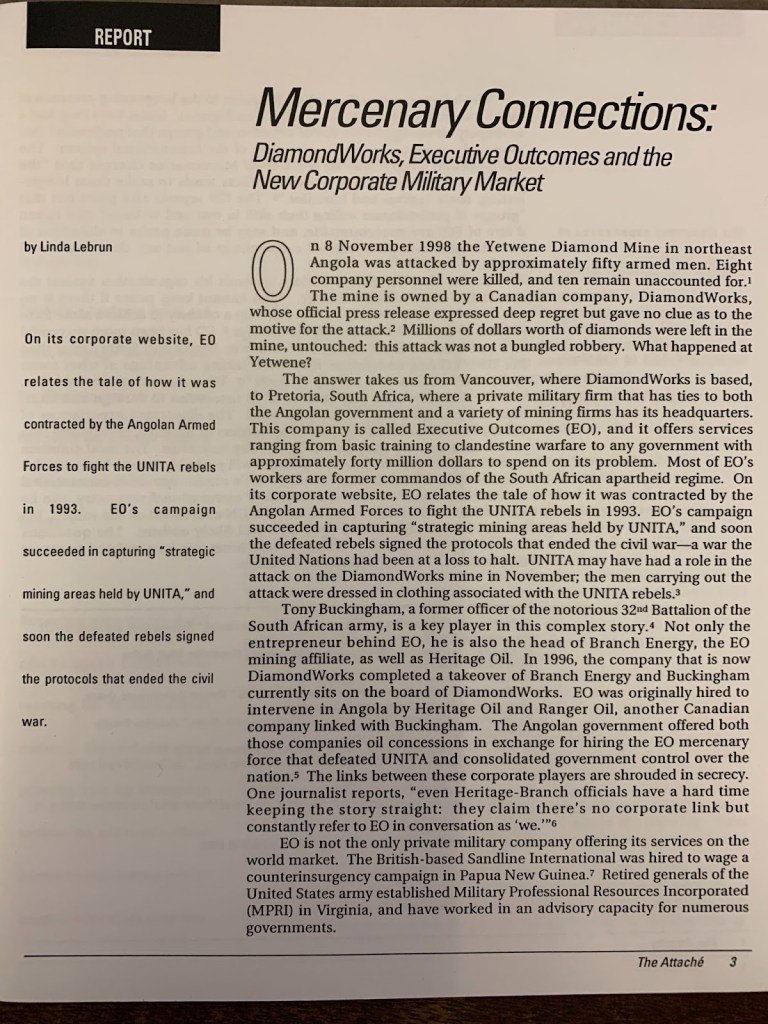
Linda Lebrun’s article in Attaché Vol.I prompted a less-than-stellar reaction from DiamondWorks, Ltd.
As we (read: I) are wont to remind our readers, The Attaché Journal of International Affairs has, by the standards of a student journal, a storied and yet understated history. Having not received an archival study to this point, we are only ever able to represent the 28 years and 24 issues of this journal through the “est. 1998” marker on our branding, and the Roman numerals on the spines of our issues (when they aren’t staple-bound, as our mid-2000s issues tended to be).
While this is not strictly a journal of history, we are often reminded—and through our publications, we seek to emphasize—that International Relations is interdisciplinary to its core, certainly inclusive of the analysis of those stories that chance or choice leaves to us. TRN151 and TRN250 veterans (I am lucky to count myself in both camps) have lived this truth. It is in the spirit of this strain of our multifaceted discipline, and in the interest of stating part of the fascinating history of our journal, that I share a story from earlier last year which illuminated a peculiar bit of trivia from our first year in print: when The Attaché was nearly sued for an article on a mining company’s use of private mercenaries. It carries, in my view, an essential insight for those who publish, and particularly those who publish diametrically opposite to power.
When I joined The Attaché as an Associate Editor in December 2022, I was only passingly aware of its long tenure as the University of Toronto’s undergraduate International Relations journal. As I quickly came to experience, The Attaché was no more immune from slow deaths, glorious revivals, and the associated undulations than any other university group. And so, when becoming its Editor-in-Chief in November 2024, I was reviving rather than retaining its legacy.
On my first day back on campus after my appointment, I travelled up to the stacks of Robarts Library, to flip through some of the only physical Attaché copies on campus (or so I thought, at that time), hoping to draw on our past to refine my vision for the future. It dawned upon me, in that moment, that 27 years in print only yielded to our academic community these brief glimpses of its belated self. Fascinating as they were, I ached to learn more.
The opportunity eventually presented itself. In late February of 2025, I received an email from one of our journal authors, who, as it happened, was also working for the IR Program at the time. She explained that, while re-organizing and archiving program files, she stumbled upon a veritable gold mine of Attaché history—not just publications, but letters, printed-out emails; the work, as she explained, of an erstwhile program staffer with, depending on your view, either an archivist’s or hoarder’s sentimentalism. As I eventually took her up on the offer to review these artifacts, those 27 unknown years felt closer than ever. There is no feeling, I have found, quite like understanding one’s place in the woven tapestry of a shared strivance.
Peculiar to me was a letter dated May of 1999. It was not from the Attaché letterhead. Rather, it was to The Attaché from an official representing Diamondworks, Ltd., a mining company with Canadian headquarters in Vancouver. The company alleges that one of the articles from our first-ever issue, entitled Mercenary Connections: DiamondWorks, Executive Outcomes, and the New Corporate Military Market, made errors that imperil the TSX-traded company’s business interests. The article in question describes alleged links between DiamondWorks, through a fully-owned subsidiary known as Branch Energy, and Executive Outcomes Ltd., a private military company based in Pretoria and staffed by apartheid-era South African commandos. The company chastised our editors for not fact-checking the article against DiamondWorks themselves, via their corporate website or by calling into their office. They called on The Attaché to issue a retraction and apologize.
I glanced again at the original piece. The claims identified by DiamondWorks were not properly cited. However, a particular citation did catch my eye: a journalist from the February 1997 issue of Harper’s Magazine wrote that, even in interviews, officials from Branch Energy would refer to Executive Outcomes with the collective “we,” while still insisting there is no link between the two corporations. This source, from an actor with no clear fiduciary interest in any of the involved companies, presents information that muddies the undoubtedly sanitized press releases from the corporate office. This, and other crucial insights into the operation of these companies, would have been lost if they had taken Diamondworks’ refutations at their word, as the corporation clearly hoped they would do.
The retraction The Attaché eventually published showed, in my view, the principled fortitude that has always characterized our journal. While, yes, acquiescing on the uncited claims, they invited our readers to continue their study of the subject by reviewing other sources, including an Economist article that states:
“Many of the South African soldiers from Executive Outcomes, the mercenary outfit that swung the war in the government’s favour, are still in the country. Now called Branch Energy, they are mining diamonds in Angola’s north-east.”
Only deeper study could reveal what, if any, external pressures shaped The Attaché board’s response at that time. The potential for further legal action, I would only imagine, loomed heavy on the minds of my predecessors. Nonetheless, The Attaché continued to present the truth to its readers, instead of lying prostrate in the face of corporate pressure. With Underwoodian flair—though, I would argue, for nobler reasons than the named antihero of House of Cards—we shook with our right hand and held a rock in our left.
The Attaché does not conduct its own journalistic investigations (yet, though I wouldn’t be surprised to hear that our Commentary Heads, Siya and Matt, have something like that planned). Nonetheless, academic journals, from those at the undergraduate level like The Attaché, to Nature and The Lancet and everything in between, contribute to the same, essential civic conversation: one of hard, unflinching truths, acquiescing nothing to the desired distortions of power.
Any publication must bear witness, not just as a contemplation upon the state of global democracy, but as a threat to the health of this civic dialogue, to the dire threats to academic and journalistic freedom becoming only more common worldwide. Just recently, President Trump threatened a billion-dollar lawsuit against the BBC for unfavourable coverage of the January 6th insurrection. Both the direct and implicit power of an imperious White House, as well as the corporate control of media companies themselves, have imposed self-censorship and systematically silenced voices that confront corporate interests and Trump’s preferred narratives. This destroys the conversation that sustains democracy. Consent manufactured, as we so often see, are facts belied.
At the end of the day, The Attaché is just an undergraduate journal. But its resolve to speak truth to an entity with exponential levels of power over it is crucial all the same. That time The Attaché nearly got sued is, as I have come to realize, far more than a piece of trivia—it is, in just a few words, a full history of The Attaché and the principles underpinning its work.
The work, dear readers, continues.
Luca Rampersad is a fourth-year International Relations and Political Science (ASIP co-op) student. He was the 27th Editor-in-Chief of the Attaché Journal of International Affairs (2024-25). He currently serves alongside Mira Zola as Co-Editor-in-Chief for the 2025-26 year. Luca is currently based in Ottawa, participating in the Parliamentary Internship for the Environment program.

The author wishes to convey his deep gratitude to Ngila Stone for facilitating access to materials crucial to the development of this piece.
References
1. Lebrun, Linda. “Mercenary Connections: DiamondWorks, Executive Outcomes, and the New Corporate Military Market.” The Attaché Journal of International Affairs 1, no. 1. Winter 1998-1999.
2. Rubin, E. “An Army of One’s Own.” Harper’s Magazine, February 1997.
3. “Behind the murk in Angola.” The Economist, 6 August, 1998.
 The Attaché