
Alisa Yudina | Originally Published: 11 March 2026
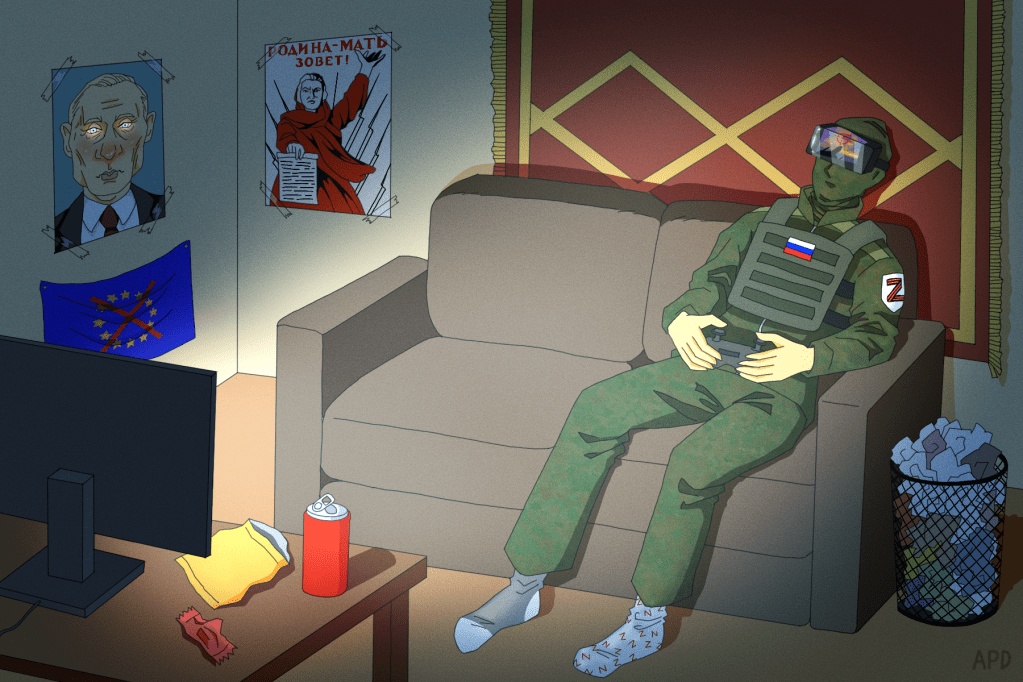
Artworks by Attaché Commentary’s Political Cartoonist, Amelia Dease
“We are not at war, but we are no longer at peace either,” said Friedrich Merz on the 29th of September, 2025, while discussing recent Russian drone attacks in the European Union (EU).
Merz’s remarks came after Russia sent drones over Poland, was caught in election interference in Moldova and Romania, and brought “the little green men” into Estonia—all signifying a new and unprecedented scale of provocation. To give it justice, Russia has always engaged in such actions—with unrecognizable planes, assassinations of Russian escapees, and election interference.
However, Russia never intervened so overtly. And Europe has never felt so vulnerable. The Russian drone attack has exposed the new nature of EU vulnerabilities – making the threat from Moscow more visible than ever.
The first new vulnerability lies in the United States’ response: “Here we go.” That was Trump’s reaction to a Russian drone strike that crossed into European airspace. His tone is dismissive, suggestive of the attack being a mistake. As revealed by Reuters, he gave a reaction that, behind the closed doors of the European Union, was called “a shrug.”
This is not an isolated moment, but perhaps the “cherry on top” of the continuous criticism of a part of the American President regarding European security. Trump’s “America First” policy has long questioned the value of NATO, and he has openly expressed skepticism towards the foundation of the post-WW2 European military strategy, including NATO’s commitment to collective self-defence (Article 5). And while officials in Washington periodically reassure European allies of American commitment to the alliance, substituting wishful thinking for national defence strategy is dangerous. The truth is: the United States has chosen to stay out of Europe’s wars before. If 2014 was when the US chose not to trigger “1914”, what’s to say it won’t choose absenteeism again, when military aggression starts not in Ukraine, but in Poland or the Baltics? For Trump and the political movement behind him, the so-called “red lines” may not be red at all.
The second vulnerability is coming from the voice within: Budapest. While Hungarian Prime Minister Viktor Orbán has condemned the drone attack, he never mentioned that the drones were Russian or attributed remarks to Russian actions specifically. Rather, his rhetoric suggested that the drone attack on Poland was a natural consequence given how “up to their neck” Poles are in supporting the Ukrainian war effort. The avoidance of attribution and shift of responsibility in Hungarian rhetoric is particularly visible in comparison with the speeches of other EU leaders: with Macron characterizing the drones as a “deliberate strategy by Russia” or Merz condemning the attack as a “completely reckless action by the Russian government.”
This discrepancy in reactions is revealing of the EU’s structural vulnerability: the European Union is not a unified military actor. While the EU has achieved considerable integration as an economic alliance with common markets, customs union, and common currency, the EU’s mutual defense clause, Article 42(7) of the Treaty on European Union, remains largely untested. The military spending within the EU is highly asymmetrical and the rhetoric heterogeneous. Without a unified chain of command and the ability to act as one, the EU’s decision-making capability remains limited and its relative power fractured: Russia has one decision-maker; The European Union has twenty-seven.
With the US stepping back and Europe tripping over their own feet, a power vacuum has appeared – and Russia is working to fill it. Moscow’s strategy operates on the following old, time-tested principles:
1) Russia’s Longstanding Practice: Divide and conquer.
Modern Russian warfare never starts with tanks. Russia begins by eroding unity. Through disinformation, cyberattacks, sabotage – from drone strikes to underwater cable cuts – it finds the weakest members and weaponizes their futility. That is how Russia operates through Donbas in Ukraine, Abkhazia in Georgia, and Transnistria in Moldova. With Europe no longer safe under the umbrella of American protection, Russia has a window of opportunity to disorient Western powers and to isolate potential allies and future victims.
With its leverage over oil supply, strategic corruption networks, and aggressive disinformation system, Russia has long hands in Europe. While it is far from securing stable public political support for its interests and lacks an attractive model for EU members to join, what Russia offers best is survival in exchange for collaboration. This prompted the start of what the Institute of War denounced as the “Phase 0” in Europe, a psychological and ideological destabilization of the state in preparation for Russian advancement.
2) The Kremlin’s Textbook Geopolitics: The best defense is offense.
Russia, at its core, is an insecure actor with a superiority complex. It’s militarily exhausted, economically isolated, with no domestic policy – but that acts as a catalyst to engage “Phase 0,” not a deterrent. Lying in the lowlands, Russia is vulnerable to invasion, and it seeks geographical borders through conquest. Understanding its vulnerability and the grievances against it, Russia is eager to demonstrate power as a way to protect itself.
To start an offensive, a country doesn’t need to be strong – it just needs a relative advantage. And Russia does indeed have that – in centralized power, experienced army, a strong ideological narrative, and an economy wired for expansionist wars. Europe has none of that.
Yet, it would be unfair to portray Europe as helpless. The Russian full-scale invasion of Ukraine forced Europe to move toward reducing its dependence on Russian oil and gas, and seeking consensus in military aid provisions. Now, the EU is working on the Drone Wall to deter potential Russian aggression, slowly but surely furthering its collective military security. The European Union has also been adapting to Trump’s presidency, addressing the challenges posed by tariffs, and finding diplomatic intermediaries between Europe and the United States. Moreover, pursuant to the US Constitution, Trump cannot remain in the White House indefinitely, so better days for European security guarantees may yet lie ahead.
However, these facts do not offset the risks outlined above. It is one thing to consolidate support for Ukraine from a relative distance. But, it is a completely different challenge to find unity under direct attack, military or psychological. As for the US, even if Trump is replaced, his legacy in the shift toward greater isolationism and “America First” policy is unlikely to disappear. In any case, to keep up with the changes in the global order, Europe has to reinvent itself: politically, diplomatically, and militarily.
References
1. BBC. 2025. ‘What’s with Russia violating Polish airspace?’ – Trump reacts to Moscow drone incursion on Nato ally. 09 09. Accessed 03 05, 2026. https://www.bbc.com/news/live/c2enwk1l9e1t.
2. Clapp, Sebastian. 2025. Eastern Flank Watch and European Drone Wall. 10. Accessed 03 05, 2026. https://www.europarl.europa.eu/RegData/etudes/ATAG/2025/777962/EPRS_ATA%282025%29777962_EN.pdf.
3. Gavin, Gabriel. 2024. Azerbaijan Isn’t Reexporting Russian Gas to EU, Brussels Insists. 25 11. Accessed 03 05, 2026. https://www.politico.eu/article/azerbaijan-isnt-re-exporting-russian-gas-to-eu-brussels-insists/.
4. Institute for the Study of War. 2025. Russian Phase Zero Operations in Europe, Date Range: September 9, 2025 to November 29, 2025. 29 11. Accessed 03 05, 2026. https://understandingwar.org/map/russian-phase-zero-operations-in-europe-november-29-2025/.
5. Ivanna, Kostina, and Protz Anastasia. 2025. Hungarian PM says Russian drones entered Poland because Poles are “up to their necks in war. 12 September. Accessed 03 05, 2026. https://www.pravda.com.ua/eng/news/2025/09/12/7530550/.
6. Kelemen, Daniel, and Kathleen McNamara. 2021. State-building and the European Union: Markets, War, and Europe’s Uneven Political Development. 15 10. Accessed 03 05, 2026. https://journals.sagepub.com/doi/10.1177/00104140211047393.
7. Le Monde. 2025. France summons Russian ambassador after ‘unacceptable’ Poland drone raid . 12 09. Accessed 03 05, 2026. https://www.lemonde.fr/en/russia/article/2025/09/12/france-summons-russian-ambassador-after-unacceptable-poland-drone-raid_6745323_140.html.
8. Lunday, Chris, Jake Traylor, and Laura Kayali. 2025. Trump casts doubt on Article 5 commitment en route to NATO summit. 24 06. Accessed 03 05, 2026. https://www.politico.eu/article/donald-trump-nato-summit-sidesteps-article-5-mark-rutte-eu-defense-budget-russia-vladimir-putin-iran-israel-strikes-qatar/.
9. Nostlinger, Netter. 2025. Germany’s Merz says Putin deliberately targeted NATO . 10 09. Accessed 03 05, 2026. https://www.politico.eu/article/germany-friedrich-merz-kremlin-nato-russia-drones-poland-defense/.
10. Rainsford, Sarah, and Paul Kirby. 2025. Moldova’s pro-EU party wins vote mired in claims of Russian interference. 29 09. Accessed 03 05, 2026. https://www.bbc.com/news/articles/cx2rdlj8ejgo.
11. Reuters. 2025. Europe ‘no longer at peace’ with Russia, says Germany’s Merz . 29 September. Accessed 03 05, 2026. https://www.reuters.com/world/europe-no-longer-peace-with-russia-says-germanys-merz-2025-09-29/.
12. Sario, Federica Di. 2026. The EU Wanted Stability. Trump’s Tariff Fallout Brings Fresh Uncertainty. 27 February. Accessed 03 05, 2026. https://www.theparliamentmagazine.eu/news/article/the-eu-wanted-stability-trumps-tariff-fallout-brings-fresh-uncertainty.
13. Stewart, Briar. 2025. Poland says it found 14 Russian drones on its territory. Just how will NATO respond? 10 09. Accessed 03 05, 2026. https://www.cbc.ca/news/world/poland-nato-1.7630155.
14. Strategic Compass. 2022. ARTICLE 42(7) TEU THE EU’S MUTUAL ASSISTANCE CLAUSE. 10. Accessed 03 05, 2026. https://www.eeas.europa.eu/sites/default/files/documents/Article%2042%287%29%20TEU%20-The%20EU%27s%20mutual%20assistance%20clause.pdf.
15. The European Commission. 2025. EU agrees to permanently stop Russian gas imports and phase out Russian oil. 02 12. Accessed 03 05, 2026. https://ec.europa.eu/commission/presscorner/detail/en/ip_25_2860.
16. The Moscow Times. 2025. Drone Incursion Into Romania a Ukrainian ‘Provocation,’ Moscow Claims. 15 09. Accessed 03 05, 2026. https://www.themoscowtimes.com/2025/09/15/drone-incursion-into-romania-a-ukrainian-provocation-moscow-claims-a90523.
17. The White House. 2025. National Security Strategy of the United States of America. 11. Accessed 03 05, 2026. https://www.whitehouse.gov/wp-content/uploads/2025/12/2025-National-Security-Strategy.pdf.Zadorozhnyy, Tim. 2025. Estonia spots Russian troops without insignia near border — officials say ‘not a new tactic’.13 10. Accessed 03 05, 20. https://kyivindependent.com/estonia-spots-russian-little-green-men-near-border-officials-say-not-a-new-tactic/.
 The Attaché