
Diego Moura Panario | Originally Published: 23 November 2025
Building out a rail corridor from Basrah, Iraq to multiple ports in Turkey would shorten the journey for trade from Asia and the Gulf states to Europe, decreasing transportation costs and creating redundancy in trade. At the cost of US$250M, the project is worth it because of its various benefits to most parts of Turkish society. This project would create high-paying jobs in the poorest areas of Turkey, increase Turkey’s regional dominance, and bring in foreign reserves through rail transport and port fees.
Over-Dependence on the Suez Canal
The Suez Canal currently facilitates 12% of all global trade, representing over $US 1 trillion. Over the last few years, this trade route has become more precarious. Since the beginning of Israel’s genocide in Gaza, the Houthis in Yemen have maintained a naval blockade of the Red Sea, attacking 160 ships in the first 5 months of the crisis. This blockade has forced many vessels to deviate and circumvent the Cape of Good Hope, increasing shipping time by 10 to 15 days. Further, in 2021, the pandemic, a ship got stuck in the Suez Canal for 6 days, leading to massive trade disruptions worldwide. The Suez Canal is such an important trade artery that any disruption can lead to issues around the world. With worsening climate change, more ships will likely become obstructed in the canal, making alternative trade routes increasingly important.
As a result, building the Iraqi-Turkish trade corridor is tremendously important. It would produce an alternate route which would lessen the dependence on the Suez Canal and any future disruptions. But, this trade corridor wouldn’t only increase redundancy, it would also lower the shipping times between East Asia and the Gulf to the European Union.
What is the Iraqi-Turkish Trade Corridor?
The Iraqi-Turkish Trade Corridor is a proposed development project which would build freight rail, highway, and oil pipelines from Iraq’s southern coast near Basrah to the northwest of the country, connecting to Turkey’s existing infrastructure to transport goods across the country towards Europe. The major hiccup at the moment is the lack of movement by the Turkish government in building the necessary infrastructure to connect to what is being built in Iraq.
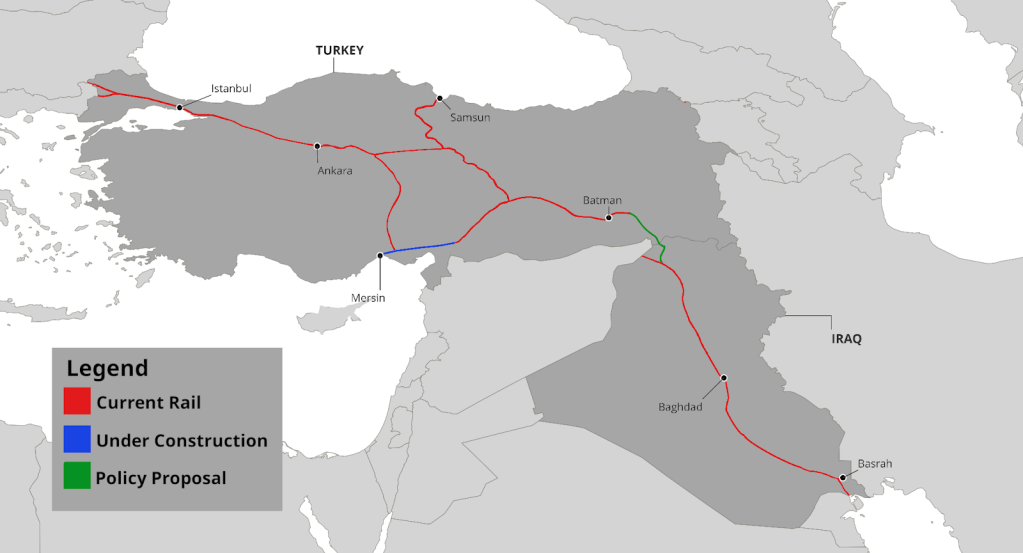
Map of Current and Future Rail Construction + Policy Proposal
The current duration for freight to arrive by sea from Shenzhen, China (the 4th largest port in the world by volume) to the port of Piraeus, Greece (the first EU port after the Suez Canal) through the canal is around 40 days. If this trade instead were to be loaded on freight trains in Basrah, Iraq, and then transported across Iraq and Turkey to the port of Mersin and shipped to Piraeus, this trip could be reduced by 20 days. This would cut the trip in half, meaning a large portion of the US$1 trillion in trade that passes the Suez Canal could be captured by this project. But for such a project to be viable, Turkey needs to construct additional freight infrastructure across the southeast of the country.
Benefits of the Iraqi-Turkish Trade Corridor:
This project would be beneficial to Turkey in multiple ways. For the general public, an increase in infrastructure spending from the government would increase jobs immediately, as well as future high paying jobs in maintenance and rail operations in one of the poorest regions of the country. It would help disperse economic activity more equally across the country, circumventing Istanbul and the Northern Mediterranean coast. For the private sector, there will be large construction contracts. While for the government, this project would have various benefits domestically, internationally, and economically. On the domestic part, it would improve the development inequality by creating higher-paid jobs in the East and Southeast. Internationally, it would increase the European Union’s dependence on Turkey for a larger part of its trade. As well as improving relations with Iraq and increasing Turkish regional dominance in the Middle East. With the recent disarmament of the PKK, this infrastructure build-up could benefit the Kurdish-majority regions of Turkey and better integrate them into the rest of the economy. With a few upgrades to oil pipelines, more oil and liquified natural gas (LNG) could also be exported from Gulf petrostates to the EU. Economically, having this trade pass through Turkey will give the government additional revenue through the fees charged for the transportation of goods and the use of Turkish ports.
Benefits for Turkish Government:
- Increased revenue (Port Fees, Transportation fees)
- Increased Turkish-EU integration and trade
- Increased development in the poorest provinces
- Increase Turkey’s sphere of influence in Iraq
Benefits for Turkish Private Sector:
- Large infrastructure projects
- Long-term transportation contracts
- Possibility for Iraqi infrastructure construction contracts
Benefits for Workers:
- High-paying jobs in construction
- Increased economic activity and the poorest provinces
As the map above demonstrates, this alternative trade route would save 20 days on cargo shipping times between China and the EU. Freight shipping from Shengzen to Piraeus currently takes around 40 days. If instead this freight was shipped to Basrah, where it would be loaded on trains to Mersin and then shipped by sea to the Port of Piraeus, it would take half the time when accounting for the additional loading and unloading time. As the Suez Canal blockage during the pandemic demonstrates, having alternative routes for global shipping is critical to maintain lower prices and stability in international trade.
Even at a cost of US$250 million, the project is still worth it. This route cuts transportation time in half and increases reliability. This project is very likely to receive European Union and Development Bank grants and subsidized financing due to its importance to global trade. If the project were able to take only 10% of the current freight traffic through the Suez Canal, this project would generate US$137 million a year.
Recommendations for Building the Trade Corridor:
Turkey already has an extensive freight rail network, meaning a few new rail segments plus upgrading existing infrastructure would open up a very valuable trade corridor.
New Rail Segment: Build a Rail connection from the Iraq border at the Ibrahim Khalil border crossing to Batman
Optional Upgrade Existing Rail Infrastructure: Building up the rail infrastructure from Batman to Ankara and Mersin to allow for larger freight rail
The cost of US$250 million was calculated based on the Bursa-Osmaneli project, which has a similar terrain. That project has an actualized cost of US$1 million per kilometre of rail. The distance from the Iraqi border to Batman is 217km. The costs were adjusted to account for the additional complications with mountains in South Eastern Turkey.
With 3.78 million containers passing through the Suez Canal every year, if 10% of trade passed through the Port of Mersin, that would equal US$109 million solely from port fees of US$289 per container. Another US$30 million from transporting cargo and leasing the tracks for transporting the cargo. For a Total of US$137 million per year. This project would be more constrained by the capacity of the infrastructure than by demand. Even with a small adoption this project would become profitable in under 5 years.
These upgrades would allow shipping freight by rail from Basrah, Iraq, to the Port of Mersin in the Mediterranean, the Port of Samsun in the Black Sea, or across the whole country into Bulgaria or Greece. The new delivery times would be 13 days to Mersin, 14 days to Samsun, 15 days to the Bulgarian or Greek borders and 20 days to Athens from China, cutting all these trips by half.
References
1. “Turkish railway construction update,” Eurasia Rai, accessed November 17, 2025, https://eurasiarail.eu/en/market-insights/turkish-railway-construction-update
2. “Global Oil Infrastructure Tracker,” Global Energy Monitor, accessed November 17, 2025, https://globalenergymonitor.org/projects/global-oil-infrastructure-tracker/tracker-map/
3. “Shipping from China to Greece,” Basenton, accessed November 17, 2025, https://www.basenton.com/shipping-from-china-to-greece/
4. “How Long does it take to Ship from China to Iraq,” Basenton, accessed November 17, https://www.basenton.com/how-long-does-it-take-to-ship-from-china-to-iraq/
5. “Open Railway Map,” Open Railway Map, accessed November 17, https://www.openrailwaymap.org/
 The Attaché