
Jena Wouako | Originally Published: 28 February 2026
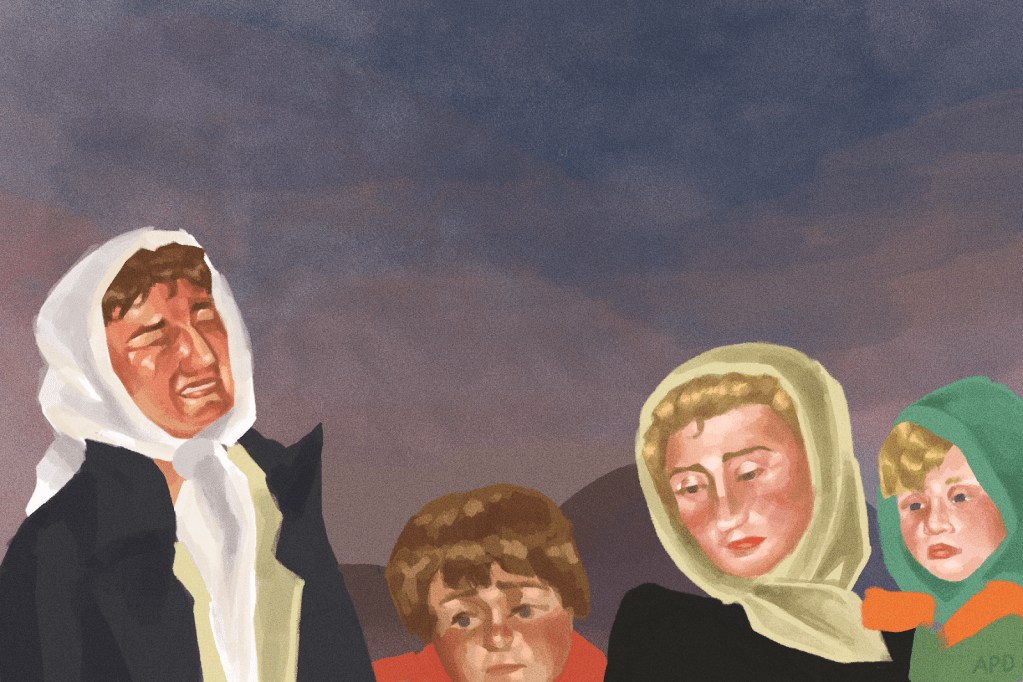
Artwork by Attaché Commentary’s Political Cartoonist, Amelia Dease
After the horrors seen in the Yugoslav Wars and the Rwandan Genocide, sexual violence became officially classified as a crime against humanity by the International Criminal Court (ICC) in 2002. Despite this being an advancement for international feminist legislation, colonial schools of thought cast a shadow on the prosecution process. Nicola Henry dissects issues within the legal and social reactions to wartime rape in her article, “The Fixation on Wartime Rape: Feminist Critique and International Criminal Law.” While she offers a detailed analysis of the subject matter, her investigation remains incomplete in its disregard for racial politics. In this article, I will expand on Henry’s arguments against the notion of the “over-recognition” of wartime rape to argue that victimization is dependent on the racial identities of those involved. This will be done by contextualizing and affirming the colonial roots behind contemporary inconsistencies seen in the occurrence, recognition and prosecution process of both female and male victims of wartime sexual violence.
Turning first to an analysis of the inconsistent victimization of female wartime rape victims, Henry does, in part, acknowledge its factuality. She discusses arguments made that the sensationalization of wartime rape has lead to the infantilization of female victims and the erasure of victims of other wartime crimes. Though Henry then counters that in courts’ disregard for diversity in victimization, it can be argued that the subject, even when regarding women, is instead under-recognized. The intersection of misogyny and class is exemplified to illustrate her point, as lower-class and rural women face higher risks of sexual violence in times of conflict.
Ironically, in discussing diversity, Henry fails to address a critical intersection with race. Despite the prevelence of sexual violence against racialized women, the recognition they receive is highly dependent on the racial identity of their attacker. The ICC has long been accused of racist targeting, and this accusation is substantiated by the ICC’s published court documents. These documents reveal that since the International Criminal Tribunal for the Former Yugoslavia (ICTY) and the International Tribunal for Rwanda (ICTR), every arrest warrant made alleging sexual violence has been towards African or Middle Eastern leaders. Thereby, the ICC has been proven to care for racialized victims only when the violence is intra-racial, specifically within racialized communities. At the hands of white attackers, racialized women are not offered the same empathy.
As stated by Kali Nicole Gross, this reduced empathy stems from colonial interpretations of racialized femininity; as innocence and sexual purity was reserved for white women, animalistic hypersexuality associated with racialized women justified and delegitimized any harm caused when suffering sexual violence. Importantly, this hypersexuality takes place concurrently with infantilization in contemporary international courts. Henry disagrees with claims that rape trials represent victims as powerless and lacking agency, rather stating that any form of exposure can be used as a tool for resistance. However, Henry’s argument is invalidated when considering the initial claim’s unique application to racialized women. Makua Matua explains that portrayals of supposed helplessness function to reinforce a paternalistic white saviour narrative in which racialized women desperately need saving from their violent racialized oppressors.This very narrative further undermines efforts to acquire justice when assaulted by their supposed saviours, white men.
This is illustrated in the ICC’s arrest warrants made against Mohammed Deif, Yoav Gallant and Benjamin Netanyahu due to their involvement in the ongoing Gaza Genocide. While all were respectively accused of war crimes and crimes against humanity, only Deif, the sole racialized defendant, was charged with sexual violence. The leaders of Israel’s government escaped this charge despite reports of IDF soldiers sexually abusing both Palestinian civilians and incarcerated Palestinians (UNHRC 2025; The Guardian 2026). This selective nature of sexual violence charges demonstrates that access to justice for racialized victims is dependent on the racial identity of the perpetrator. By ignoring these facts, Henry fails to acknowledge critical colonial influences on victim recognition by international courts.
Turning now to racial stereotypes, which significantly contributes to the occurrence and stigma surrounding male rape. In regards to allegations that a hyper-fixation on female rape victims has overshadowed the plights of male victims, Henry states this “obscures the role that colonialism, capitalism and sexism play in the perpetration of these crimes”. While she recurringly mentions class and gender oppression, Henry herself obscures the role colonialism, and the resulting racial politics play in the perpetuations of wartime sexual violence.
Male-on-male rape is a particular form of harm, weaponizing the victim’s relationship with manhood to further humiliate them. Specifically when racialized men experience this attack, they more often conceal it out of shame and fear of social stigma. White perpetrators exploit this fact, as well as the unique positionality of racialized men to evade consequences for their crimes. Similarly to racialized women, racialized men faced accusations of hypersexuality in colonial times. In an attempt to establish them as inherent threats, colonial powers characterized racialized men as hyper-masculine, animalistic and sexually perverted. As asserted by Elise Feron in her article “Wartime Sexual Violence Against Men,” this depiction functioned to reinforce the aforementioned white saviour narrative, by classifying them solely in the role of the aggressor and never the victim.
Henry uses the conviction of Dusko Tadic during the ICTY to argue against the under-recognition of male victims. However, it is important to acknowledge that the victims and offenders in question were white. The case of Abu Ghraib better showcases the reality of the biased prosecution process. Iraqi prisoners at the Abu Ghraib prison faced torture at the hands of American military and intelligence officers, including rape and sexual humiliation rituals. The American troops preyed on the stereotypes applied to Arab men, knowing that they were perceived as patriarchal rapists themselves; having them undergo sexual violence would only ever be seen as retributive justice. This strategy, alongside pre-established global power inequalities, allowed the perpetrators and commanding officers to never stand trial in an international court. Moreover, Henry claims that attention to female victims will open possibilities for men to also acquire justice; however, this is a simplistic understanding and does not account the ideological structures which permits the initial occurrence of male rape. Through neglecting racial politics, Henry weakens her thesis on the supposed equitability of wartime sexual violence prosecutions. Rather, inconsistent access to justice confirms a hyper-fixation exists, though heavily influenced by the residues and intersections of colonial racial, gendered and state hierarchies.
In conclusion, the prosecution of wartime rape remains flawed. While Nicola Henry offers arguments for and against international courts, her “over-recognition” analysis is incomplete without the acknowledgement of race in the victimisation of sexual assault survivors. Therefore, I have argued, through an illustration of the unique struggles faced by racialized male and female victims, that rape recognition is dependent on racial identification and stereotyping. Specifically, that wartime sexual violence and its subsequent social and legal reactions have underlying racial dynamics embedded into them; which cannot be overlooked.
References
1. Feron, Elise. “Wartime Sexual Violence Against Men: Why So Oblivious?” European Review of International Studies, vol. 4, no. 1 (2017): 60-74.
2. Gross, Kali Nicole. “African American Women, Mass Incarceration, And the Politics of Protection” The Journal of American History, vol. 102, no. 1 (2015): 25-33.
3. Henry, Nicola. “The Fixation on Wartime Rape: Feminist Critique and International Criminal Law” Social and Legal Studies, vol. 23, no. 1 (2014): 93-111.
4. International Criminal Court. “Defendants.” accessed February 23 2026.
5. ““More Than A Human Can Bear”:Israel’s Systemic Use of Sexual, Reproductive and Other Forms of Gender-Based Violence Since October 2023” UNHRC, March 13 2025. https://www.ohchr.org/en/press-releases/2025/03/more-human-can-bear-israels-systematic-use-sexual-reproductive-and-other
6. Mutua, Makau. “Savage, Victims, and Saviors: The Metaphor of Human Rights” Harvard International Journal, vol. 42, no. 1 (2001): 201-246.
7. Tondo, Lorenzo. “Dozens of Palestinian Journalist Beaten, Starved or Raped, Report Alleges.” The Guardian, February 19, 2026. https://www.theguardian.com/world/2026/feb/19/dozens-of-palestinian-journalists-beaten-starved-or-raped-report-alleges
 The Attaché