
Layan Alothaimeen | Originally Published: 4 April 2026
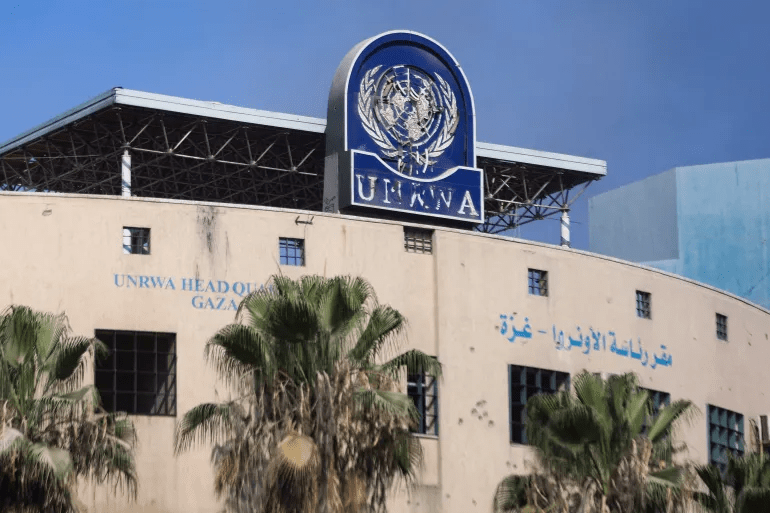
A damaged UNRWA sign at the organisation’s headquarters after an Israeli raid in Gaza City (Source: Dawoud Abu Alkas/Reuters via Al Jazeera)
The UN Relief and Works Agency for Palestinian Refugees in the Near East (UNRWA) has been under fire by Israel in efforts to dismantle and discredit the institution. In late 2024, the Israeli Knesset passed legislation to ban UNRWA from operating in the West Bank, East Jerusalem, and Gaza. To justify this move, the Knesset relied on accusations that some UNRWA staff members were directly involved in the Hamas strikes on October 7th, 2023. Accordingly, as revealed by Oruc Haydar, since October 7, Israel has attacked UNRWA facilities in Gaza 141 times, killing 152 of its staff. The Israeli government and policymakers have positioned the October 7 attacks as the reason for their opposition to UNRWA, but many critics and Palestinian scholars connect the Israeli opposition to a deeper issue surrounding Palestinian refugees and refugee status. This criticism is rooted in the fact that UNRWA is not only responsible for providing aid and services for Palestinian refugees, but it is also responsible for keeping a record of refugees and their descendants through the refugee status. This article argues that the motivations behind banning UNRWA stem from deeper structural concerns. Specifically, UNRWA plays a central role in preserving the legal and political status of Palestinian refugees through the intergenerational transmission of refugee status. At the same time, Israel seeks to undermine and ultimately erase the Palestinian right of return. Dismantling UNRWA would shift responsibility onto host countries, effectively removing the refugee issue from Israel’s political and legal obligations.
For some background, UNRWA is a UN mandate that was created on December 8, 1949, after the Nakba in 1948, where 700,000 Palestinians were displaced. UNRWA was established to support Palestinian refugees with relief in the Occupied West Bank, East Jerusalem, the Gaza Strip, Syria, Lebanon and Jordan. Currently, UNRWA serves six million Palestinian refugees as a state-like entity by providing social services that Palestinian refugees depend on. During periods of conflict in the region, UNRWA provides humanitarian aid to Palestinians. According to Al Jazeera, “Since Israel launched its war on Gaza on October 7, approximately a million Palestinians from Gaza, or nearly 45 percent of the enclave’s population, have been sheltering in UNRWA schools, clinics and other public buildings.”
Looking more closely at UNRWA’s most recent budget (2024-2025), 2,219,261 US dollars were required to maintain the mandate’s activities, with education, health, and the Relief & Social Services programmes needing the most funding respectively. As per 2023 data, UNRWA has a total of 61 refugee camps that operate across the regions, 169 schools and 25 health care centers. Through UNRWA services, the mandate can be seen as acting as a government-in-exile, especially between 1948 and 1964, a period when Palestine was essentially removed from the map, the Palestinian Liberation Organization did not exist, and Palestinians living in Gaza and the West Bank were governed by Egypt and Jordan, respectively. Essentially, UNRWA was their only Palestinian-focused source of welfare and assistance.
An archive with the record of Palestinian refugees since 1948 is also an important mechanism that UNRWA operates to keep the Palestinian identity alive for refugees. Maintaining this refugee archive helps Palestinians have evidence to appeal to Article 194 of the UN Charter, the right of return for refugees. The archives also document atrocities against Palestinians, which are important to international law. For example, the International Court of Justice used UNRWA documentation as evidence in the ongoing case alleging that Israel is committing genocide in Gaza.
Despite Israeli attempts to dismantle UNRWA, the agency keeps Palestinian identity alive in other ways. UNRWA is a unique UN mandate as it deals solely with Palestinian refugees, outside of the UN Refugee Agency, and it defends a multigenerational refugee status. As explained by Yasmeen Abu-Laban, their multigenerational definition expands on what it means to be a Palestinian refugee, as opposed to the UNHCR definition that focuses on the individual. A measurable impact of this is the number of Palestinian refugees. Given the UNRWA definition of refugee, the number of Palestinian refugees today is 6 million, which includes people who were not born in occupied Palestine or the state of Israel. Despite UNRWA not being directly engaged “in the political nature of the refugee issue”, it is not an inherently apolitical institution as it upholds Palestinian identity with this refugee status.
The UNRWA’s role in maintaining the refugee status and the importance of this status to upholding the Palestinian identity stand in opposition to Israeli efforts to deny the existence of a Palestinian identity. Up until the 1993 Oslo Accords, Israel did not recognize the Palestinian people or any representation, but it recognized the PLO as the only representation of the Palestinian people. However, this did not mean sovereignty for the PLO in historically Palestinian land nor control over roads or borders in the West Bank or Gaza Strip. What it essentially meant was that Palestinians would get some form of formal recognition, but no sovereignty over their own people, land, and, ultimately, their identity. In short, Israel still denies the Palestinian people their identity as they are still confined to Israeli control.
To further minimize the existence of a Palestinian people, Israel denies Palestinian refugees rights, as it has repeatedly attempted to dismantle UNRWA without providing an alternative. Some critics of UNRWA argue that the agency further perpetuates the refugee crisis as it does not allow for the resettlement of Palestinians in host countries and keeps them as refugees through multigenerational refugee status. UNRWA responds to this criticism by stating that the mandate is not responsible for solving the issue of the refugees but is in charge of providing relief to Palestinian refugees. The fact that the agency’s mandate is still being renewed by the UN displays the failure of the international community in solving the refugee problem.
The dismantling of UNRWA would not solve the refugee crisis but would cause further instability for Palestinians. It is clear that Israel is attempting to cause such instability, as the state has made numerous attempts to undermine UNRWA without providing an alternative or discussing the consequences of doing so. UNRWA was not able to operate in Israeli borders until Israel occupied Gaza, the West Bank and East Jerusalem; then Israel allowed UNRWA to function as they did not want to be legally obligated to provide these services. Einat Wilf, a former member of the Israeli Knesset, summed up Israeli sentiment against UNRWA, as she stated that because all the staff are Palestinian, UNRWA is a breeding ground for Palestinian nationalism. As stated in an article by Riley Sparkset, Einat Wilf positioned Palestinian nationalism as involving the destruction of the Israeli state. Given the lack of an alternative to UNRWA, “Palestinians see any weakening of UNRWA as a weakening of their rights.”
Another element of the Israeli campaign to undermine Palestinian identity is that it has pressured host countries to absorb Palestinian refugees in an effort to avoid the international legal requirement of the right to return. As per UN Resolution 194, refugees have the right to return. However, the potential return of Palestinian refugees is seen as a threatening disruption to the Israeli state, as it would hinder the establishment of a Jewish majority in Israel. As explained by Michael Kagan, Israel also does not want disruption to Israeli property rights, “and fear of socio-political disruption as a justification to avoid full or partial implementation of the right of return.”Palestinians see it as their right through international law, but Israelis see it as an infringement of their rights and stability.
According to Haydar Oruç, “Israel claims that the right of return is no longer possible because it has systematically settled Jewish occupiers (settlers) in the Palestinian territories it occupies.” This is why Israel wants to dissolve UNRWA altogether, as then Palestinians will not have claims to return according to international law, making it “legally” possible for Arab states to integrate Palestinians into their societies. According to Tianshei Chen, Israel has called on Palestinian refugees to stay in the countries in which they are currently residing. However, Arab states and Palestinians assert that removing the right to return negates the ability for Palestinians to create a state and denies their connection to the Palestinian identity. Not only has Israel steered away from refugees in 2024, but it also did so during the Madrid conference in 1991 and the Oslo Accords in 1993. Israel’s actions suggest it wishes to eliminate the Palestinian refugee question altogether by denying the right of return rather than facilitating the return of displaced Palestinians.
To conclude, Israel has displayed from its actions that UNRWA is seen as a threat to its state as it upholds the Palestinian right to return. The issue of the refugees is a core part of the Palestinian cause, and UNRWA is a key institution that keeps this issue relevant to Israel and the international community. UNRWA is not responsible for solving the refugee issue; it is mandated to serve Palestinian refugees through relief efforts; consequently, Israeli actions against UNRWA are also an attack on Palestinian rights. For the 6 million Palestinians registered with UNRWA, the organization is one of their only means of survival and stability. Israel wants to eliminate the issue of the refugees, as it is not willing to provide for refugees and does not want disruption to their state structure or economy. This is why Israel tries to connect its actions to dismantle UNRWA to more surface-level allegations, such as involvement in the October 7 attacks. In reality, Israel has never wanted to solve the refugee issue but rather wants to get rid of it. Simply put, Israel would rather destroy UNRWA to get rid of the Palestinian issue quickly than engage in diplomacy to solve the core issue here, which is the fate of the Palestinian refugees.
References
1. Abu-Laban, Yasmeen. “Chapter 22: Re-defining the International Refugee Regime: UNHCR, UNRWA, and the Challenge of Multigenerational Protracted Refugee Situations.” In Research Handbook on the Law and Politics of Migration. Cheltenham, UK: Edward Elgar Publishing, 2021. https://doi.org/10.4337/9781789902266.00034.
2. Al Jazeera. “Israel’s Parliament Votes to Ban UNRWA, the UN’s Palestine Aid Agency,” October 28, 2024. https://www.aljazeera.com/news/2024/10/28/israel-parliament-approves-bill-to-ban-unrwa.
3. Al Jazeera. “What Is UNRWA and Why Is It Important for Palestinians?” February 1, 2024. https://www.aljazeera.com/news/2024/2/1/what-is-unrwa-and-why-it-is-important-for-palstinian.
4. Chen, Tianshe. “Palestinian Refugees in Arab Countries and Their Impacts.” Journal of Middle Eastern and Islamic Studies (in Asia) 3, no. 3 (2009): 42–56. https://doi.org/10.1080/19370679.2009.12023136.
5. Human Rights Watch. “Gaza: US, UK Outliers in Holding Back UNRWA Funding.” July 23, 2024. https://www.hrw.org/news/2024/07/18/gaza-us-uk-outliers-holding-back-unrwa-funding.
6. Irfan, A. “UNRWA and the Palestinian Precedent: Lessons from the International Response to the Palestinian Refugee Crisis.” Global Politics Review 3, no. 1 (2017): 10–24.
7. Israel Policy Forum. “Understanding Israel’s New Anti-UNRWA Laws.” July 8, 2025. https://israelpolicyforum.org/anti-unrwa-laws/.
8. Kagan, Michael. “Do Israeli Rights Conflict with the Palestinian Right of Return? Identifying the Possible Legal Arguments.” Zochrot, July 2005. https://www.zochrot.org/publication_articles/view/52360/en.
9. Khoury, Nadim. “Israel and Palestinian Peoplehood: The Power to Eliminate and the Power to Constitute.” Confluences Méditerranée 2021/2, no. 117 (2021): 61–71. https://doi.org/10.3917/e.come.117.0063.
10. Lahav, Gallya. “UNRWA, UNHCR, and the Politicization of Refugee Protections: Re-Evaluating a Humanitarian International Refugee Regime in the 21st Century.” Democracy and Security (2026): 1–31. https://doi.org/10.1080/17419166.2026.2624388.
11. McCann, Paul. “The Role of UNRWA and the Palestine Refugees.” United Nations, April 15, 2009. https://www.un.org/unispal/document/auto-insert-214224/.
12. Miller, Elhanan. “Israel’s UNRWA Dilemma: Who Else Will Provide Aid to the Palestinians?” The Jewish Independent, March 21, 2024. https://thejewishindependent.com.au/israels-unrwa-dilemma-who-else-will-provide-aid-to-the-palestinians.
13. Oruç, Haydar. “Israel’s Efforts to Discredit UNRWA.” 2024.
14. Sparks, Riley, Hajar Harb, and Omar Nabil Abdel Hamid. “Gaza In-Depth: Why Israel Wants to End UNRWA and What Its Closure Would Mean.” The New Humanitarian, March 6, 2024. https://www.thenewhumanitarian.org/analysis/2024/03/06/gaza-depth-why-israel-wants-end-unrwa-and-what-its-closure-would-mean.
15. Thomas, Cheryl. “Israel’s Influence on the Palestinian Protection Gap.” Undergraduate Research Office at Texas A&M University, May 2021. https://oaktrust.library.tamu.edu/server/api/core/bitstreams/60ec6ea0-f870-4607-8ce5-6e11d14f70c4/content.
16. United Nations. “Israel Almost Completely Destroyed UNRWA’s Compound in Occupied East Jerusalem, UNRWA Official Tells the UN Palestinian Rights Committee.” Question of Palestine, February 6, 2026.
17. UNRWA. “Preserving History: Esraa and the UNRWA Archives.” September 5, 2025. https://www.unrwa.org/newsroom/features/preserving-history-esraa-and-unrwa-archives.
18. UNRWA. Programme Budget 2024–2025. August 2023. https://www.unrwa.org/sites/default/files/2024-2025_programme_budget_blue_book.pdf.
19. UNRWA. “Resolution 194.” Accessed March 26, 2026. https://www.unrwa.org/content/resolution-194.
20. UNRWA. “UNRWA: Facts versus Claims.” Accessed March 26, 2026. https://www.unrwa.org/unrwa-claims-versus-facts-2025.
21. UNRWA. “Where We Work.” Accessed March 26, 2026. https://www.unrwa.org/where-we-work.
 The Attaché